• 文献检索
  • 文档翻译
  • 深度研究
  • 学术资讯
  • Suppr Zotero 插件Zotero 插件
  • 邀请有礼
  • 套餐&价格
  • 历史记录
应用&插件
Suppr Zotero 插件Zotero 插件浏览器插件Mac 客户端Windows 客户端微信小程序
定价
高级版会员购买积分包购买API积分包
服务
文献检索文档翻译深度研究API 文档MCP 服务
关于我们
关于 Suppr公司介绍联系我们用户协议隐私条款
关注我们

Suppr 超能文献

核心技术专利:CN118964589B侵权必究
粤ICP备2023148730 号-1Suppr @ 2026

文献检索

告别复杂PubMed语法,用中文像聊天一样搜索,搜遍4000万医学文献。AI智能推荐,让科研检索更轻松。

立即免费搜索

文件翻译

保留排版,准确专业,支持PDF/Word/PPT等文件格式,支持 12+语言互译。

免费翻译文档

深度研究

AI帮你快速写综述,25分钟生成高质量综述,智能提取关键信息,辅助科研写作。

立即免费体验

角质细胞生长因子-1 可预防碘 131 致小鼠唾液腺功能损伤。

Keratinocyte Growth Factor-1 Protects Radioiodine-Induced Salivary Gland Dysfunction in Mice.

机构信息

Translational Research Center, Inha University, Incheon 22332, Korea.

Inha Research Institute for Medical Sciences, Inha University College of Medicine, Incheon 22332, Korea.

出版信息

Int J Environ Res Public Health. 2020 Aug 31;17(17):6322. doi: 10.3390/ijerph17176322.

DOI:10.3390/ijerph17176322
PMID:32878050
原文链接:https://pmc.ncbi.nlm.nih.gov/articles/PMC7503708/
Abstract

BACKGROUND

Most patients with thyroid cancer suffer from salivary gland (SG) dysfunctions after radioiodine (RI) therapy. We investigated the effects of keratinocyte growth factor (KGF)-1 on RI-induced SG dysfunction in an animal model.

METHODS

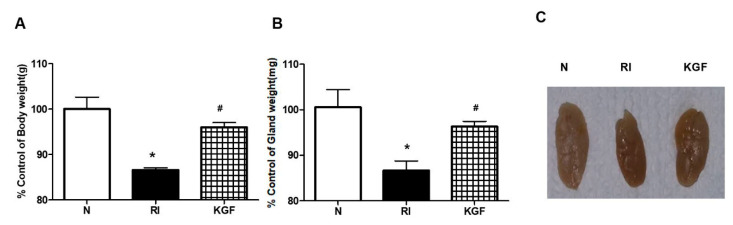
Six C57BL/6 mice were assigned to each of the following groups: treatment naïve control group, RI group, and RI+KGF-1 group. Body and SG weights, salivary flow rates, salivary lag times and changes in 99mTc pertechnetate uptake and excretion were measured, and histologic changes were noted. Amylase activities and epidermal growth factor (EGF) concentrations in saliva were also measured. In addition, TUNEL assays were performed and apoptosis-related protein expressions were assessed.

RESULTS

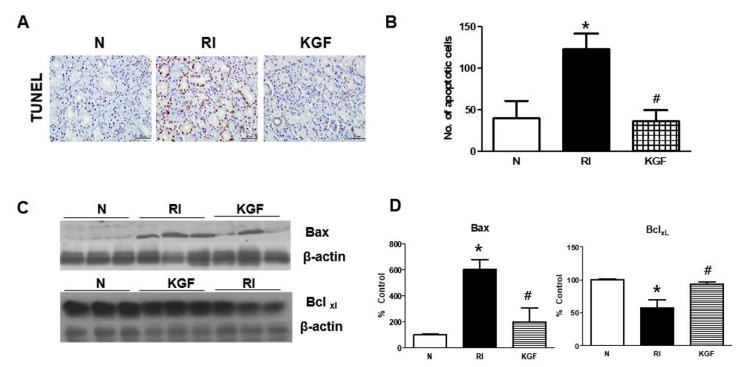
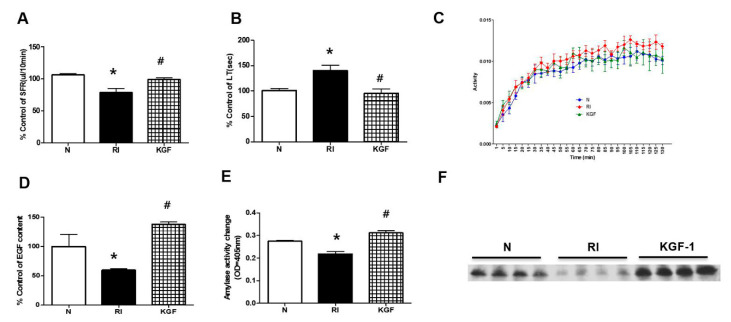
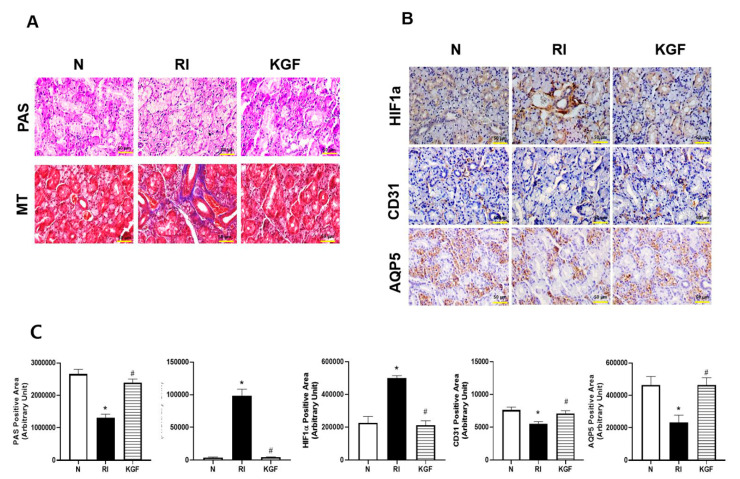
RI-induced reductions in salivary flow rates and increases in salivary lag times observed in the RI group were not observed in RI+KGF-1 group. Mice in RI group had higher HIF1a levels than controls, but HIF1a levels in RI+KGF-1 group were similar to those in control group. Furthermore, mice in RI+KGF-1 group had more mucin stained acini and decreased periductal fibrosis than mice in RI group, and tissue remodeling of many salivary epithelial cells (AQP5) and endothelial cells (CD31) were observed in RI+KGF-1 group. Amylase activity and expression in saliva were greater in RI+KGF-1 group than in RI group, and fewer apoptotic cells were observed in RI+KGF-1 group. Furthermore, BCLxl (anti-apoptotic) expression was higher, and Bax (pro-apoptotic) expression was lower in RI+KGF-1 group than in RI group.

CONCLUSIONS

Local delivery of KGF-1 might prevent RI-induced SG damage by reducing apoptosis.

摘要

背景

大多数甲状腺癌患者在接受放射性碘(RI)治疗后会出现唾液腺(SG)功能障碍。我们在动物模型中研究了角质细胞生长因子(KGF)-1对 RI 诱导的 SG 功能障碍的影响。

方法

将 6 只 C57BL/6 小鼠分别分配到以下各组:治疗初治对照组、RI 组和 RI+KGF-1 组。测量体重和 SG 重量、唾液流量、唾液滞后时间以及 99mTc 过锝酸盐摄取和排泄的变化,并观察组织学变化。还测量了唾液中的淀粉酶活性和表皮生长因子(EGF)浓度。此外,进行了 TUNEL 检测,并评估了凋亡相关蛋白的表达。

结果

RI 组观察到的唾液流量减少和唾液滞后时间增加在 RI+KGF-1 组中未观察到。RI 组小鼠的 HIF1a 水平高于对照组,但 RI+KGF-1 组的 HIF1a 水平与对照组相似。此外,RI+KGF-1 组的小鼠有更多的粘蛋白染色的腺泡和减少的导管周围纤维化,比 RI 组的小鼠多,许多唾液上皮细胞(AQP5)和内皮细胞(CD31)的组织重塑在 RI+KGF-1 组中观察到。RI+KGF-1 组的唾液淀粉酶活性和表达高于 RI 组,且 RI+KGF-1 组的凋亡细胞较少。此外,RI+KGF-1 组的 BCLxl(抗凋亡)表达较高,Bax(促凋亡)表达较低。

结论

局部递送 KGF-1 可能通过减少细胞凋亡来预防 RI 诱导的 SG 损伤。
https://cdn.ncbi.nlm.nih.gov/pmc/blobs/2477/7503708/cae8a3c5947d/ijerph-17-06322-g004.jpg
https://cdn.ncbi.nlm.nih.gov/pmc/blobs/2477/7503708/cf25418f67a8/ijerph-17-06322-g001.jpg
https://cdn.ncbi.nlm.nih.gov/pmc/blobs/2477/7503708/04e2f1089381/ijerph-17-06322-g002.jpg
https://cdn.ncbi.nlm.nih.gov/pmc/blobs/2477/7503708/4799b56200a6/ijerph-17-06322-g003.jpg
https://cdn.ncbi.nlm.nih.gov/pmc/blobs/2477/7503708/cae8a3c5947d/ijerph-17-06322-g004.jpg
https://cdn.ncbi.nlm.nih.gov/pmc/blobs/2477/7503708/cf25418f67a8/ijerph-17-06322-g001.jpg
https://cdn.ncbi.nlm.nih.gov/pmc/blobs/2477/7503708/04e2f1089381/ijerph-17-06322-g002.jpg
https://cdn.ncbi.nlm.nih.gov/pmc/blobs/2477/7503708/4799b56200a6/ijerph-17-06322-g003.jpg
https://cdn.ncbi.nlm.nih.gov/pmc/blobs/2477/7503708/cae8a3c5947d/ijerph-17-06322-g004.jpg

相似文献

1
Keratinocyte Growth Factor-1 Protects Radioiodine-Induced Salivary Gland Dysfunction in Mice.角质细胞生长因子-1 可预防碘 131 致小鼠唾液腺功能损伤。
Int J Environ Res Public Health. 2020 Aug 31;17(17):6322. doi: 10.3390/ijerph17176322.
2
Protective effects of curcumin on radioiodine-induced salivary gland dysfunction in mice.姜黄素对小鼠放射性碘致唾液腺功能障碍的保护作用。
J Tissue Eng Regen Med. 2019 Apr;13(4):674-681. doi: 10.1002/term.2833. Epub 2019 Mar 20.
3
Adipose-derived mesenchymal stem cells regenerate radioiodine-induced salivary gland damage in a murine model.脂肪间充质干细胞在鼠模型中再生放射性碘诱导的唾液腺损伤。
Sci Rep. 2019 Oct 31;9(1):15752. doi: 10.1038/s41598-019-51775-9.
4
Fucoidan attenuates radioiodine-induced salivary gland dysfunction in mice.岩藻聚糖硫酸酯减轻碘 131 致小鼠唾液腺功能损伤。
BMC Oral Health. 2019 Aug 30;19(1):198. doi: 10.1186/s12903-019-0894-2.
5
Protective Effect of Ginseng on Salivary Dysfunction Following Radioiodine Therapy in a Mouse Model.人参对小鼠模型放射性碘治疗后唾液功能障碍的保护作用。
Thyroid. 2018 Aug;28(8):1034-1041. doi: 10.1089/thy.2017.0379. Epub 2018 Jul 30.
6
Protective Effect of Alpha-Lipoic Acid on Salivary Dysfunction in a Mouse Model of Radioiodine Therapy-Induced Sialoadenitis.α-硫辛酸对放射性碘治疗诱导唾液腺炎小鼠模型唾液功能障碍的保护作用。
Int J Mol Sci. 2020 Jun 10;21(11):4136. doi: 10.3390/ijms21114136.
7
Radioprotective Effect of Epigallocatechin-3-Gallate on Salivary Gland Dysfunction After Radioiodine Ablation in a Murine Model.表没食子儿茶素-3-没食子酸酯对小鼠放射性碘消融后唾液腺功能障碍的辐射防护作用
Clin Exp Otorhinolaryngol. 2016 Sep;9(3):244-51. doi: 10.21053/ceo.2015.01011. Epub 2016 May 3.
8
Morphometric and functional changes of salivary gland dysfunction after radioactive iodine ablation in a murine model.放射性碘消融后小鼠模型唾液腺功能障碍的形态和功能变化。
Thyroid. 2013 Nov;23(11):1445-51. doi: 10.1089/thy.2012.0243. Epub 2013 Jul 25.
9
Keratinocyte growth factor prevents radiation damage to salivary glands by expansion of the stem/progenitor pool.角质形成细胞生长因子通过扩大干细胞/祖细胞库来预防唾液腺的辐射损伤。
Stem Cells. 2008 Oct;26(10):2595-601. doi: 10.1634/stemcells.2007-1034. Epub 2008 Jul 31.
10
Does Salivary Function Decrease in Proportion to Radioiodine Dose?唾液腺功能是否随放射性碘剂量成比例下降?
Laryngoscope. 2020 Sep;130(9):2173-2178. doi: 10.1002/lary.28342. Epub 2019 Nov 25.

引用本文的文献

1
The Impact of Radioiodine (131I) Therapy of Thyroid Disease on Salivary Glands Function and Inflammation: A Comprehensive Review.放射性碘(¹³¹I)治疗甲状腺疾病对唾液腺功能和炎症的影响:综述
Biomedicines. 2025 Jun 7;13(6):1404. doi: 10.3390/biomedicines13061404.
2
FGFR2 is essential for salivary gland duct homeostasis and MAPK-dependent seromucous acinar cell differentiation.FGFR2 对于唾液腺导管的稳态和 MAPK 依赖性浆液黏液性腺泡细胞分化是必需的。
Nat Commun. 2023 Oct 14;14(1):6485. doi: 10.1038/s41467-023-42243-0.
3
Immunomodulatory Macrophages Enable E-MNC Therapy for Radiation-Induced Salivary Gland Hypofunction.

本文引用的文献

1
KGF inhibits hypoxia-induced intestinal epithelial cell apoptosis by upregulating AKT/ERK pathway-dependent E-cadherin expression.KGF 通过上调 AKT/ERK 通路依赖性 E-钙黏蛋白表达抑制缺氧诱导的肠上皮细胞凋亡。
Biomed Pharmacother. 2018 Sep;105:1318-1324. doi: 10.1016/j.biopha.2018.06.091. Epub 2018 Jun 23.
2
Protective Effect of Ginseng on Salivary Dysfunction Following Radioiodine Therapy in a Mouse Model.人参对小鼠模型放射性碘治疗后唾液功能障碍的保护作用。
Thyroid. 2018 Aug;28(8):1034-1041. doi: 10.1089/thy.2017.0379. Epub 2018 Jul 30.
3
Administration of growth factors promotes salisphere formation from irradiated parotid salivary glands.
免疫调节巨噬细胞使 E-MNC 疗法能够治疗辐射诱导的唾液腺功能低下。
Cells. 2023 May 17;12(10):1417. doi: 10.3390/cells12101417.
4
Advances in Antioxidant Applications for Combating I Side Effects in Thyroid Cancer Treatment.抗氧化剂在甲状腺癌治疗中对抗副作用的应用进展
Toxics. 2023 Jun 13;11(6):529. doi: 10.3390/toxics11060529.
5
Adiponectin is associated with inflammaging and age-related salivary gland lipid accumulation.脂联素与炎症衰老和与年龄相关的唾液腺脂质积累有关。
Aging (Albany NY). 2023 Mar 27;15(6):1840-1858. doi: 10.18632/aging.204618.
6
FGFR2b is essential for salivary gland duct homeostasis and MAPK-dependent seromucous acinar cell differentiation.FGFR2b对于唾液腺导管内环境稳定以及丝裂原活化蛋白激酶(MAPK)依赖的浆液性和黏液性腺泡细胞分化至关重要。
Res Sq. 2023 Feb 16:rs.3.rs-2557484. doi: 10.21203/rs.3.rs-2557484/v1.
7
Cell-derived vesicles from adipose-derived mesenchymal stem cells ameliorate irradiation-induced salivary gland cell damage.脂肪间充质干细胞来源的细胞衍生囊泡可改善辐射诱导的唾液腺细胞损伤。
Regen Ther. 2022 Oct 18;21:453-459. doi: 10.1016/j.reth.2022.09.007. eCollection 2022 Dec.
生长因子的给药促进了放射性腮腺唾液腺的唾液体形成。
PLoS One. 2018 Mar 28;13(3):e0193942. doi: 10.1371/journal.pone.0193942. eCollection 2018.
4
Hypoxia Induces Apoptosis through HIF-1 Signaling Pathway in Human Uterosacral Ligaments of Pelvic Organ Prolapse.缺氧通过 HIF-1 信号通路诱导盆腔器官脱垂患者的子宫骶骨韧带细胞凋亡。
Biomed Res Int. 2017;2017:8316094. doi: 10.1155/2017/8316094. Epub 2017 Nov 2.
5
Amifostine does not protect thyroid cancer cells in DNA damaging models.氨磷汀在DNA损伤模型中不能保护甲状腺癌细胞。
Endocr Connect. 2017 Oct;6(7):469-478. doi: 10.1530/EC-17-0138. Epub 2017 Aug 8.
6
Radioprotective effects of Keratinocyte Growth Factor-1 against irradiation-induced salivary gland hypofunction.角质形成细胞生长因子-1对辐射诱导的唾液腺功能减退的辐射防护作用。
Oncotarget. 2017 Feb 21;8(8):13496-13508. doi: 10.18632/oncotarget.14583.
7
Enhanced tissue remodelling efficacy of adipose-derived mesenchymal stem cells using injectable matrices in radiation-damaged salivary gland model.利用可注射基质增强脂肪来源间充质干细胞在放射性损伤唾液腺模型中的组织重塑效果。
J Tissue Eng Regen Med. 2018 Feb;12(2):e695-e706. doi: 10.1002/term.2352. Epub 2017 May 7.
8
Radioprotective Effect of Epigallocatechin-3-Gallate on Salivary Gland Dysfunction After Radioiodine Ablation in a Murine Model.表没食子儿茶素-3-没食子酸酯对小鼠放射性碘消融后唾液腺功能障碍的辐射防护作用
Clin Exp Otorhinolaryngol. 2016 Sep;9(3):244-51. doi: 10.21053/ceo.2015.01011. Epub 2016 May 3.
9
Radiation-Induced Loss of Salivary Gland Function Is Driven by Cellular Senescence and Prevented by IL6 Modulation.辐射诱导的唾液腺功能丧失是由细胞衰老驱动的,并可通过 IL6 调节来预防。
Cancer Res. 2016 Mar 1;76(5):1170-80. doi: 10.1158/0008-5472.CAN-15-1671. Epub 2016 Jan 12.
10
Adipose Mesenchymal Stem Cell Secretome Modulated in Hypoxia for Remodeling of Radiation-Induced Salivary Gland Damage.缺氧条件下调节的脂肪间充质干细胞分泌组用于重塑放射性唾液腺损伤
PLoS One. 2015 Nov 3;10(11):e0141862. doi: 10.1371/journal.pone.0141862. eCollection 2015.