Institute of Cognitive Neuroscience, Biopsychology, Department of Psychology, Ruhr University Bochum, Universitätsstraße 150, 44780, Bochum, Germany.
School of Medicine, University of St Andrews, St Andrews, UK.
Sci Rep. 2020 Sep 2;10(1):14501. doi: 10.1038/s41598-020-71478-w.
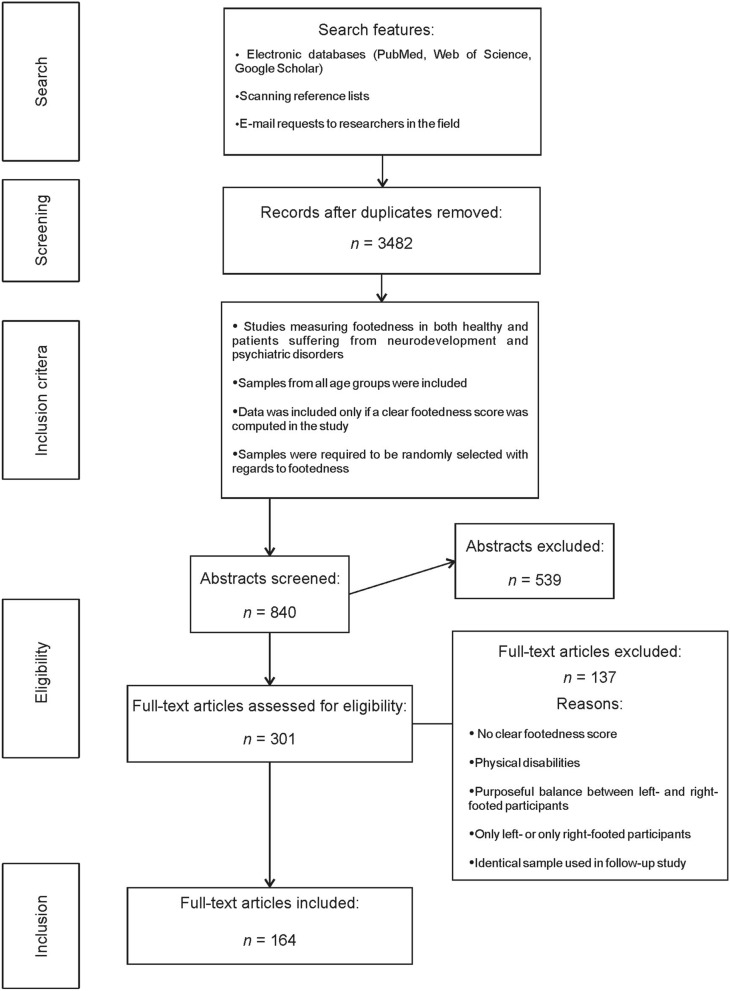
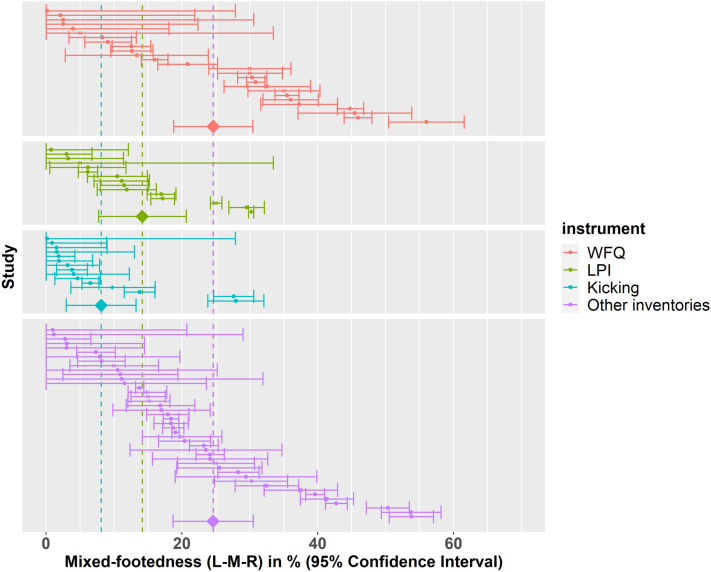
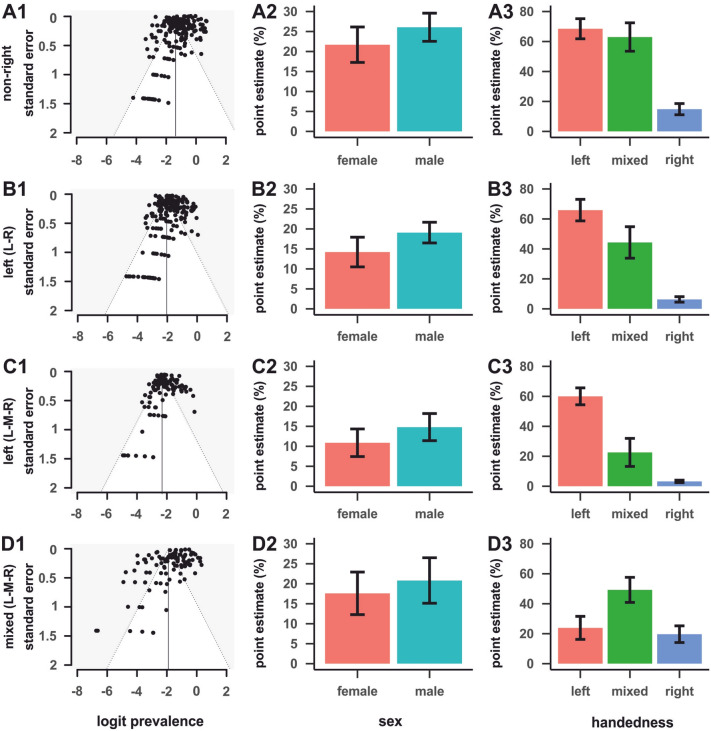
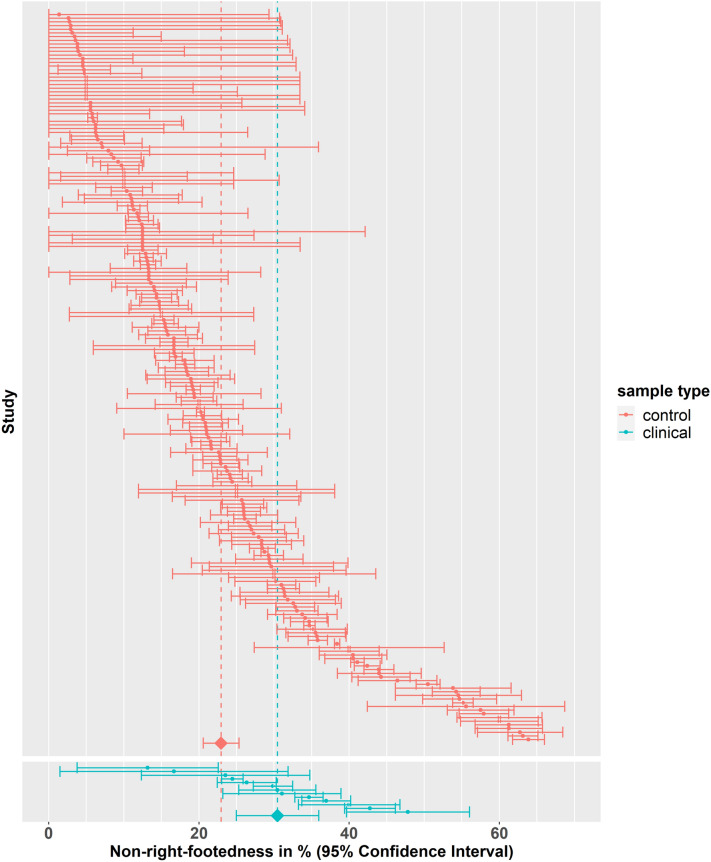
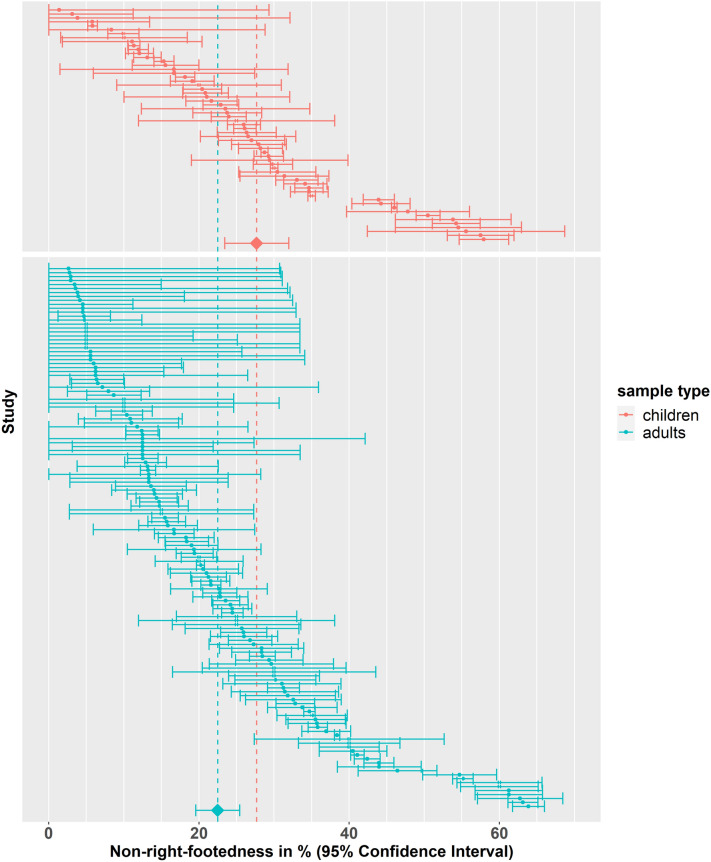
Human lateral preferences, such as handedness and footedness, have interested researchers for decades due to their pronounced asymmetries at the population level. While there are good estimates on the prevalence of handedness in the population, there is no large-scale estimation on the prevalence of footedness. Furthermore, the relationship between footedness and handedness still remains elusive. Here, we conducted meta-analyses with four different classification systems for footedness on 145,135 individuals across 164 studies including new data from the ALSPAC cohort. The study aimed to determine a reliable point estimate of footedness, to study the association between footedness and handedness, and to investigate moderating factors influencing footedness. We showed that the prevalence of atypical footedness ranges between 12.10% using the most conservative criterion of left-footedness to 23.7% including all left- and mixed-footers as a single non-right category. As many as 60.1% of left-handers were left-footed whereas only 3.2% of right-handers were left-footed. Males were 4.1% more often non-right-footed compared to females. Individuals with psychiatric and neurodevelopmental disorders exhibited a higher prevalence of non-right-footedness. Furthermore, the presence of mixed-footedness was higher in children compared to adults and left-footedness was increased in athletes compared to the general population. Finally, we showed that footedness is only marginally influenced by cultural and social factors, which play a crucial role in the determination of handedness. Overall, this study provides new and useful reference data for laterality research. Furthermore, the data suggest that footedness is a valuable phenotype for the study of lateral motor biases, its underlying genetics and neurodevelopment.
人类的侧性偏好,如惯用手和惯用脚,因其在人群水平上的显著不对称而引起了研究人员数十年的兴趣。虽然对于人群中惯用手的流行率有很好的估计,但对于惯用脚的流行率却没有大规模的估计。此外,惯用脚和惯用手之间的关系仍然难以捉摸。在这里,我们使用四种不同的惯用脚分类系统对来自 164 项研究的 145135 个人进行了荟萃分析,其中包括来自 ALSPAC 队列的新数据。该研究旨在确定惯用脚的可靠点估计值,研究惯用脚和惯用手之间的关系,并调查影响惯用脚的调节因素。我们表明,使用最保守的左撇子标准,即只有 12.10%的人是典型的左撇子,而包括所有左撇子和混合脚者在内的单一非右撇子类别,则有 23.7%的人是典型的左撇子。多达 60.1%的左撇子是左撇子,而只有 3.2%的右撇子是左撇子。与女性相比,男性非右撇子的比例高出 4.1%。患有精神和神经发育障碍的个体表现出更高的非右撇子倾向。此外,与成年人相比,儿童混合脚者的比例更高,与一般人群相比,运动员的左撇子比例更高。最后,我们表明,惯用脚仅受到文化和社会因素的轻微影响,这些因素在决定惯用手方面起着至关重要的作用。总的来说,这项研究为侧性研究提供了新的有用参考数据。此外,这些数据表明,惯用脚是研究侧倾运动偏倚、其潜在遗传学和神经发育的一个有价值的表型。