Qiu Xiang-Ting, Song Yu-Cui, Liu Jian, Wang Zhen-Min, Niu Xing, He Jing
Department of Clinical Laboratory, Linyi Central Hospital, Linyi 276400, Shandong Province, China.
Department of Operating Room, Linyi Central Hospital, Linyi 276400, Shandong Province, China.
World J Gastrointest Oncol. 2020 Aug 15;12(8):857-876. doi: 10.4251/wjgo.v12.i8.857.
Gastric cancer (GC) is the most commonly diagnosed malignancy worldwide. Increasing evidence suggests that it is necessary to further explore genetic and immunological characteristics of GC.
To construct an immune-related gene (IRG) signature for accurately predicting the prognosis of patients with GC.
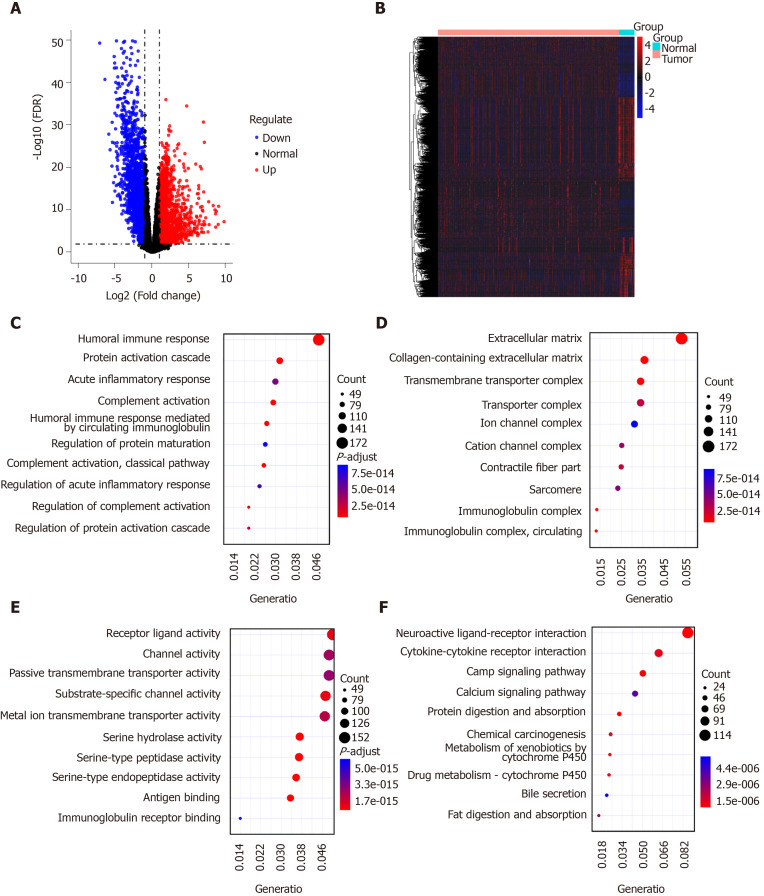
Differentially expressed genes (DEGs) between 375 gastric cancer tissues and 32 normal adjacent tissues were obtained from The Cancer Genome Atlas (TCGA) GDC data portal. Then, differentially expressed IRGs from the ImmPort database were identified for GC. Cox univariate survival analysis was used to screen survival-related IRGs. Differentially expressed survival-related IRGs were considered as hub IRGs. Genetic mutations of hub IRGs were analyzed. Then, hub IRGs were selected to conduct a prognostic signature. Receiver operating characteristic (ROC) curve analysis was used to evaluate the prognostic performance of the signature. The correlation of the signature with clinical features and tumor-infiltrating immune cells was analyzed.
Among all DEGs, 70 hub IRGs were obtained for GC. The deletions and amplifications were the two most common types of genetic mutations of hub IRGs. A prognostic signature was identified, consisting of ten hub IRGs (including , and ). This prognostic signature could accurately distinguish patients into high- and low- risk groups, and overall survival analysis showed that high risk patients had shortened survival time than low risk patients ( < 0.0001). The area under curve of the ROC of the signature was 0.761, suggesting that the prognostic signature had a high sensitivity and accuracy. Multivariate regression analysis demonstrated that the prognostic signature could become an independent prognostic predictor for GC after adjustment for other clinical features. Furthermore, we found that the prognostic signature was significantly correlated with macrophage infiltration.
Our study proposed an immune-related prognostic signature for GC, which could help develop treatment strategies for patients with GC in the future.
胃癌(GC)是全球最常被诊断出的恶性肿瘤。越来越多的证据表明,有必要进一步探索胃癌的遗传和免疫特征。
构建一个免疫相关基因(IRG)特征,用于准确预测胃癌患者的预后。
从癌症基因组图谱(TCGA)GDC数据门户获取375例胃癌组织和32例正常相邻组织之间的差异表达基因(DEG)。然后,从ImmPort数据库中鉴定出胃癌的差异表达IRG。采用Cox单因素生存分析筛选与生存相关的IRG。差异表达的生存相关IRG被视为核心IRG。分析核心IRG的基因突变情况。然后,选择核心IRG进行预后特征分析。采用受试者工作特征(ROC)曲线分析评估该特征的预后性能。分析该特征与临床特征和肿瘤浸润免疫细胞的相关性。
在所有DEG中,获得了70个胃癌核心IRG。缺失和扩增是核心IRG最常见的两种基因突变类型。鉴定出一个预后特征,由10个核心IRG组成(包括 、 和 )。该预后特征能够准确地将患者分为高风险组和低风险组,总生存分析表明,高风险患者的生存时间比低风险患者缩短( < 0.0001)。该特征的ROC曲线下面积为0.761,表明该预后特征具有较高的敏感性和准确性。多因素回归分析表明,在调整其他临床特征后,该预后特征可成为胃癌的独立预后预测指标。此外,我们发现该预后特征与巨噬细胞浸润显著相关。
我们的研究提出了一种胃癌免疫相关预后特征,这可能有助于未来制定胃癌患者的治疗策略。