Amity Institute of Biotechnology (AIB), Amity University Haryana, Manesar, Gurugram, India.
Special Centre for Molecular Medicine, Jawaharlal Nehru University, New Delhi, India.
PLoS One. 2020 Sep 3;15(9):e0226056. doi: 10.1371/journal.pone.0226056. eCollection 2020.
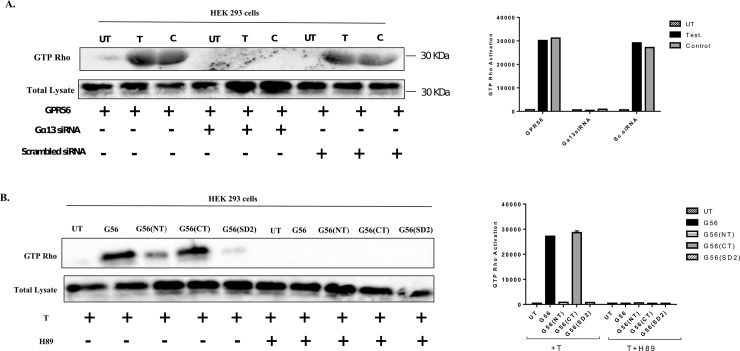
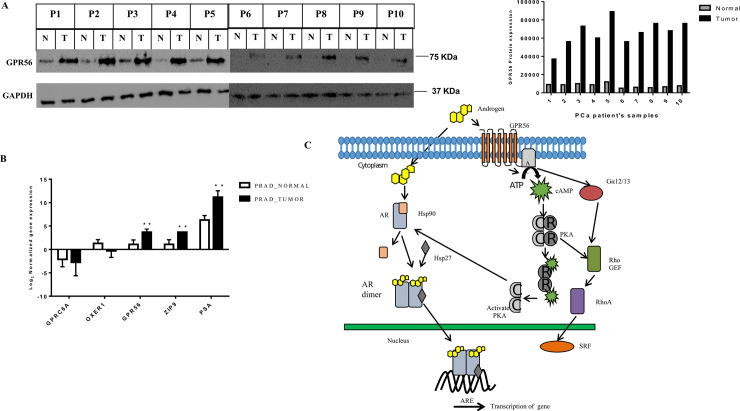
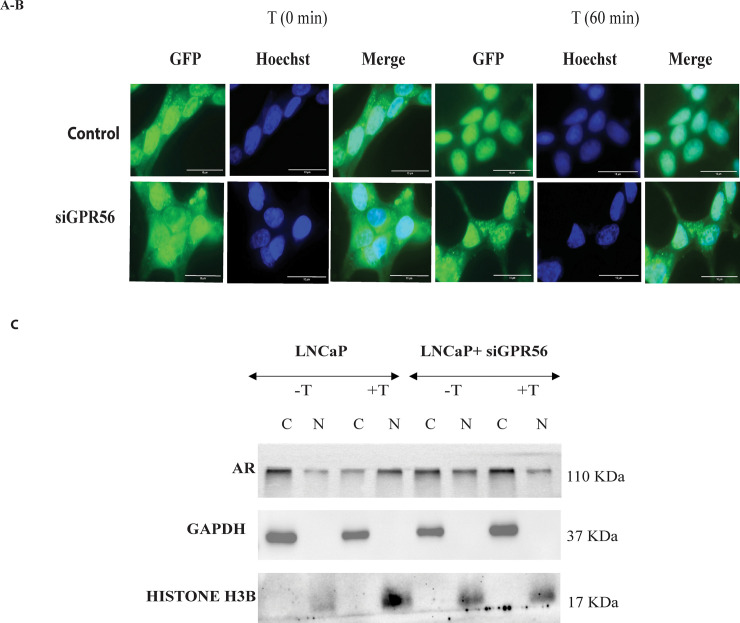
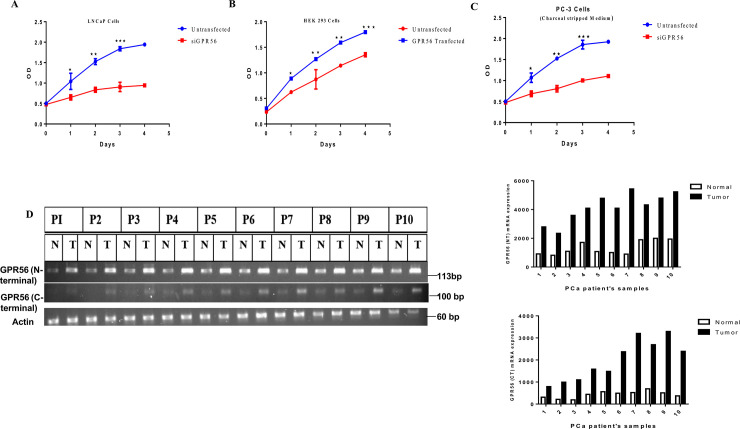
The androgen receptor (AR) is activated in patients with castration resistant prostate cancer (CRPC) despite low circulating levels of androgen, suggesting that intracellular signaling pathways and non-androgenic factors may contribute to AR activation. Many G-protein coupled receptors (GPCR) and their ligands are also activated in these cells indicating that they may play a role in development of Prostate Cancer (PCa) and CRPC. Although a cross talk has been suggested between the two pathways, yet, the identity of GPCRs which may play a role in androgen signaling, is not established yet. By using blast analysis of 826 GPCRs, we identified a GPCR, GPCR 205, which exhibited maximum similarity with the ligand binding domain of the AR. We demonstrate that adhesion GPCR 205, also known as GPR56, can be activated by androgens to stimulate the Rho signaling pathway, a pathway that plays an important role in prostate tumor cell metastasis. Testosterone stimulation of GPR56 also activates the cAMP/ Protein kinase A (PKA) pathway, that is necessary for AR signaling. Knocking down the expression of GPR56 using siRNA, disrupts nuclear translocation of AR and transcription of prototypic AR target genes such as PSA. GPR56 expression is higher in all twenty-five prostate tumor patient's samples tested and cells expressing GPR56 exhibit increased proliferation. These findings provide new insights about androgen signaling and identify GPR56 as a possible therapeutic target in advanced prostate cancer patients.
雄激素受体(AR)在去势抵抗性前列腺癌(CRPC)患者中被激活,尽管循环雄激素水平较低,这表明细胞内信号通路和非雄激素因素可能有助于 AR 的激活。许多 G 蛋白偶联受体(GPCR)及其配体也在这些细胞中被激活,表明它们可能在前列腺癌(PCa)和 CRPC 的发展中发挥作用。尽管已经提出了这两种途径之间的串扰,但参与雄激素信号的 GPCR 的确切身份尚未确定。通过对 826 个 GPCR 的 Blast 分析,我们鉴定出一个 GPCR,即 GPCR205,它与 AR 的配体结合域具有最大的相似性。我们证明,粘附 GPCR205,也称为 GPR56,可以被雄激素激活,从而刺激 Rho 信号通路,该通路在前列腺肿瘤细胞转移中发挥重要作用。睾酮刺激 GPR56 还激活了 cAMP/蛋白激酶 A(PKA)途径,该途径对于 AR 信号转导是必需的。使用 siRNA 敲低 GPR56 的表达,会破坏 AR 的核转位和原典型 AR 靶基因如 PSA 的转录。在所有 25 个前列腺肿瘤患者样本中,GPR56 的表达均升高,并且表达 GPR56 的细胞表现出增殖增加。这些发现提供了关于雄激素信号的新见解,并确定 GPR56 是晚期前列腺癌患者的潜在治疗靶点。