Department of Endocrinology, Medizinische Klinik und Poliklinik IV, LMU Klinikum, Ludwig Maximilians University Munich, München, Germany.
Endocrinology in Charlottenburg, Berlin, Germany.
J Clin Endocrinol Metab. 2020 Dec 1;105(12):e4490-8. doi: 10.1210/clinem/dgaa625.
Glucocorticoid-induced myopathy is a characteristic symptom of endogenous Cushing's syndrome (CS). Its long-term outcome is largely unknown.
To evaluate long-term muscle function following the remission of endogenous CS.
Observational longitudinal cohort study.
Tertiary care hospitals and a specialized outpatient clinic.
As part of the prospective multicenter German Cushing's Registry, we assessed muscle strength in patients with overt endogenous CS. We studied the patients at the time of diagnosis (n = 88), after 6 months (n = 69), and thereafter annually, following surgical remission over a period of up to 4 years (1 year: n = 55; 2 years: n = 34; 3 years: n = 29; 4 years: n = 22). Muscle function was evaluated by hand grip strength and by chair rising test.
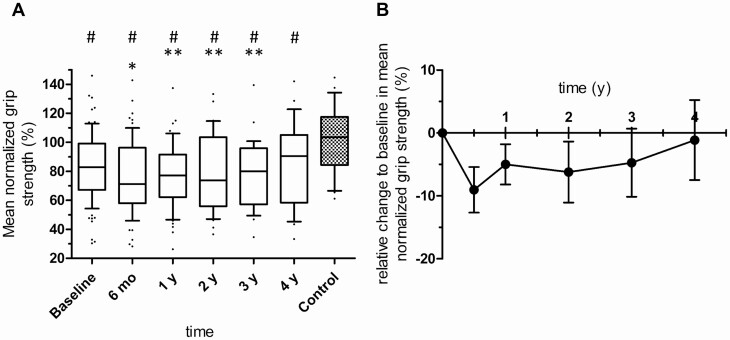
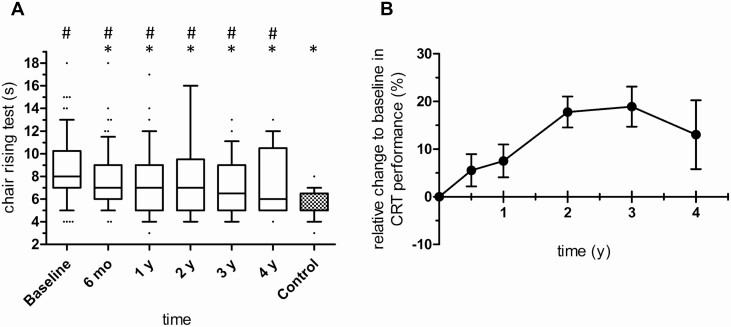
Grip strength was decreased to 83% of normal controls (100%) at the time of diagnosis. It further decreased to 71% after 6 months in remission (P ≤ 0.001) and showed no improvement during further follow-up compared with baseline. Chair rising test performance improved initially (8 seconds at baseline vs 7 seconds after 6 months, P = 0.004) but remained at this reduced level thereafter (7 seconds after 3 years vs 5 seconds in controls, P = 0.038). In multivariate analysis, we identified, as predictors for long-term muscle dysfunction, age, waist-to-hip ratio, and hemoglobin A1c at baseline. Furthermore, muscle strength during follow-up was strongly correlated with quality of life.
This study shows that CS-associated myopathy does not spontaneously resolve during remission. This calls for action to identify effective interventions to improve muscle dysfunction in this setting.
糖皮质激素诱导的肌病是内源性库欣综合征(CS)的特征性症状。其长期预后在很大程度上尚不清楚。
评估内源性 CS 缓解后肌肉功能的长期变化。
观察性纵向队列研究。
三级医院和专门的门诊诊所。
作为前瞻性德国库欣氏症候群注册研究的一部分,我们评估了显性内源性 CS 患者的肌肉力量。我们在诊断时(n = 88)、6 个月后(n = 69)以及此后每年研究患者,在此期间最多随访 4 年以达到手术缓解(1 年:n = 55;2 年:n = 34;3 年:n = 29;4 年:n = 22)。肌肉功能通过手握力和坐起试验来评估。
握力在诊断时降低至正常对照的 83%(100%)。在缓解后 6 个月时进一步降低至 71%(P ≤ 0.001),并且在与基线相比的进一步随访中没有改善。坐起试验表现最初改善(基线时为 8 秒,缓解后 6 个月时为 7 秒,P = 0.004),但此后仍保持在较低水平(缓解后 3 年时为 7 秒,对照组时为 5 秒,P = 0.038)。在多变量分析中,我们确定了年龄、腰臀比和基线时的糖化血红蛋白作为长期肌肉功能障碍的预测因素。此外,随访期间的肌肉力量与生活质量密切相关。
本研究表明,CS 相关的肌病在缓解期间不会自发缓解。这需要采取行动,以确定有效的干预措施来改善这种情况下的肌肉功能障碍。