Diagnostics Program, PATH, Seattle, WA, USA.
Laboratory of Malaria Immunology and Vaccinology, National Institute of Allergy and Infectious Diseases, National Institutes of Health, Rockville, MD, USA.
Malar J. 2020 Sep 3;19(1):323. doi: 10.1186/s12936-020-03389-0.
The recent expansion of tools designed to accurately quantify malaria parasite-produced antigens has enabled us to evaluate the performance of rapid diagnostic tests (RDTs) as a function of the antigens they detect-typically histidine rich protein 2 (HRP2) or lactate dehydrogenase (LDH).
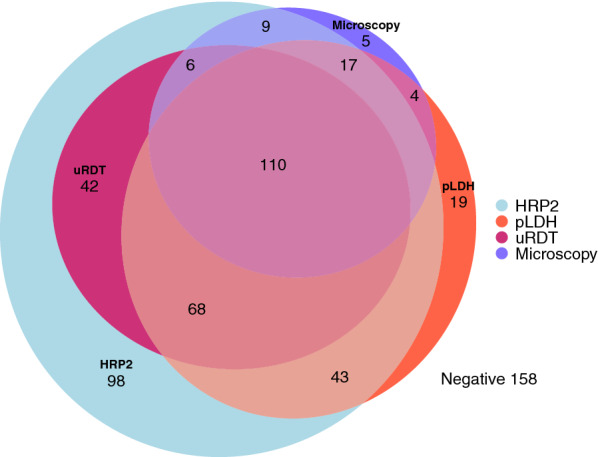
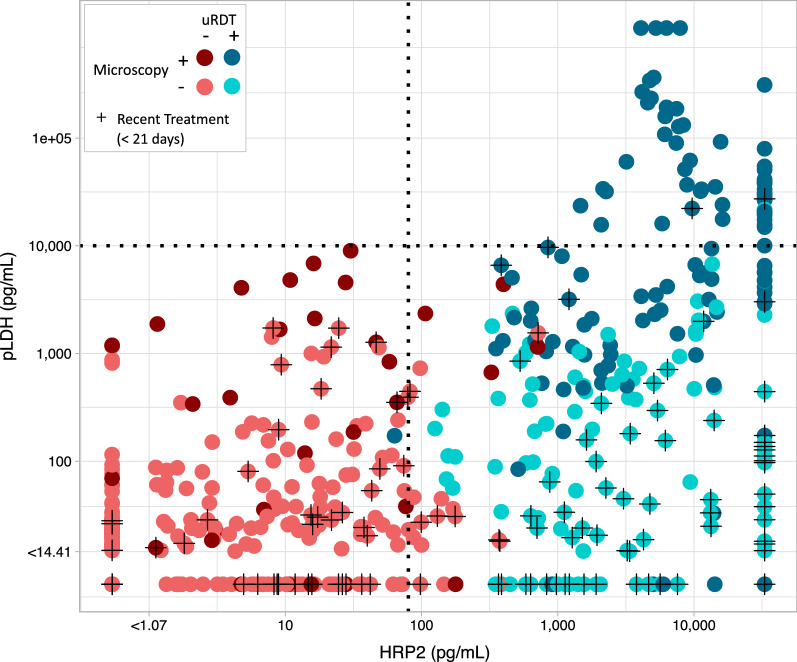
For this analysis, whole blood specimens from a longitudinal study in Bancoumana, Mali were used to evaluate the performance of the ultra-sensitive HRP2-based Alere™ Malaria Ag P.f RDT (uRDT). The samples were collected as part of a transmission-blocking vaccine trial in a high transmission region for Plasmodium falciparum malaria. Furthermore, antigen dynamics after successful anti-malarial drug treatment were evaluated in these samples using the Q-Plex Human Malaria Array (4-Plex) to quantify antigen concentrations.
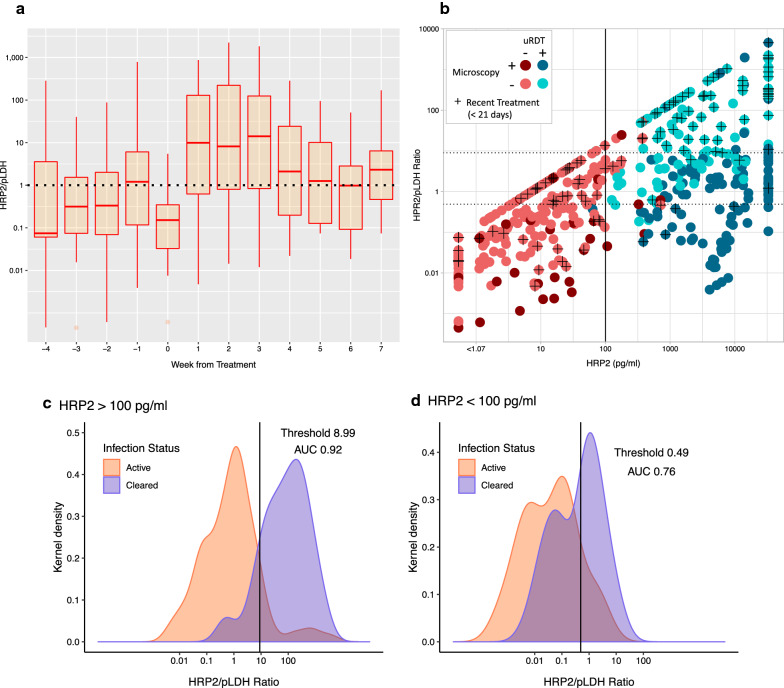
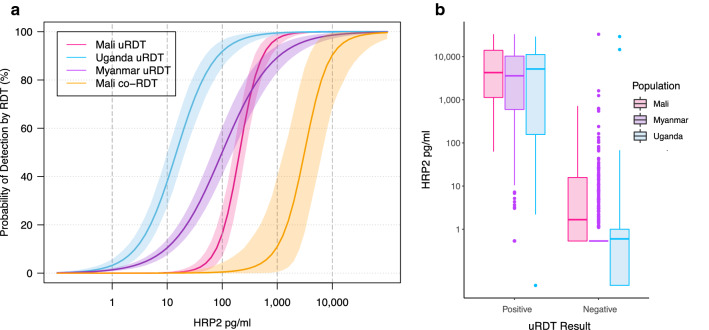
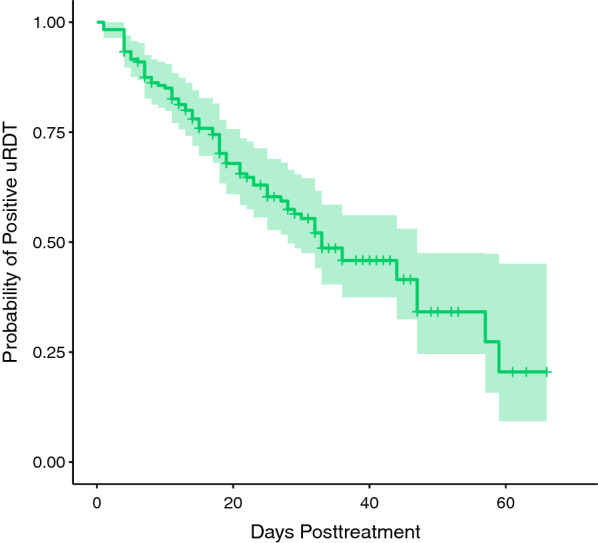
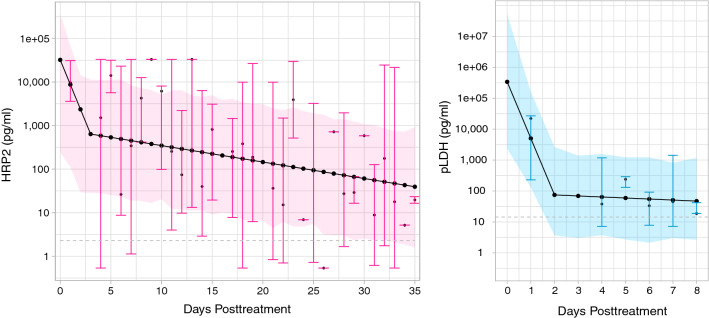
The uRDT had a 50% probability of a positive result at 207 pg/mL HRP2 [95% credible interval (CrI) 160-268]. Individuals with symptomatic infection remained positive by uRDT for a median of 33 days [95% confidence interval (CI) 28-47] post anti-malarial drug treatment. Biphasic exponential decay models accurately captured the population level post-treatment dynamics of both HRP2 and Plasmodium LDH (pLDH), with the latter decaying more rapidly. Motivated by these differences in rates of decay, a novel algorithm that used HRP2:pLDH ratios to predict if an individual had active versus recently cleared P. falciparum infection was developed. The algorithm had 77.5% accuracy in correctly classifying antigen-positive individuals as those with and without active infection.
These results characterize the performance of the ultra-sensitive RDT and demonstrate the potential for emerging antigen-quantifying technologies in the field of malaria diagnostics to be helpful tools in distinguishing between active versus recently cleared malaria infections.
最近,设计用于准确量化疟原虫产生的抗原的工具不断扩展,使我们能够评估快速诊断测试(RDT)的性能,其功能取决于它们所检测的抗原——通常是富含组氨酸蛋白 2(HRP2)或乳酸脱氢酶(LDH)。
在马里班库马纳的一项纵向研究中,采集全血样本,用于评估超敏 HRP2 基于的 Alere™ 疟疾 Ag P.f RDT(uRDT)的性能。这些样本是在恶性疟原虫高传播地区进行的阻断传播疫苗试验的一部分。此外,还使用 Q-Plex 人类疟疾阵列(4-Plex)来评估这些样本中抗原动力学,以定量抗原浓度,评估成功抗疟药物治疗后的抗原动态。
uRDT 在 207pg/mL HRP2 时具有 50%的阳性结果概率[95%置信区间(CrI)160-268]。在接受抗疟药物治疗后,有症状感染的个体通过 uRDT 保持阳性中位数为 33 天[95%置信区间(CI)28-47]。双相指数衰减模型准确地捕获了人群水平治疗后 HRP2 和疟原虫 LDH(pLDH)的动力学,后者衰减更快。受这些衰减率差异的启发,开发了一种新算法,该算法使用 HRP2:pLDH 比值来预测个体是否患有活动性或近期清除的恶性疟原虫感染。该算法在正确分类抗原阳性个体为活动性感染和非活动性感染方面具有 77.5%的准确性。
这些结果描述了超敏 RDT 的性能,并证明了新兴抗原定量技术在疟疾诊断领域作为区分活动性与近期清除疟疾感染的有用工具的潜力。