Woolcock Institute of Medical Research, The University of Sydney, Camperdown, NSW, Australia.
Sydney Local Health District, Camperdown, NSW, Australia.
BMC Psychol. 2020 Sep 3;8(1):95. doi: 10.1186/s40359-020-00461-x.
Although electronic monitoring is the "gold standard" for adherence monitoring, the range of inhaler devices on the market exceeds the availability of appropriate monitoring devices. Simple tools, applicable across a range of inhalers, are needed to assess patients' adherence to prescribed inhaled medication. This study reports on the validation of an Inhaler Adherence Questionnaire (IAQ).
Seventy-four adults who self-reported doctor diagnosed asthma and who were prescribed daily inhaled corticosteroids (ICS) for asthma contributed data for these analyses. These participants were part of a larger study, investigating factors associated with non-adherence to prescribed daily inhaled corticosteroid medication. Participants were informed the research was investigating asthma management without explicit mention that medication adherence was being monitored. Inhaled corticosteroid medication adherence was measured in two ways. Firstly, participants completed the 6-item IAQ at enrolment. Secondly, ICS via pressurised Metered Dose Inhaler (pMDI) use was monitored electronically using the DoserCT which recorded daily use over 6 weeks. During the 6 weeks of prospective medication monitoring via the DoserCT we did not have contact with participants so that the adherence measure would reflect usual self-management behaviour.
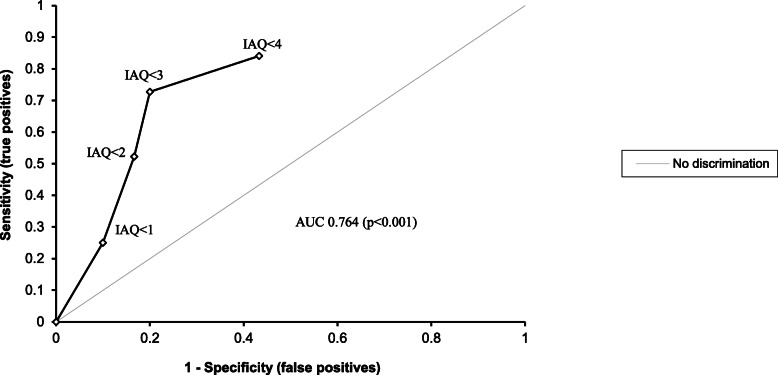
Two of the six questions in the IAQ had poor face validity and their exclusion from the questionnaire resulted in improved internal consistency. Mean days adherent were 37.1, 29.2 and 33.2% for subjects with IAQ scores of 0, 1 and 2 respectively. Higher IAQ scores of 3 and 4 were associated with greater mean days adherent of 73.7 and 67.4% respectively. A cut-point of 2 or less had a sensitivity of 73% and a specificity of 80% for detecting non-adherence. The area under the ROC curve was 0.764 (p < 0.001).
The modified 4-item IAQ is simple, quick to complete and useful for measuring adherence with prescribed daily inhaled medication. This validation of the IAQ provides evidence for its utility in research and it will be important to validate this simple, inexpensive tool for use in clinical practice.
尽管电子监测是依从性监测的“金标准”,但市场上的吸入器设备种类繁多,可用的监测设备却有限。因此,需要一种简单的工具,适用于各种吸入器,以评估患者对处方吸入药物的依从性。本研究报告了一种吸入器依从性问卷(IAQ)的验证结果。
74 名自我报告患有医生诊断的哮喘且每天服用吸入性皮质类固醇(ICS)治疗哮喘的成年人参与了这些分析。这些参与者是一项更大规模研究的一部分,该研究调查了与不遵医嘱使用每日吸入皮质类固醇药物相关的因素。参与者被告知该研究正在调查哮喘管理情况,但并未明确提及正在监测药物依从性。ICS 通过压力定量吸入器(pMDI)的使用以两种方式进行测量。首先,参与者在入组时完成了 6 项 IAQ。其次,通过 DoserCT 电子监测 ICS 的使用情况,该仪器记录了 6 周内的每日使用情况。在通过 DoserCT 进行为期 6 周的前瞻性药物监测期间,我们与参与者没有联系,因此该依从性测量将反映通常的自我管理行为。
IAQ 中的六个问题中有两个问题的表面效度较差,将它们从问卷中删除后,内部一致性得到了改善。IAQ 得分为 0、1 和 2 的受试者的平均依从天数分别为 37.1、29.2 和 33.2%。IAQ 得分为 3 和 4 的受试者的平均依从天数分别为 73.7%和 67.4%,更高。得分 2 或更低的得分具有 73%的敏感性和 80%的特异性,可用于检测不依从性。ROC 曲线下面积为 0.764(p<0.001)。
修改后的 4 项 IAQ 简单、快速完成,可用于测量遵医嘱使用每日吸入药物的情况。IAQ 的验证为其在研究中的应用提供了证据,重要的是要验证这种简单、廉价的工具在临床实践中的应用。