Department of Infectious Diseases and Microbiology, University of Pittsburgh, Pittsburgh, USA.
Department of Microbiology and Molecular Genetics, University of Pittsburgh, Pittsburgh, USA.
Sci Rep. 2020 Sep 3;10(1):14598. doi: 10.1038/s41598-020-71548-z.
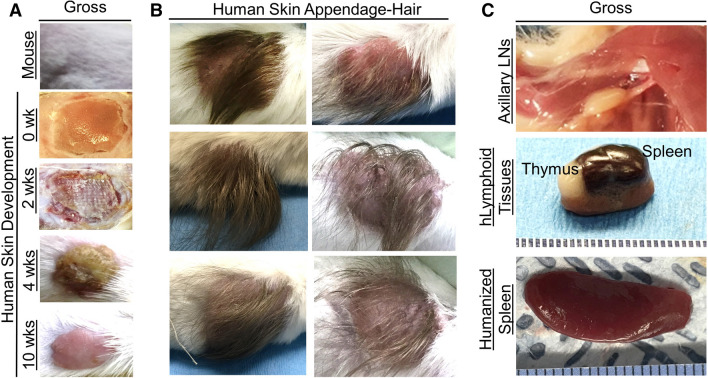
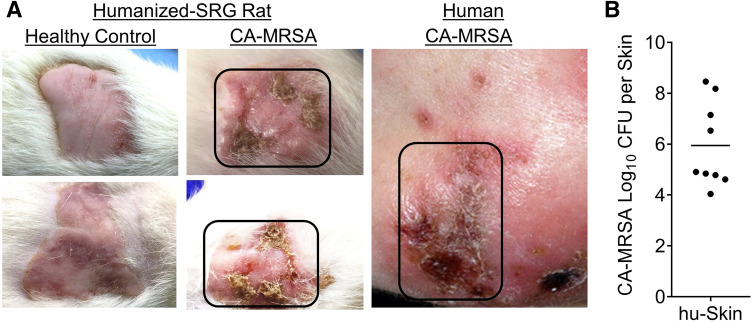
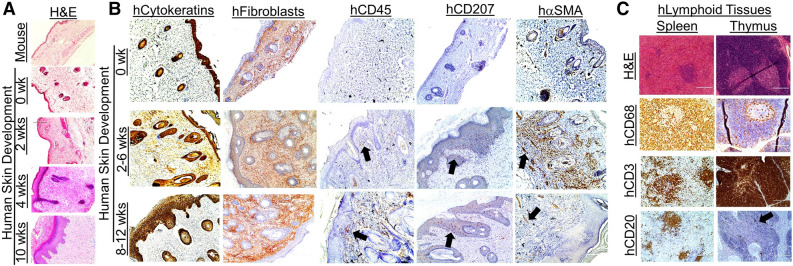
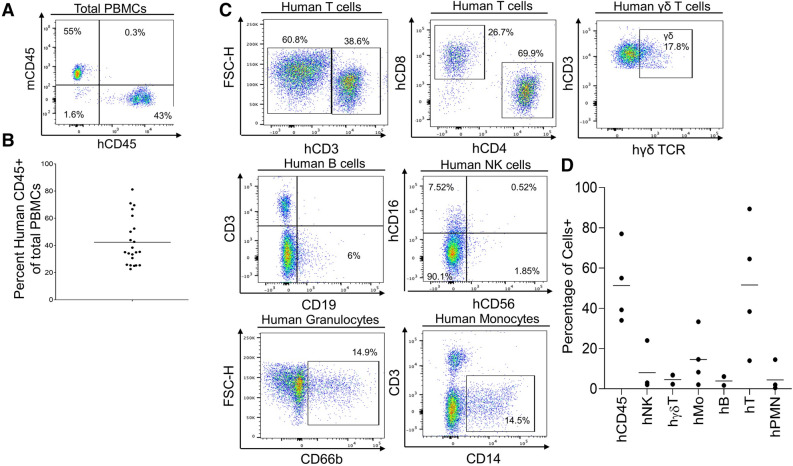
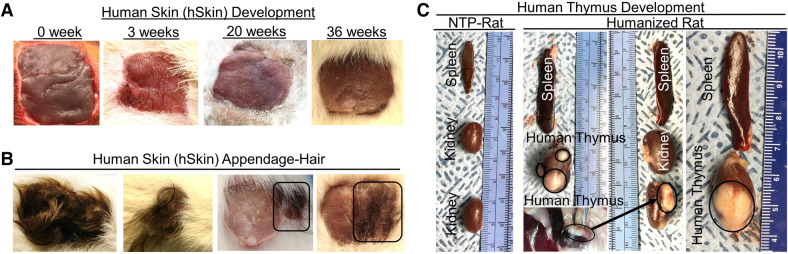
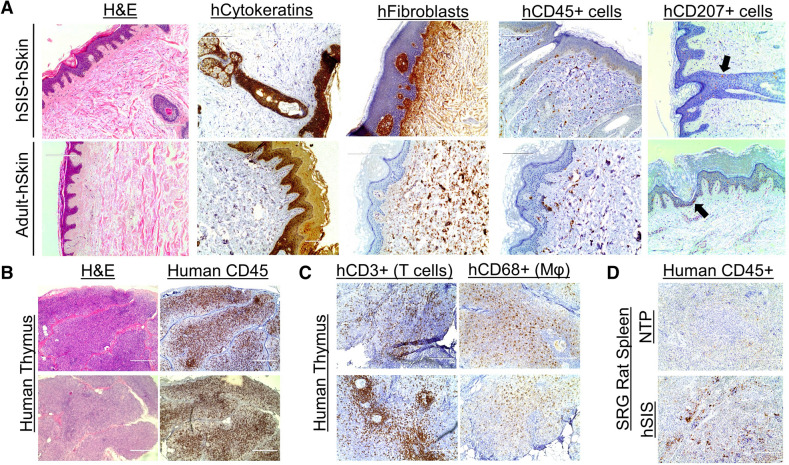
The human skin is a significant barrier for protection against pathogen transmission. Rodent models used to investigate human-specific pathogens that target the skin are generated by introducing human skin grafts to immunocompromised rodent strains. Infection-induced immunopathogenesis has been separately studied in humanized rodent models developed with human lymphoid tissue and hematopoietic stem cell transplants. Successful co-engraftment of human skin, autologous lymphoid tissues, and autologous immune cells in a rodent model has not yet been achieved, though it could provide a means of studying the human immune response to infection in the human skin. Here, we introduce the human Skin and Immune System (hSIS)-humanized NOD-scid IL2Rγ (NSG) mouse and Sprague-Dawley-Rag2 Il2rγ (SRG) rat models, co-engrafted with human full-thickness fetal skin, autologous fetal lymphoid tissues, and autologous fetal liver-derived hematopoietic stem cells. hSIS-humanized rodents demonstrate the development of human full-thickness skin, along with autologous lymphoid tissues, and autologous immune cells. These models also support human skin infection following intradermal inoculation with community-associated methicillin-resistant Staphylococcus aureus. The co-engraftment of these human skin and immune system components into a single humanized rodent model could provide a platform for studying human skin infections.
人体皮肤是防止病原体传播的重要屏障。用于研究针对皮肤的人类特异性病原体的啮齿动物模型是通过将人皮肤移植物引入免疫功能低下的啮齿动物品系来生成的。已经分别研究了用人淋巴组织和造血干细胞移植开发的人类化啮齿动物模型中的感染诱导的免疫发病机制。尽管将人皮肤、自体淋巴组织和自体免疫细胞共同移植到啮齿动物模型中可以提供一种研究人类对感染的免疫反应的方法,但尚未成功实现。在这里,我们介绍了人皮肤和免疫系统(hSIS)-人源化 NOD-scid IL2Rγ(NSG)小鼠和 Sprague-Dawley-Rag2 Il2rγ(SRG)大鼠模型,这些模型共同移植了人全厚胎儿皮肤、自体胎儿淋巴组织和自体胎肝来源的造血干细胞。hSIS 人源化啮齿动物表现出全厚人皮肤的发育,以及自体淋巴组织和自体免疫细胞。这些模型还支持社区相关耐甲氧西林金黄色葡萄球菌经皮内接种后的人皮肤感染。这些人皮肤和免疫系统成分共同移植到单个人类化啮齿动物模型中可以为研究人类皮肤感染提供一个平台。