Sivinski S E, Mamedova L K, Rusk R A, Elrod C C, Swartz T H, McGill J M, Bradford B J
Department of Animal Sciences and Industry, Kansas State University, Manhattan, 66506 USA.
Department of Diagnostic Medicine/Pathobiology, Kansas State University, Manhattan, 66506 USA.
J Anim Sci Biotechnol. 2020 Sep 1;11:89. doi: 10.1186/s40104-020-00497-4. eCollection 2020.
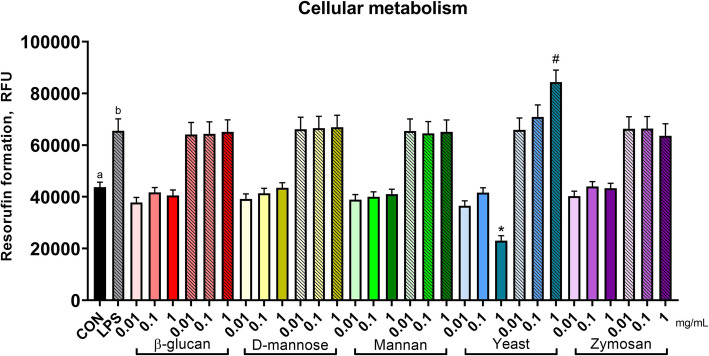
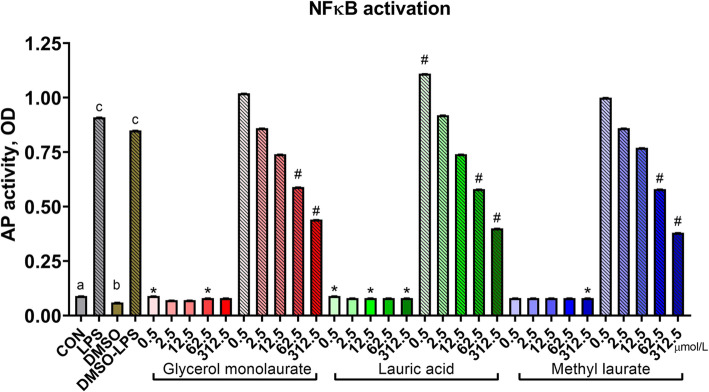
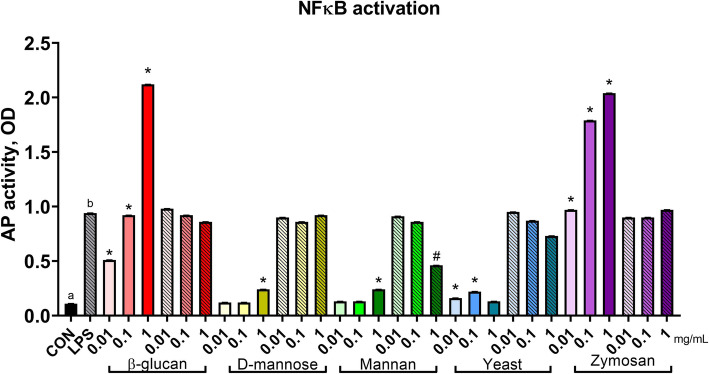
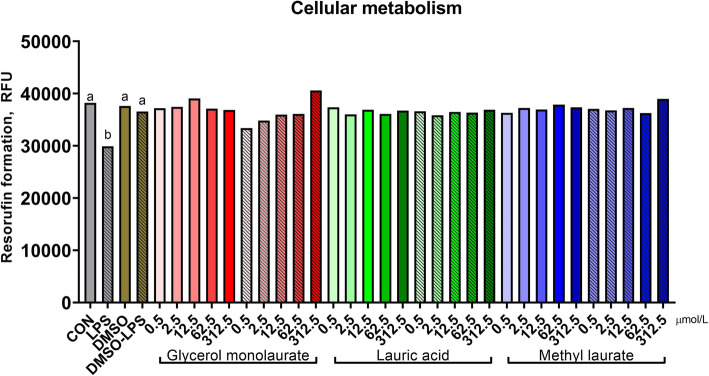
While feed components capable of modulating the immune system are highly sought after and marketed, often little evidence is available to support functional immune response claims. Thus, a high-throughput cell screening system was developed to test these compounds for innate immune signaling effects, using and its cell wall components in addition to lauric acid and its esters as models in two separate experiments. This screening system utilized RAW 264.7 murine macrophages to assess live cells and -derived cell wall components β-glucan, mannan, and zymosan (a crude cell wall preparation containing both β-glucan and mannan). -mannose was also evaluated as the monomer of mannan. We also examined the effect of a saturated fatty acid (C12:0, lauric acid) and its esters (methyl laurate and glycerol monolaurate) on innate immune cell activation and cellular metabolism. RAW cells were transfected with a vector that drives expression of alkaline phosphatase upon promoter activation of nuclear factor κ-light-chain-enhancer of activated B cells (NFκB), a major inflammatory/immune transcription factor. RAW cells were incubated with 0.01, 0.1 or 1 mg/mL of yeast compounds alone or RAW cells were challenged with LPS and then incubated with yeast compounds. In a separate experiment, RAW cells were incubated with 0, 0.5, 2.5, 12.5, 62.5, and 312.5 μmol/L of lauric acid, methyl laurate, or glycerol monolaurate alone, or RAW cells were challenged with LPS and then incubated with fatty acid treatments.
Treatment with zymosan or β-glucan alone induced NFκB activation in a dose-dependent manner, whereas treatment with -mannose, mannan, or live cells did not. Post-treatment with mannan after an LPS challenge decreased NFκB activation, suggesting that this treatment may ameliorate LPS-induced inflammation. Slight increases in NFκB activation were found when fatty acid treatments were applied in the absence of LPS, yet substantial reductions in NFκB activation were seen when treatments were applied following an LPS challenge.
Overall, this cell screening system using RAW macrophages was effective, high-throughput, and sensitive to feed components combined with LPS challenges, indicating modulation of innate immune signaling .
尽管能够调节免疫系统的饲料成分备受追捧且已上市销售,但往往缺乏支持其功能性免疫反应声明的证据。因此,开发了一种高通量细胞筛选系统,以测试这些化合物对先天免疫信号传导的影响,在两个独立实验中分别使用[具体物质]及其细胞壁成分以及月桂酸及其酯类作为模型。该筛选系统利用RAW 264.7小鼠巨噬细胞来评估活细胞以及[具体物质]衍生的细胞壁成分β-葡聚糖、甘露聚糖和酵母聚糖(一种同时含有β-葡聚糖和甘露聚糖的粗制细胞壁制剂)。甘露糖作为甘露聚糖的单体也进行了评估。我们还研究了饱和脂肪酸(C12:0,月桂酸)及其酯类(月桂酸甲酯和甘油单月桂酸酯)对先天免疫细胞激活和细胞代谢的影响。RAW细胞用一种载体转染,该载体在活化B细胞的核因子κ轻链增强子(NFκB,一种主要的炎症/免疫转录因子)启动子激活时驱动碱性磷酸酶的表达。RAW细胞单独与0.01、0.1或1mg/mL的酵母化合物孵育,或者RAW细胞先用脂多糖(LPS)刺激,然后再与酵母化合物孵育。在另一个实验中,RAW细胞单独与0、0.5、2.5、12.5。62.5和312.5μmol/L的月桂酸、月桂酸甲酯或甘油单月桂酸酯孵育,或者RAW细胞先用LPS刺激,然后再用脂肪酸处理孵育。
单独用酵母聚糖或β-葡聚糖处理以剂量依赖方式诱导NFκB激活,而用甘露糖、甘露聚糖或活细胞处理则未诱导。LPS刺激后用甘露聚糖后处理可降低NFκB激活,表明这种处理可能减轻LPS诱导的炎症。在无LPS情况下应用脂肪酸处理时发现NFκB激活略有增加,但在LPS刺激后应用处理时则可见NFκB激活大幅降低。
总体而言,这种使用RAW巨噬细胞的细胞筛选系统有效、高通量,且对饲料成分与LPS刺激的组合敏感,表明对先天免疫信号传导有调节作用。