Pan Hong, Dai Huming, Wang Linzhi, Lin Silong, Tao Yuefeng, Zheng Yi, Jiang Renyi, Fang Fan, Wu Yifan
Department of Orthopaedics, Affiliated Anqing Hospital of Anhui Medical University, No.352 Ren Min Road, Yingjiang District, Anqing City, 246003, Anhui Province, China.
BMC Musculoskelet Disord. 2020 Jul 24;21(1):486. doi: 10.1186/s12891-020-03489-7.
Osteoarthritis (OA) is the most prevalent type of arthritis, which commonly involves inflammation in the articular cartilage in OA pathogenesis. MicroRNAs (miRNAs) play essential roles in the regulation and pathophysiology of various diseases including OA. MiR-410-3p has been demonstrated to mediate inflammatory pathways, however, the regulatory functions of miR-410-3p in OA remain largely unknown.
The regulations of miR-410-3p were investigated in OA. Mouse primary chondrocytes and mouse in vivo models were used. The expression levels of miR-410-3p and HMGB1 were measured by qPCR. The transcription activity of NF-κB was assessed by luciferase reporter assay. MTT assay was performed to assess cellular proliferation. Cell apoptosis was evaluated with the Fluorescein Isothiocyanate (FITC) Annexin V assay. Expression levels of proteins were determined by Western blot.
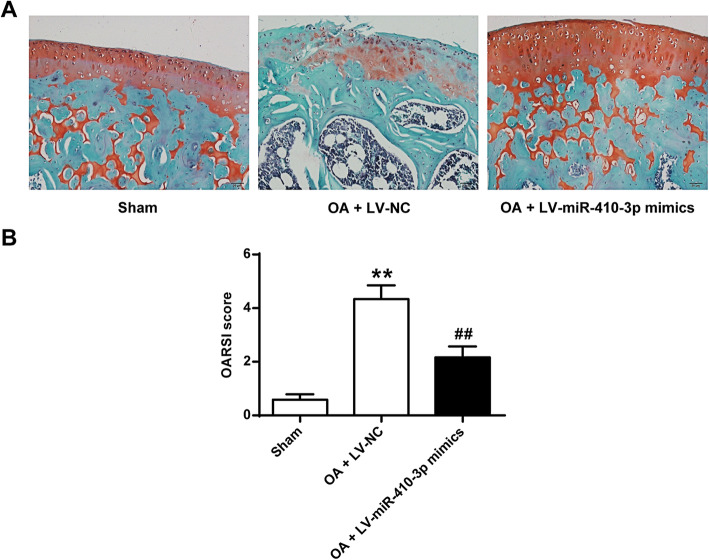
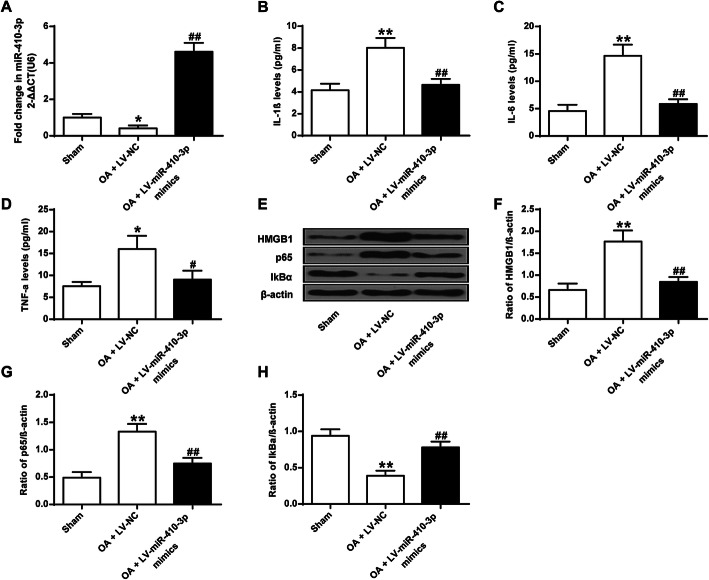
The results demonstrated that miR-410-3p was markedly downregulated in articular cartilage tissues as well as in lipopolysaccharide (LPS)-treated chondrocytes in OA mice. In addition, upregulation of miR-410-3p markedly inhibited LPS-induced apoptosis of chondrocytes. The results also demonstrated that the high mobility group box 1 (HMGB1) was a target of miR-410-3p. LPS-induced upregulated expression of HMGB1 significantly suppressed expression of miR-410-3p. Furthermore, upregulation of miR-410-3p markedly inhibited HMGB1 expression, the nuclear factor (NF)-kB activity and pro-inflammatory cytokines production. Taken together, the results suggested that miR-410-3p targeted HMGB1 and modulated chondrocytes apoptosis and inflammation through the NF-κB signaling pathway.
These findings provide insights into the potential of miR-410-3p/ HMGB1 as therapeutic targets for OA treatment.
骨关节炎(OA)是最常见的关节炎类型,在OA发病机制中通常涉及关节软骨炎症。微小RNA(miRNA)在包括OA在内的各种疾病的调节和病理生理学中发挥重要作用。已证明miR-410-3p介导炎症途径,然而,miR-410-3p在OA中的调节功能在很大程度上仍不清楚。
在OA中研究miR-410-3p的调节作用。使用小鼠原代软骨细胞和小鼠体内模型。通过qPCR测量miR-410-3p和HMGB1的表达水平。通过荧光素酶报告基因测定评估NF-κB的转录活性。进行MTT测定以评估细胞增殖。用异硫氰酸荧光素(FITC)膜联蛋白V测定评估细胞凋亡。通过蛋白质印迹法测定蛋白质的表达水平。
结果表明,在OA小鼠的关节软骨组织以及脂多糖(LPS)处理的软骨细胞中,miR-410-3p明显下调。此外,miR-410-3p的上调明显抑制LPS诱导的软骨细胞凋亡。结果还表明,高迁移率族蛋白B1(HMGB1)是miR-410-3p的靶标。LPS诱导的HMGB1表达上调显著抑制miR-410-3p的表达。此外,miR-410-3p的上调明显抑制HMGB1表达、核因子(NF)-κB活性和促炎细胞因子的产生。综上所述,结果表明miR-410-3p靶向HMGB1并通过NF-κB信号通路调节软骨细胞凋亡和炎症。
这些发现为miR-410-3p/HMGB1作为OA治疗的潜在治疗靶点提供了见解。