Simione Meg, Frost Holly M, Cournoyer Rachel, Mini Fernanda Neri, Cassidy Jackie, Craddock Cassie, Moreland Jennifer, Wallace Jessica, Metlay Joshua, Kistin Caroline J, Sease Kerry, Hambidge Simon J, Taveras Elsie M
Division of General Academic Pediatrics, MassGeneral Hospital for Children, 125 Nashua Street, Suite 860, Boston, MA 02114 USA.
Department of Pediatrics, Harvard Medical School, Boston, MA USA.
Implement Sci Commun. 2020 Jun 17;1:55. doi: 10.1186/s43058-020-00047-z. eCollection 2020.
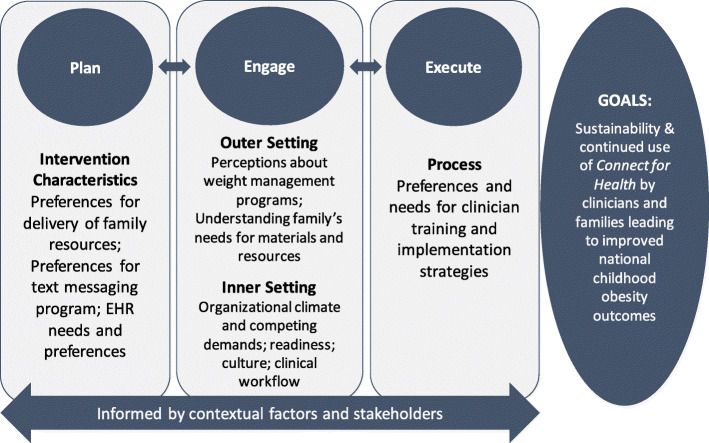
is an evidence-based weight management program with clinical- and family-facing components for delivery in pediatric primary care for families of children ages 2 to 12 years. We used the Consolidated Framework for Implementation Research (CFIR) to guide formative work prior to national implementation. The purpose of this study was to describe the process and results of stakeholder engagement and program adaptation.
We used mixed qualitative and quantitative methods to iteratively adapt and optimize the program by assessing needs and perspectives of clinicians and parents, as well as contextual barriers, facilitators, and organizational readiness for the uptake of the proposed program tools and implementation strategies. We conducted interviews with primary care clinicians from four health care organizations in Boston, MA; Denver, CO; and Greenville, SC, and used principles of immersion-crystallization for qualitative analyses. We also conducted surveys of parents of children with a body mass index ≥ 85th percentile.
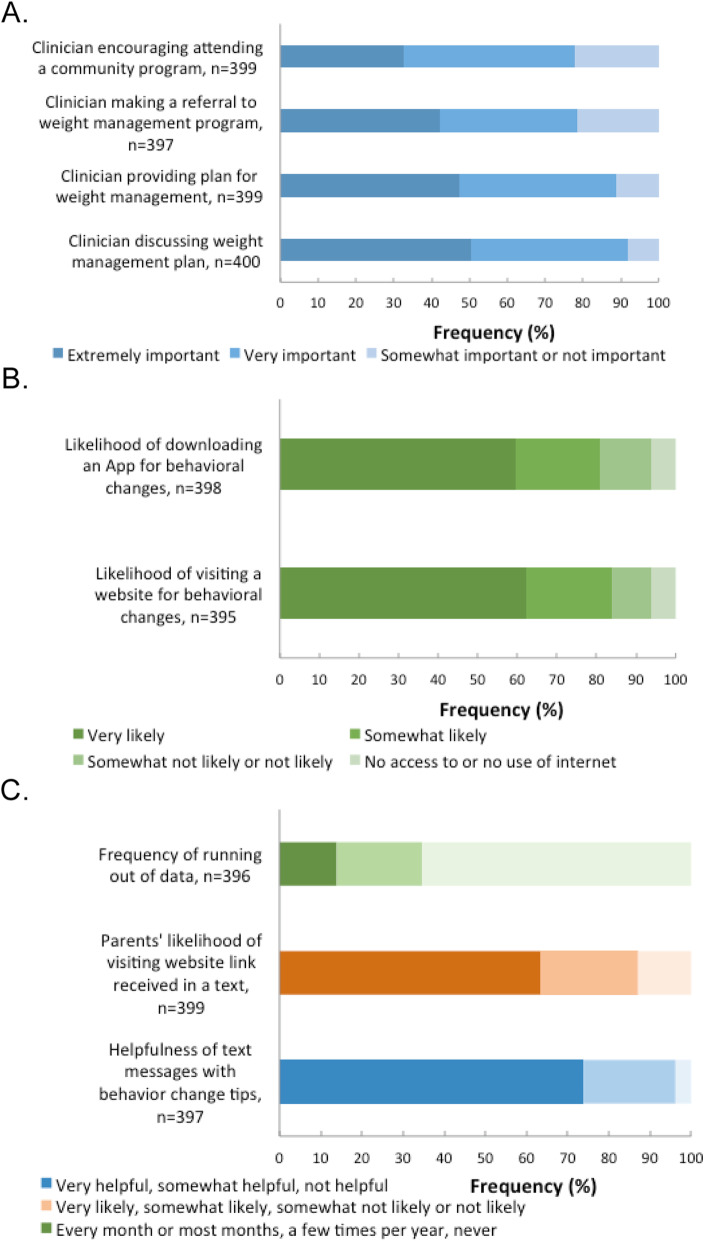
We reached thematic saturation after 52 clinician interviews. Emergent themes representing the CFIR domains of intervention characteristics, outer and inner setting, and process included (1) importance of evidence-based clinical decision support tools that integrate into the workflow and do not extend visit time, (2) developing resources that respond to family's needs, (3) using multimodal delivery options for family resources, (4) addressing childhood obesity while balancing competing demands, (5) emphasizing patient care rather than documentation and establishing sustainability plans, and (6) offering multiple training methods that incorporate performance feedback. Of the parents surveyed ( = 400), approximately 50% were Spanish-speaking and over 75% reported an annual income < $50,000. Parents affirmed the importance of addressing weight management during well-child visits, being provided with referrals and resources, and offering multiple methods for resource delivery. Decisions about program modifications were made at the program and healthcare-system level and based on stakeholder engagement findings. Modifications included cultural, geographic, and target audience adaptations, as well as varied resource delivery options.
To ensure the fit between the program and national implementation settings, adaptations were systematically made through engagement of clinician and parent stakeholders to support adoption, sustainability, and health outcomes.
NCT04042493.
是一项基于证据的体重管理项目,具有面向临床和家庭的组成部分,可在儿科初级保健中为2至12岁儿童的家庭提供服务。我们使用实施研究综合框架(CFIR)来指导在全国实施之前的形成性工作。本研究的目的是描述利益相关者参与和项目调整的过程及结果。
我们使用混合定性和定量方法,通过评估临床医生和家长的需求及观点,以及情境障碍、促进因素和组织对采用拟议项目工具和实施策略的准备情况,来迭代调整和优化该项目。我们对来自马萨诸塞州波士顿、科罗拉多州丹佛和南卡罗来纳州格林维尔的四个医疗保健组织的初级保健临床医生进行了访谈,并使用沉浸 - 结晶原则进行定性分析。我们还对体重指数≥第85百分位儿童的家长进行了调查。
在对52名临床医生进行访谈后,我们达到了主题饱和。代表CFIR干预特征、外部和内部环境以及过程领域的新出现主题包括:(1)整合到工作流程中且不延长就诊时间的基于证据的临床决策支持工具的重要性;(2)开发满足家庭需求的资源;(3)为家庭资源使用多模式交付选项;(4)在平衡相互竞争的需求的同时解决儿童肥胖问题;(5)强调患者护理而非文档记录并制定可持续性计划;(6)提供包含绩效反馈的多种培训方法。在接受调查的家长中(n = 400),约50%讲西班牙语,超过75%报告年收入低于50,000美元。家长们肯定了在儿童健康检查期间解决体重管理问题、提供转诊和资源以及提供多种资源交付方法的重要性。关于项目修改的决策是在项目和医疗保健系统层面做出的,并基于利益相关者参与的结果。修改包括文化、地理和目标受众方面的调整,以及多种资源交付选项。
为确保该项目与全国实施环境相匹配,通过让临床医生和家长利益相关者参与,系统地进行了调整,以支持采用、可持续性和健康结果。
NCT04042493。