Nevedal Andrea L, Reardon Caitlin M, Jackson George L, Cutrona Sarah L, White Brandolyn, Gifford Allen L, Orvek Elizabeth, DeLaughter Kathryn, White Lindsay, King Heather A, Henderson Blake, Vega Ryan, Damschroder Laura
Center for Innovation to Implementation, VHA Palo Alto Health Care System, 795 Willow Road (152-MPD), Menlo Park, CA 94025 USA.
Center for Clinical Management Research, VHA Ann Arbor Healthcare System, 2215 Fuller Rd., 152, Ann Arbor, MI 48105 USA.
Implement Sci Commun. 2020 Jul 3;1:61. doi: 10.1186/s43058-020-00053-1. eCollection 2020.
One goal of health systems seeking to evolve into learning health systems is to accelerate the implementation and sustainment of evidence-based practices (EBPs). As part of this evolution, the Veterans Health Administration (VHA) developed the Innovation Ecosystem, which includes the Diffusion of Excellence (DoE), a program that identifies and diffuses Gold Status Practices (GSPs) across facilities. The DoE hosts an annual "Shark Tank" competition in which leaders bid on the opportunity to implement a GSP with 6 months of implementation support. Over 750 diverse practices were submitted in cohorts 2 and 3 of Shark Tank; 23 were designated GSPs and were implemented in 31 VA networks or facilities. As part of a national evaluation of the DoE, we identified factors contributing to GSP implementation and sustainment.
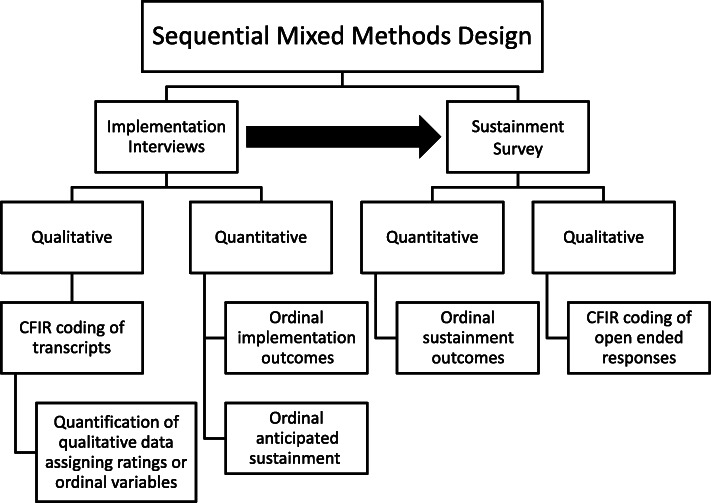
Our sequential mixed methods evaluation of cohorts 2 and 3 of Shark Tank included semi-structured interviews with at least one representative from 30/31 implementing teams ( = 78/105 people invited) and survey responses from 29/31 teams ( = 39/47 invited). Interviews focused on factors influencing implementation and future sustainment. Surveys focused on sustainment 1.5-2 years after implementation. The Consolidated Framework for Implementation Research (CFIR) informed data collection and directed content analysis. Ordinal scales were developed inductively to rank implementation and sustainment outcomes.
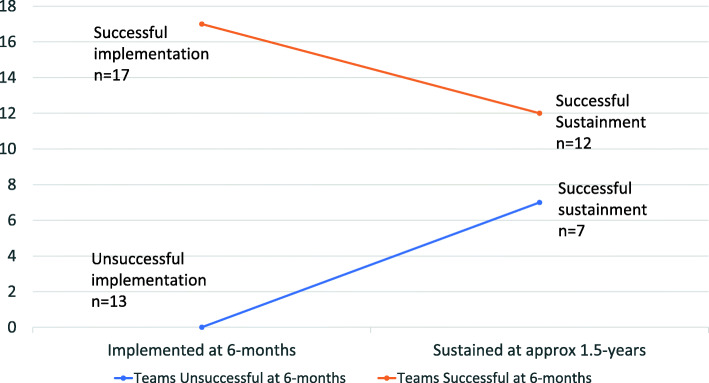
Over 50% of teams (17/30) successfully implemented their GSP within the 6-month implementation period. Despite extensive implementation support, significant barriers related to centralized decision-making, staffing, and resources led to partial ( = 6) or no ( = 7) implementation for the remaining teams. While 12/17 initially successful implementation teams reported sustained use of their GSP, over half of the initially unsuccessful teams ( = 7/13) also reported sustained GSP use 1.5 years after the initial implementation period. When asked at 6 months, 18/27 teams with complete data accurately anticipated their future sustainability based on reported sustainment an average of 1.5 years later.
Most teams implemented within 6 months and/or sustained their GSP 1.5 years later. High levels of implementation and sustainment across diverse practices and teams suggest that VHA's DoE is a successful large-scale model of diffusion. Team predictions about sustainability after the first 6 months of implementation provide a promising early assessment and point of intervention to increase sustainability.
寻求向学习型卫生系统发展的卫生系统的一个目标是加速循证实践(EBP)的实施和维持。作为这一发展的一部分,退伍军人健康管理局(VHA)开发了创新生态系统,其中包括卓越传播(DoE)项目,该项目识别并在各机构间传播黄金标准实践(GSP)。DoE举办年度“鲨鱼坦克”竞赛,领导者们竞标获得在6个月实施支持下实施一项GSP的机会。在“鲨鱼坦克”竞赛的第2组和第3组中提交了750多种不同的实践;23种被指定为GSP,并在31个退伍军人事务部网络或机构中实施。作为对DoE的全国性评估的一部分,我们确定了有助于GSP实施和维持的因素。
我们对“鲨鱼坦克”竞赛第2组和第3组进行的序贯混合方法评估包括对31个实施团队中的30个团队的至少一名代表进行半结构化访谈(邀请了105人,78人参与)以及29个团队(邀请了47人,39人参与)的调查回复。访谈重点关注影响实施和未来维持的因素。调查重点关注实施1.5 - 2年后的维持情况。实施研究综合框架(CFIR)为数据收集提供指导并指导内容分析。通过归纳法制定顺序量表以对实施和维持结果进行排名。
超过50%的团队(17/30)在6个月的实施期内成功实施了其GSP。尽管有广泛的实施支持,但与集中决策、人员配备和资源相关的重大障碍导致其余团队部分(6个)或未(7个)实施。虽然17个最初成功实施的团队中有12个报告持续使用其GSP,但超过一半最初未成功的团队(7/13)也报告在初始实施期1.5年后持续使用GSP。在6个月时被询问时,18个拥有完整数据的团队中有27个根据报告的平均1.5年后的维持情况准确预测了其未来的可持续性。
大多数团队在6个月内实施和/或在1.5年后维持其GSP。不同实践和团队的高水平实施和维持表明VHA的DoE是一个成功的大规模传播模式。实施前6个月后团队对可持续性的预测提供了一个有前景的早期评估和干预点,以提高可持续性。