Center for Clinical Management Research (CCMR), Veterans Affairs Ann Arbor Healthcare System, 2215 Fuller Rd, Mail Stop 152, Ann Arbor, MI, 48105, USA.
Center of Innovation to Accelerate Discovery and Practice Transformation (ADAPT), Durham Veterans Affairs Health Care System, Durham, NC, USA.
Implement Sci. 2024 May 7;19(1):34. doi: 10.1186/s13012-024-01361-z.
The Veterans Health Administration (VHA) is the United States largest learning health system. The Diffusion of Excellence (DoE) program is a large-scale model of diffusion that identifies and diffuses evidence-informed practices across VHA. During the period of 2016-2021, 57 evidence-informed practices were implemented across 82 VHA facilities. This setting provides a unique opportunity to understand sustainment determinants and pathways. Our objective was to characterize the longitudinal pathways of practices as they transition from initial implementation to long-term sustainment at each facility.
A longitudinal, mixed-methods evaluation of 82 VHA facilities. Eighty-two facility representatives, chosen by leadership as points-of-contact for 57 DoE practices, were eligible for post-implementation interviews and annual sustainment surveys. Primary outcomes (implementation, sustainment), and secondary outcomes (institutionalization, effectiveness, anticipated sustainment) at four time-points were collected. We performed descriptive statistics and directed content analysis using Hailemariam et al.'s factors influencing sustainment.
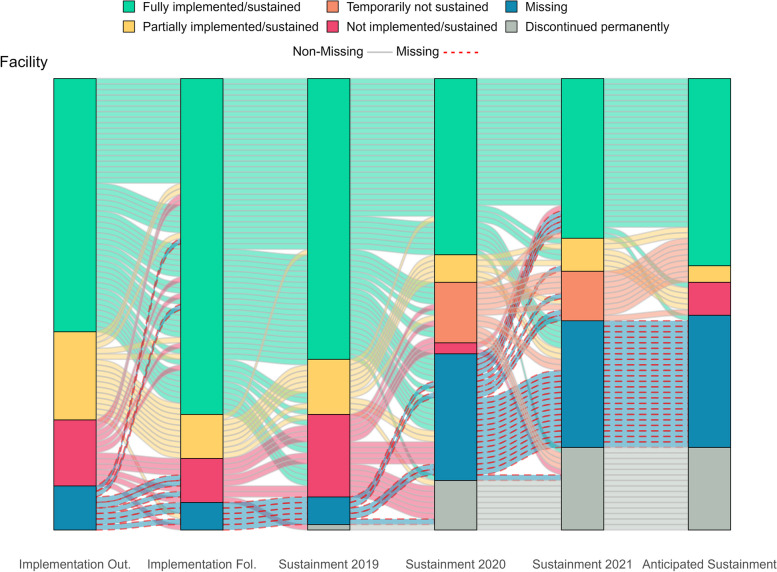
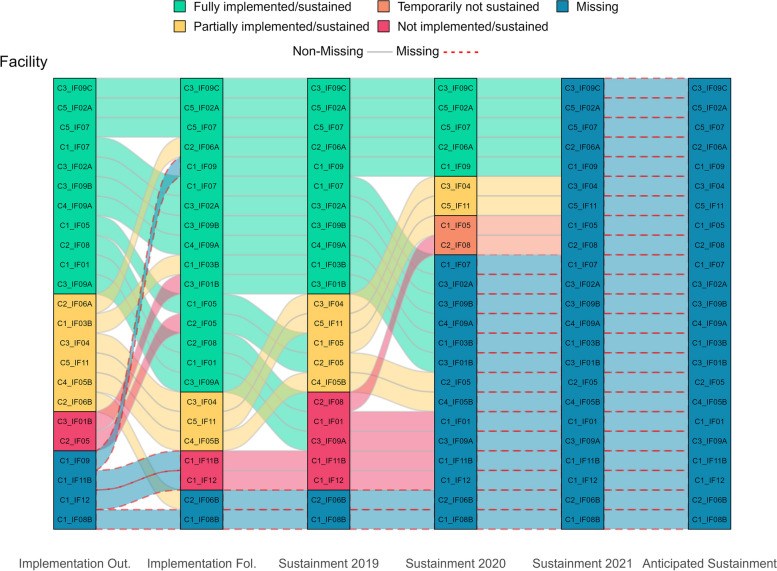
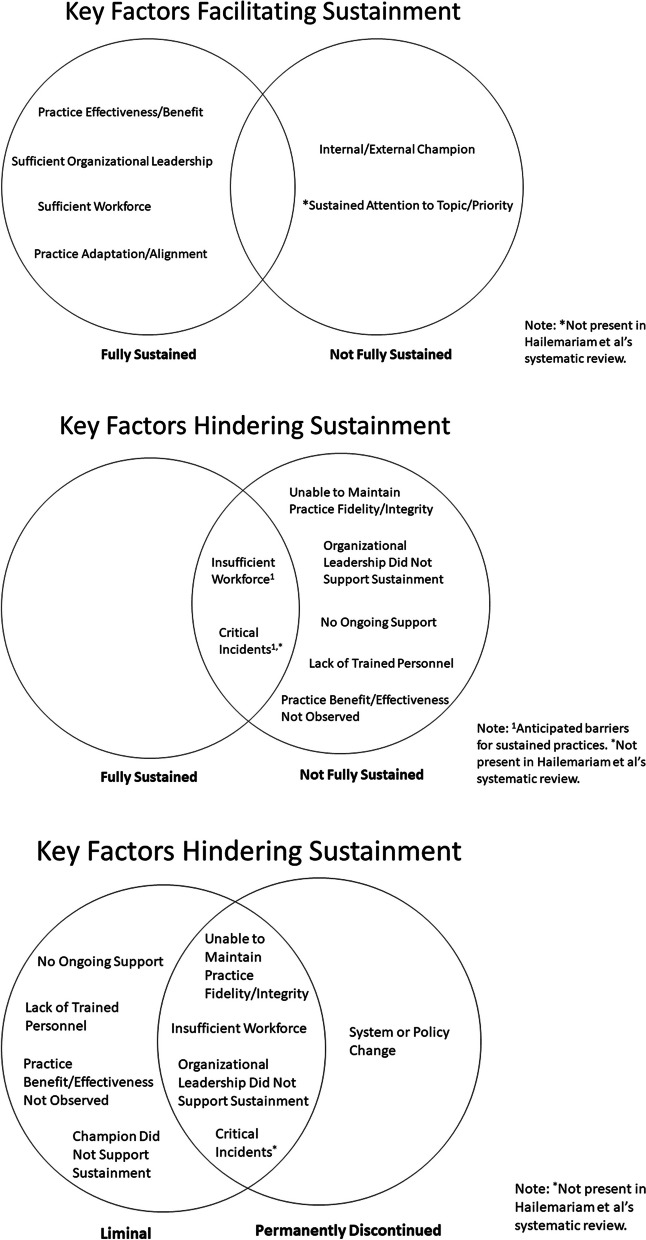
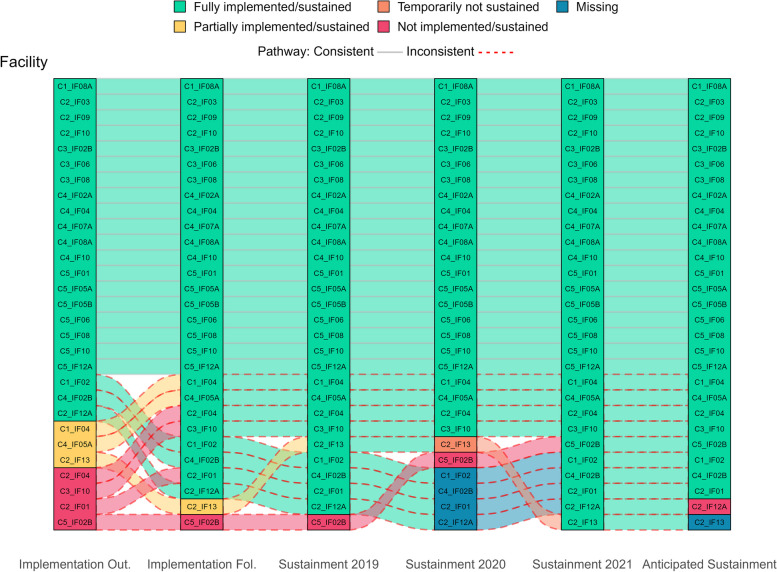
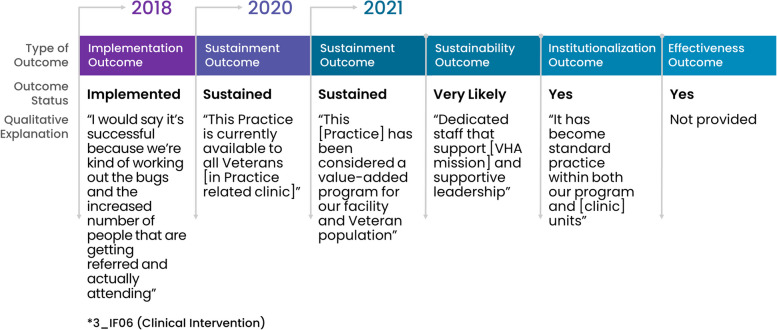
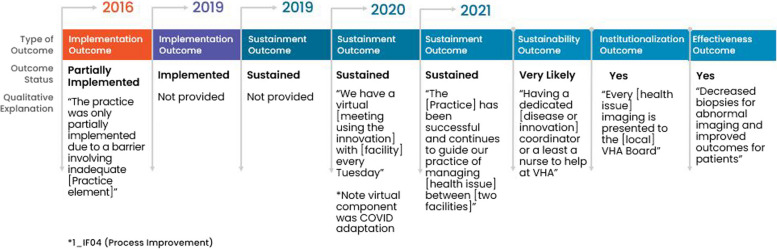
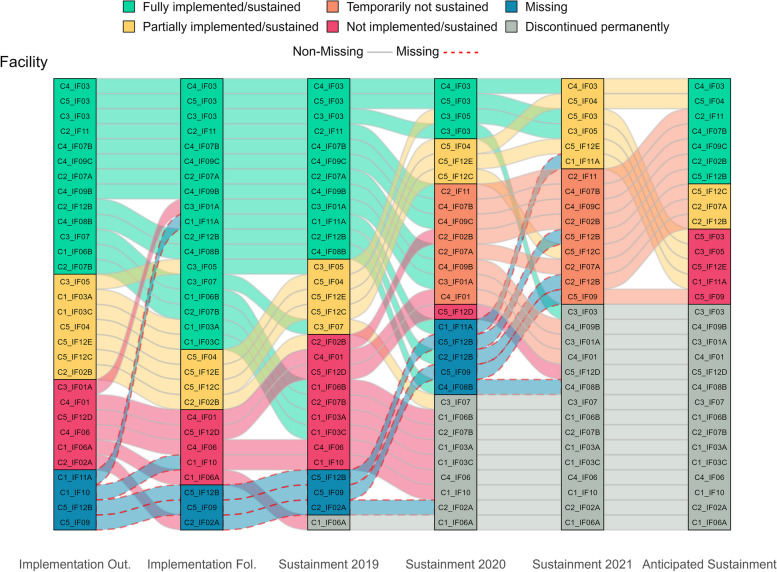
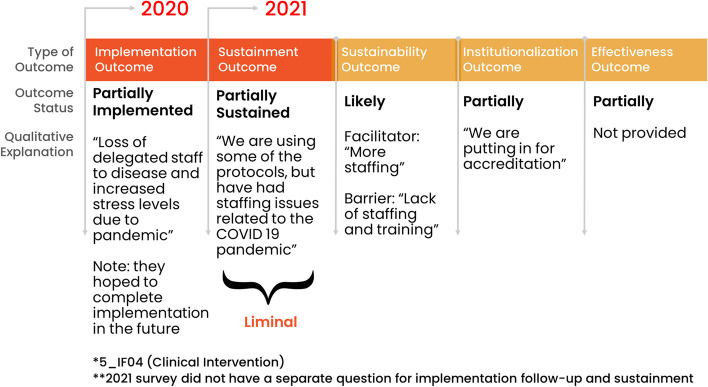
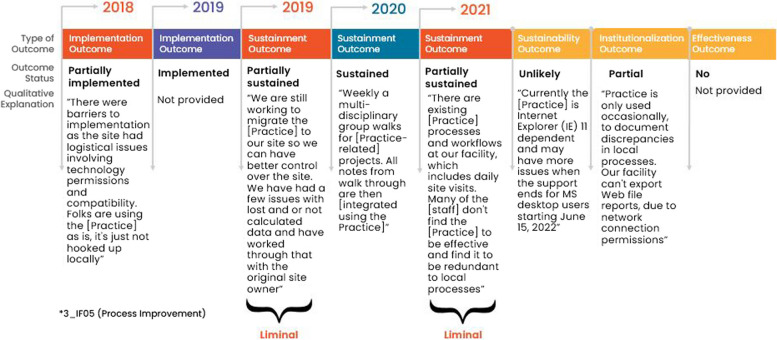
After approximately five years post-implementation (e.g., 2021 sustainment outcomes), of the 82 facilities, about one-third fully sustained their practice compared to one-third that did not fully sustain their practice because it was in a "liminal" stage (neither sustained nor discontinued) or permanently discontinued. The remaining one-third of facilities had missing 2021 sustainment outcomes. A higher percentage of facilities (70%) had inconsistent primary outcomes (changing over time) compared to facilities (30%) with consistent primary outcomes (same over time). Thirty-four percent of facilities with sustained practices reported resilience since they overcame implementation and sustainment barriers. Facilities with sustained practices reported more positive secondary outcomes compared to those that did not sustain their practice. Key factors facilitating practice sustainment included: demonstrating practice effectiveness/benefit, sufficient organizational leadership, sufficient workforce, and adaptation/alignment with local context. Key factors hindering practice sustainment included: insufficient workforce, not able to maintain practice fidelity/integrity, critical incidents related to the COVID-19 pandemic, organizational leadership did not support sustainment of practice, and no ongoing support.
We identified diverse pathways from implementation to sustainment, and our data underscore that initial implementation outcomes may not determine long-term sustainment outcomes. This longitudinal evaluation contributes to understanding impacts of the DoE program, including return on investment, achieving learning health system goals, and insights into achieving high-quality healthcare in VHA.
退伍军人健康管理局(VHA)是美国最大的学习型健康系统。卓越传播(DoE)计划是一个大规模的传播模式,旨在识别和传播 VHA 内部的循证实践。在 2016 年至 2021 年期间,57 项循证实践在 82 个 VHA 设施中得到实施。这种环境为了解维持的决定因素和途径提供了独特的机会。我们的目标是描述实践从初始实施到每个设施的长期维持的纵向途径。
对 82 个 VHA 设施进行了纵向、混合方法评估。82 个设施的代表,由领导层作为 57 项 DoE 实践的联络人选出,有资格进行实施后访谈和年度维持调查。在四个时间点收集了主要结果(实施、维持)和次要结果(制度化、效果、预期维持)。我们使用 Hailemariam 等人的影响维持的因素进行了描述性统计和定向内容分析。
在实施后大约五年(例如,2021 年维持结果),在 82 个设施中,大约三分之一的设施完全维持了他们的实践,而三分之一的设施没有完全维持他们的实践,因为它处于“中间”阶段(既不维持也不停止)或永久停止。其余三分之一的设施缺少 2021 年的维持结果。与设施(30%)相比,有更高比例的设施(70%)的主要结果(随时间变化)不一致,而设施(30%)的主要结果(随时间保持不变)一致。34%的维持实践的设施报告说,他们克服了实施和维持的障碍,具有弹性。与没有维持实践的设施相比,维持实践的设施报告了更多的积极的次要结果。促进实践维持的关键因素包括:展示实践的有效性/益处、足够的组织领导力、足够的劳动力,以及与当地环境的适应/调整。阻碍实践维持的关键因素包括:劳动力不足、无法保持实践的保真度/完整性、与 COVID-19 大流行相关的重大事件、组织领导力不支持实践的维持、以及没有持续的支持。
我们确定了从实施到维持的不同途径,我们的数据强调,初始实施结果可能不会决定长期维持结果。这项纵向评估有助于了解 DoE 计划的影响,包括投资回报、实现学习型健康系统目标,以及了解 VHA 实现高质量医疗保健的途径。