Fiona Stanley Hospital, Murdoch, WA, Australia.
PathWest Laboratory Medicine, Murdoch, WA, Australia.
Blood Adv. 2020 Sep 8;4(17):4147-4150. doi: 10.1182/bloodadvances.2020002431.
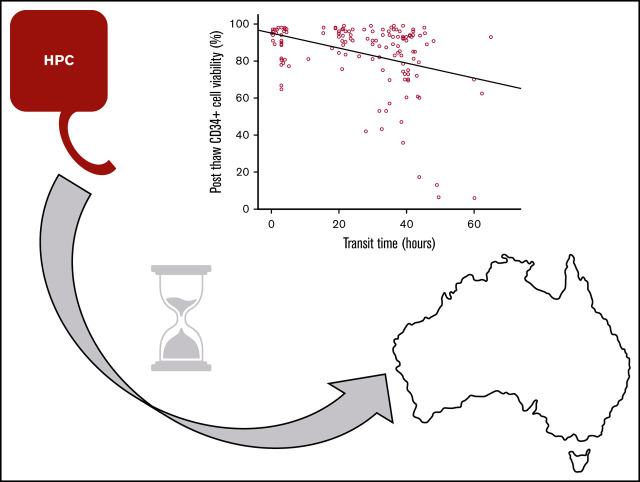
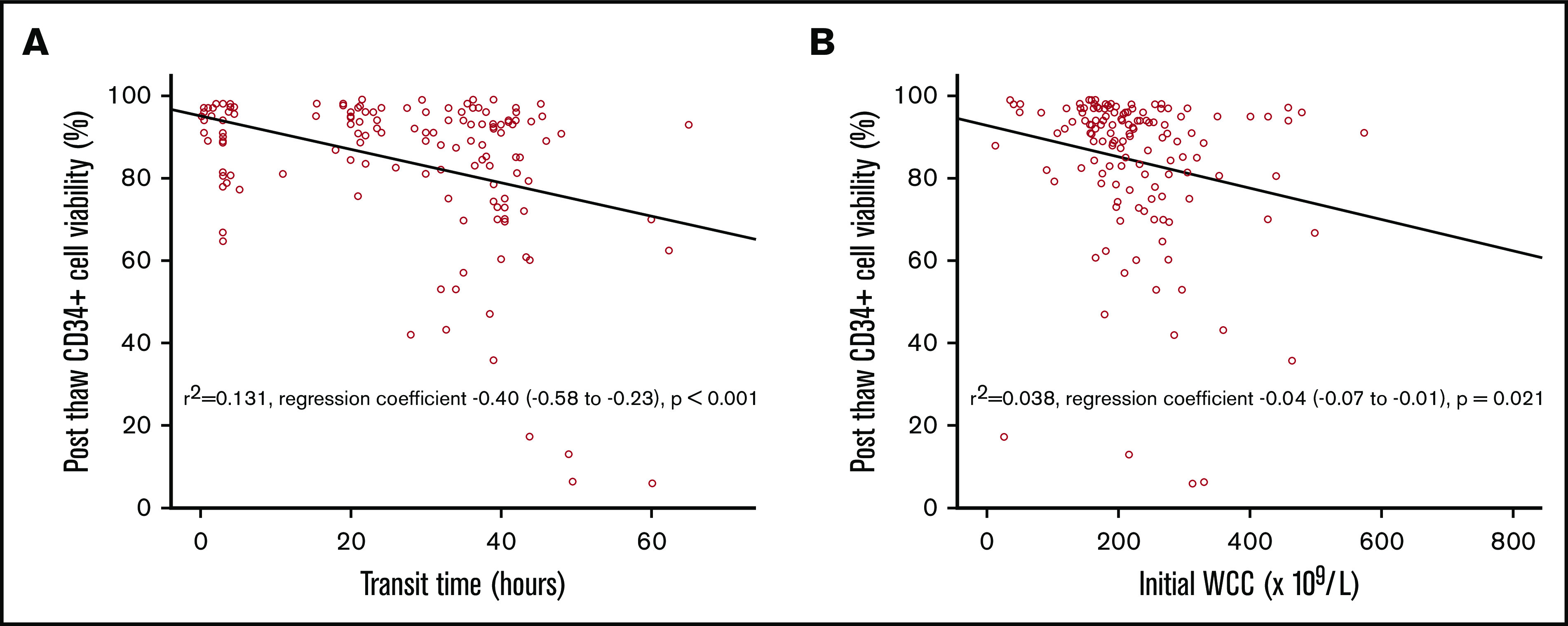
Donor registries and transplantation societies recommend cryopreservation of unrelated donor hemopoietic progenitor cell (HPC) products before the recipient commences conditioning therapy to mitigate the donor and travel risks associated with the COVID-19 pandemic. However, little is known regarding the postthaw quality of such allogeneic products or the effect of precryopreservation storage and processing on these characteristics. We investigated the postthaw CD34+ cell recovery and viability of 305 allogeneic HPC products cryopreserved at 9 laboratories across Australia. Median postthaw CD34+ cell recovery was 76% and ranged from 6% to 122%. Longer transit time before cryopreservation, white cell count (WCC) during storage, and complex product manipulation before cryopreservation were independently associated with inferior postthaw CD34+ cell recovery. Longer precryopreservation transit time and WCC were also associated with inferior postthaw CD34+ cell viability. We conclude that although postthaw CD34+ cell recovery and viability of cryopreserved allogeneic HPC is generally acceptable, there is a significant risk of poor postthaw product quality, associated with prolonged storage time, higher WCC, and complex product manipulation precryopreservation. Awareness of expected postthaw recovery and practices that influence it will assist collection, processing, and transplant centers in optimizing outcomes for transplant recipients.
供者登记处和移植协会建议在受者开始预处理治疗之前,对无关供者造血祖细胞(HPC)产品进行冷冻保存,以减轻与 COVID-19 大流行相关的供者和旅行风险。然而,对于此类同种异体产品的解冻后质量或预冷冻储存和处理对这些特性的影响知之甚少。我们调查了澳大利亚 9 个实验室冷冻保存的 305 种同种异体 HPC 产品的解冻后 CD34+细胞回收率和活力。解冻后 CD34+细胞回收率的中位数为 76%,范围为 6%至 122%。在冷冻保存之前的运输时间更长、储存期间的白细胞计数(WCC)更高,以及在冷冻保存之前进行复杂的产品操作与解冻后 CD34+细胞回收率较低独立相关。较长的预冷冻保存运输时间和 WCC 也与解冻后 CD34+细胞活力较低相关。我们得出结论,尽管冷冻保存的同种异体 HPC 的解冻后 CD34+细胞回收率和活力通常是可以接受的,但与长时间储存、较高的 WCC 和复杂的产品操作相关的解冻后产品质量较差的风险仍然存在。了解预期的解冻后恢复以及影响它的实践将有助于采集、处理和移植中心为移植受者优化结果。