Lee Ji Hwan, Kim Woojin
Department of Physiology, College of Korean Medicine, Kyung Hee University, Seoul 02453, Korea.
Biomedicines. 2020 Sep 2;8(9):324. doi: 10.3390/biomedicines8090324.
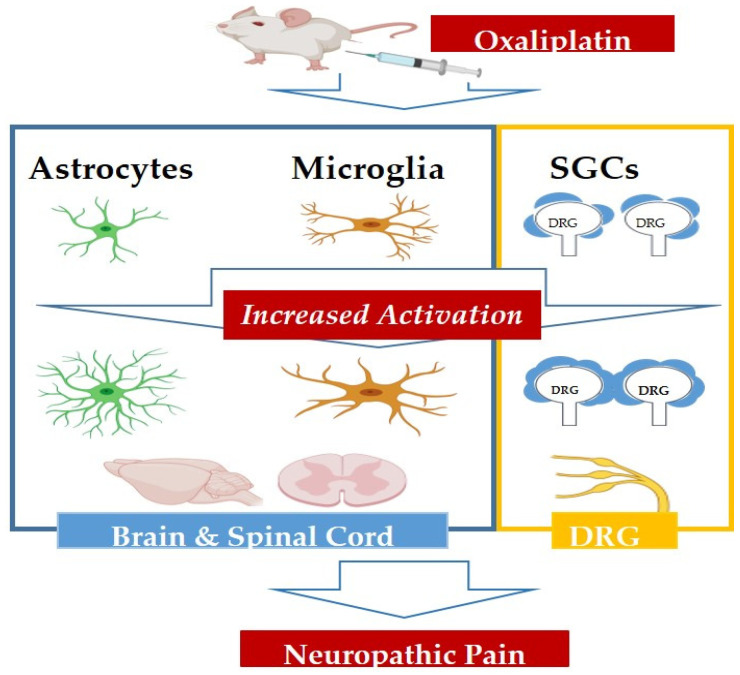
Oxaliplatin is a third-generation platinum-based chemotherapeutic drug. Although its efficacy against colorectal cancer is well known, peripheral neuropathy that develops during and after infusion of the agents could decrease the quality of life of the patients. Various pathways have been reported to be the cause of the oxaliplatin-induced paresthesia and dysesthesia; however, its mechanism of action has not been fully understood yet. In recent years, researchers have investigated the function of glia in pain, and demonstrated that glia in the peripheral and central nervous system could play a critical role in the development and maintenance of neuropathic pain. These results suggest that targeting the glia may be an effective therapeutic option. In the past ten years, 20 more papers focused on the role of glia in oxaliplatin-induced thermal and mechanical hypersensitivity. However, to date no review has been written to summarize and discuss their results. Thus, in this study, by reviewing 23 studies that conducted in vivo experiments in rodents, the change of satellite glial cells, astrocytes, and microglia activation in the dorsal root ganglia, spinal cord, and the brain of oxaliplatin-induced neuropathic pain animals is discussed.
奥沙利铂是一种第三代铂类化疗药物。尽管其对结直肠癌的疗效众所周知,但在输注该药物期间及之后出现的周围神经病变会降低患者的生活质量。据报道,多种途径是奥沙利铂诱导的感觉异常和感觉迟钝的原因;然而,其作用机制尚未完全明确。近年来,研究人员对神经胶质细胞在疼痛中的功能进行了研究,并证明外周和中枢神经系统中的神经胶质细胞在神经性疼痛的发生和维持中可能起关键作用。这些结果表明,针对神经胶质细胞可能是一种有效的治疗选择。在过去十年中,又有20多篇论文聚焦于神经胶质细胞在奥沙利铂诱导的热和机械超敏反应中的作用。然而,迄今为止尚未有综述对其结果进行总结和讨论。因此,在本研究中,通过回顾23项在啮齿动物身上进行的体内实验研究,探讨了奥沙利铂诱导的神经性疼痛动物的背根神经节、脊髓和大脑中卫星神经胶质细胞、星形胶质细胞和小胶质细胞激活的变化。