Department of Orthopaedic Surgery, Woodlands Health Campus, National Healthcare Group, Singapore, Singapore.
Lee Kong Chian School of Medicine, Nanyang Technological University, Singapore, Singapore.
BMC Musculoskelet Disord. 2020 Sep 4;21(1):592. doi: 10.1186/s12891-020-03611-9.
Osteoarthritis is a leading cause of global disability resulting in significant morbidity and cost to the healthcare system. Current guidelines recommend lifestyle changes such exercises and weight loss as first line treatment prior to surgical consideration. Our current model of care is inefficient with suboptimal allied health intervention for effective behaviour changes. A 12-week community based, individualized, multidisciplinary new model of care for knee osteoarthritis was developed in light of current deficiencies.
The primary aim of this study was to determine the feasibility of a full randomized controlled trial evaluating this new model of care using pre-defined progression criteria. The secondary aim was to optimize the intervention and study design through a process evaluation. A pilot exploratory, parallel arm, single blinded randomized trial design using a mixed method approach was utilized. Progression criteria for a full trial including key domains of patient recruitment and retention, outcome measure acceptability and improvement, adverse events were developed. The primary outcome measure was the Knee Injury and Osteoarthritis Outcome Score (KOOS) at baseline and 12-weeks. Secondary outcomes included quality of life, functional and psychological assessments. Semi-structured interviews were conducted with the patients at 12-weeks.
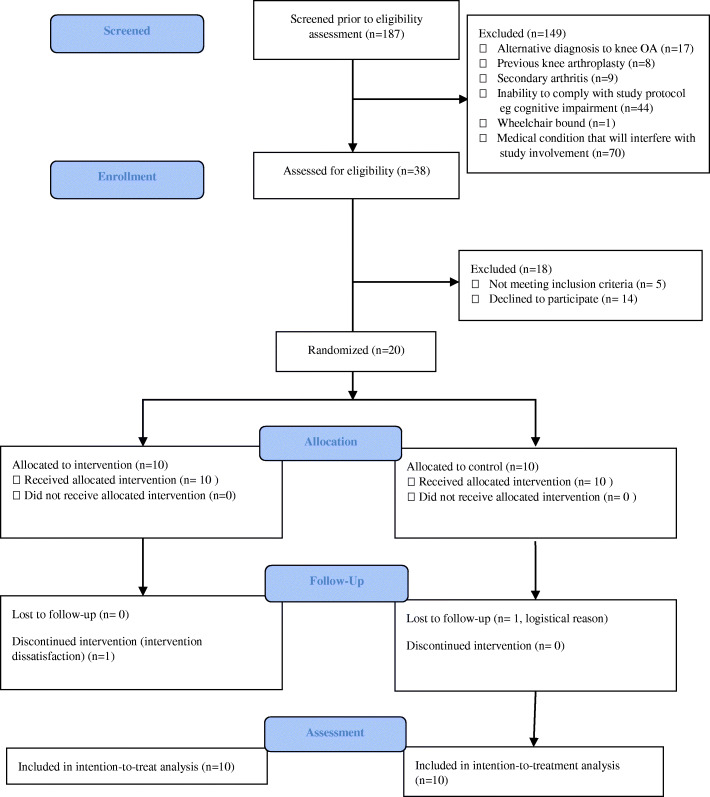
20 patients (3 males, 17 females) were randomized (10 intervention, 10 control). Intervention arm patients reported better improvements in their knee function, quality of life, psychological outcome, dietary improvement and weight loss compared to the control arm at 12-weeks. Semi-structured interviews revealed several themes pertaining to feasibility and intervention optimization. 5 out of the 6 progression criteria's domains were met (recruitment criteria not met).
This pilot has demonstrated the feasibility of a full randomized control trial investigating the potential effectiveness of the new proposed model of care for knee osteoarthritis using pre-defined progression criteria and process evaluation. Results from the qualitative study were used to modify and improve the intervention content, delivery model and study design for a large effectiveness-implementation hybrid randomized control trial that is currently underway.
Retrospectively registered on 18 January 2019 at http://clinicaltrial.gov ID: NCT03809975 .
骨关节炎是全球残疾的主要原因,导致医疗系统发病率和成本显著增加。目前的指南建议在考虑手术之前,先进行生活方式的改变,如运动和减肥。我们目前的治疗模式效率低下,联合健康干预效果不佳,无法实现有效的行为改变。鉴于目前的不足,我们开发了一种新的基于社区的、个体化的、多学科的膝关节骨关节炎治疗新模式。
本研究的主要目的是确定使用预定义的进展标准评估这种新模式的全随机对照试验的可行性。次要目的是通过过程评估优化干预措施和研究设计。采用探索性、平行臂、单盲随机试验设计,结合混合方法。为全试验制定了进展标准,包括患者招募和保留的关键领域、结局测量的可接受性和改善、不良事件。主要结局指标是基线和 12 周时的膝关节损伤和骨关节炎结果评分(KOOS)。次要结局包括生活质量、功能和心理评估。在 12 周时对患者进行半结构化访谈。
20 名患者(3 名男性,17 名女性)被随机分配(10 名干预组,10 名对照组)。干预组患者在 12 周时报告膝关节功能、生活质量、心理结局、饮食改善和体重减轻方面的改善优于对照组。半结构化访谈揭示了与可行性和干预优化相关的几个主题。6 个进展标准中有 5 个(未达到招募标准)得到满足。
本研究通过使用预定义的进展标准和过程评估,为使用新提出的膝关节骨关节炎护理新模式的全随机对照试验的可行性提供了证据。定性研究的结果用于修改和改进干预内容、传递模式和研究设计,以开展目前正在进行的一项大型有效性-实施混合随机对照试验。
于 2019 年 1 月 18 日在 http://clinicaltrial.gov 上进行回顾性注册,注册号为 NCT03809975。