Han Xuequan, Cui Junqi, Xie Kai, Jiang Xu, He Zihao, Du Jingke, Chu Linyang, Qu Xinhua, Ai Songtao, Sun Qi, Wang Liao, Wu Haishan, Zhang Weituo, Yu Zhifeng, Yan Mengning
Shanghai Key Laboratory of Orthopaedic Implants, Department of Orthopaedic Surgery, Shanghai Ninth People's Hospital, Shanghai Jiao Tong University School of Medicine, Shanghai, China.
Department of Pathology, Shanghai Ninth People's Hospital, Shanghai Jiao Tong University School of Medicine, Shanghai, Shanghai, China.
Arthritis Res Ther. 2020 Sep 4;22(1):203. doi: 10.1186/s13075-020-02274-0.
Knee osteoarthritis (OA) is a common disabling disease involving the entire joint tissue, and its onset and progression are affected by many factors. However, the current number of studies investigating the relationship between subchondral trabecular bone (STB), knee alignment, and OA severity is limited. We aimed to investigate the variation in tibial plateau STB microarchitecture in end-stage knee OA patients and their association with knee alignment (hip-knee-ankle, HKA, angle) and OA severity.
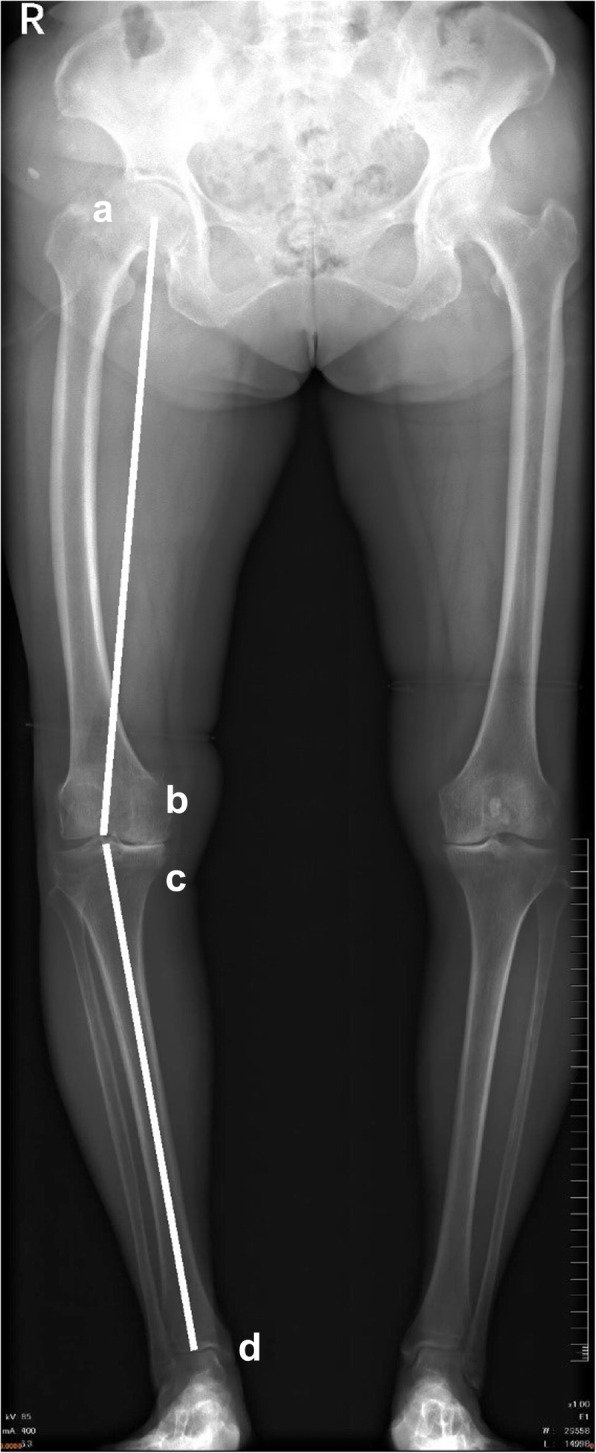
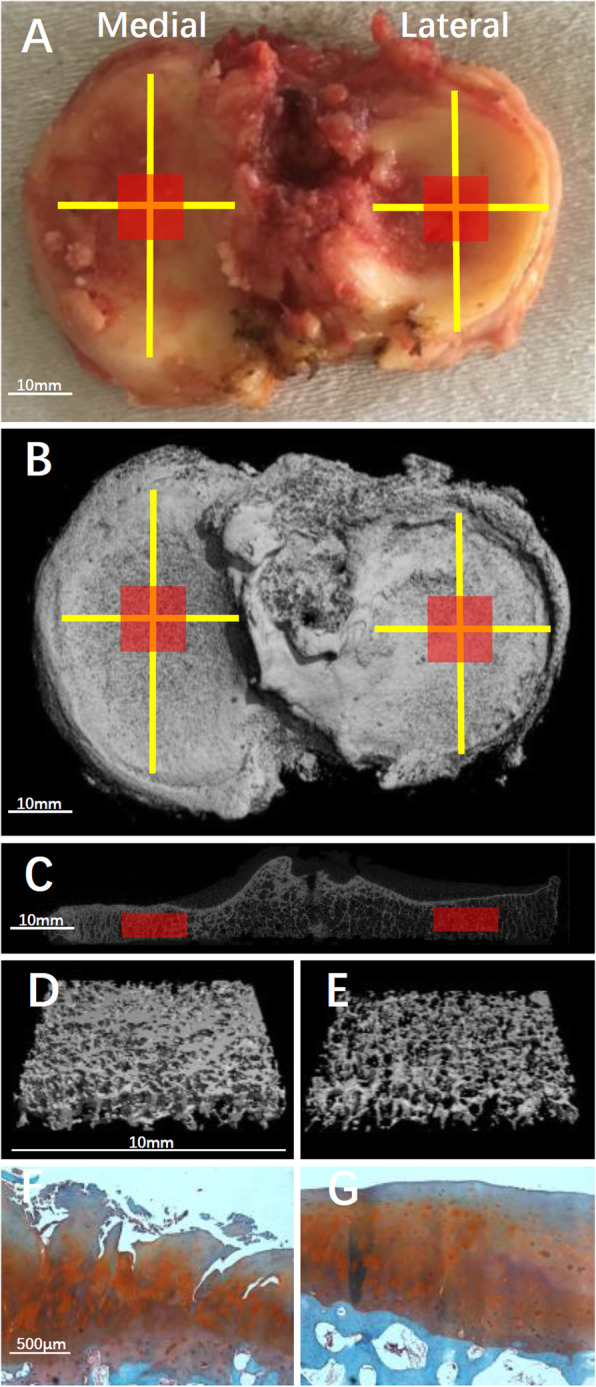
Seventy-one knee OA patients scheduled for total knee arthroplasty (TKA) underwent preoperative radiography to measure the HKA angle and Kellgren-Lawrence grade. Tibial plateaus collected from TKA were scanned using micro-computed tomography to analyze the STB microarchitecture. Histological sections were used to assess cartilage degeneration (OARSI score). Correlations between the HKA angle, OA severity (OARSI score, Kellgren-Lawrence grade), and STB microarchitecture were evaluated. Differences in STB microstructural parameters between varus and valgus alignment groups based on the HKA angle were examined.
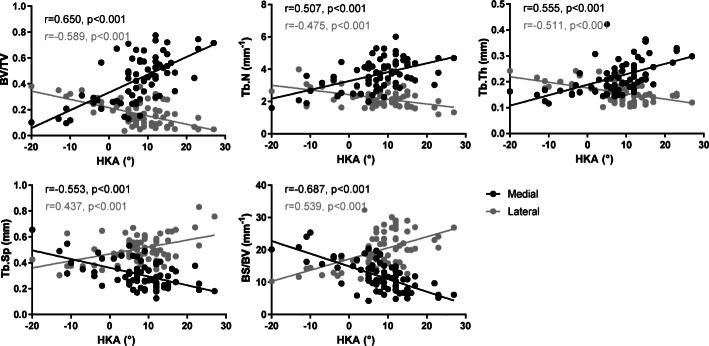
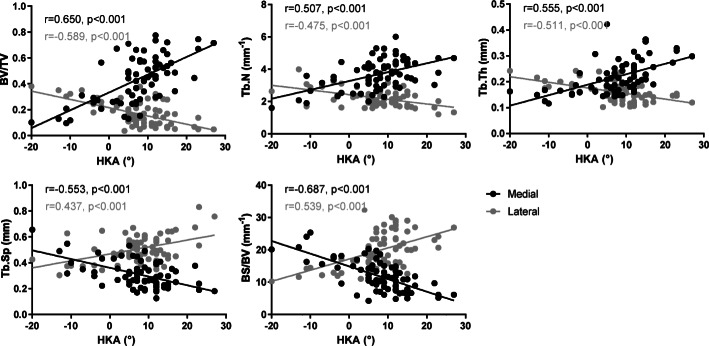
The HKA angle was significantly correlated with all STB microarchitecture parameters (p < 0.01). The HKA angle was more correlated with the medial-to-lateral ratios of the microarchitecture parameters than with the medial or lateral tibia plateaus. The HKA angle and all STB microarchitecture parameters are significantly correlated with both the OARSI score and Kellgren-Lawrence grade (p < 0.01).
The STB microarchitecture is associated with the HKA angle and OA severity. With the increase of the knee alignment deviation and OA severity, the STB of the affected side tibial plateau increased in bone volume, trabecular number, and trabecular thickness and decreased in trabecular separation.
膝关节骨关节炎(OA)是一种累及整个关节组织的常见致残性疾病,其发病和进展受多种因素影响。然而,目前研究软骨下小梁骨(STB)、膝关节对线与OA严重程度之间关系的研究数量有限。我们旨在研究终末期膝关节OA患者胫骨平台STB微结构的变化及其与膝关节对线(髋-膝-踝,HKA,角)和OA严重程度的关联。
71例计划行全膝关节置换术(TKA)的膝关节OA患者术前行X线摄影以测量HKA角和Kellgren-Lawrence分级。对TKA术中采集的胫骨平台进行微计算机断层扫描以分析STB微结构。组织学切片用于评估软骨退变(OARSI评分)。评估HKA角、OA严重程度(OARSI评分、Kellgren-Lawrence分级)与STB微结构之间的相关性。检查基于HKA角的内翻和外翻对线组之间STB微结构参数的差异。
HKA角与所有STB微结构参数均显著相关(p < 0.01)。HKA角与微结构参数的内外侧比值的相关性高于与内侧或外侧胫骨平台的相关性。HKA角和所有STB微结构参数均与OARSI评分和Kellgren-Lawrence分级显著相关(p < 0.01)。
STB微结构与HKA角和OA严重程度相关。随着膝关节对线偏差和OA严重程度的增加,患侧胫骨平台的STB在骨体积、小梁数量和小梁厚度方面增加,而在小梁间距方面减小。