Nie Shao-Bo, Zhao Yan-Peng, Li Jian-Tao, Zhao Zhe, Zhang Zhuo, Zhang Li-Cheng, Tang Pei-Fu
Department of Orthopaedics, The First Medical Center, Chinese PLA General Hospital, Beijing 100853, China.
Department of Orthopedics, the Fourth Medical Centre, Chinese PLA General Hospital, Beijing 100853, China.
Chin Med J (Engl). 2020 Nov 20;133(22):2682-2687. doi: 10.1097/CM9.0000000000001031.
The reverse obliquity inter-trochanteric fracture is a distinct fracture pattern that is mechanically different from most inter-trochanteric fractures and the optional treatment of it is still controversial. The purpose of this study was to compare differences in the efficacy of a novel nail (medial support nail [MSN-II]) and proximal femoral nail anti-rotation (PFNA-II) in the treatment of reverse obliquity inter-trochanteric fractures (Arbeitsgemeinschaft fur Osteosynthesfrogen/Orthopedic Trauma Association [AO/OTA] 31-A3.1) using finite-element analysis.
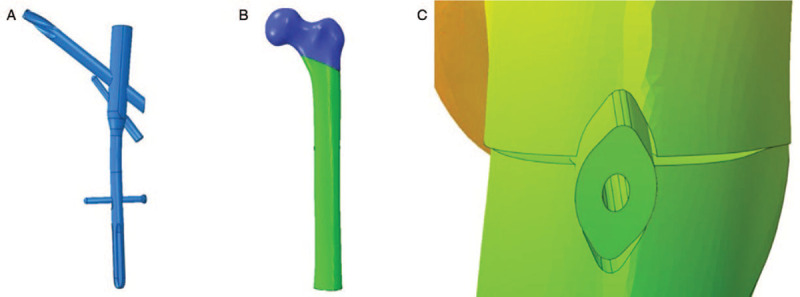
Modeling software was used to establish a three-dimensional model of MSN-II and PFNA-II and an A3.1 inter-trochanteric fracture model. Abaqus software was used to implement different force loads to compare finite-element biomechanical parameters such as the maximum stress in implant and the displacement of fracture site.
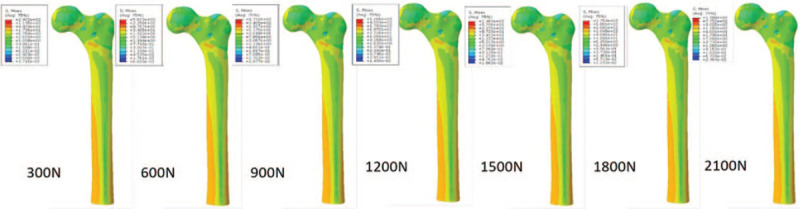
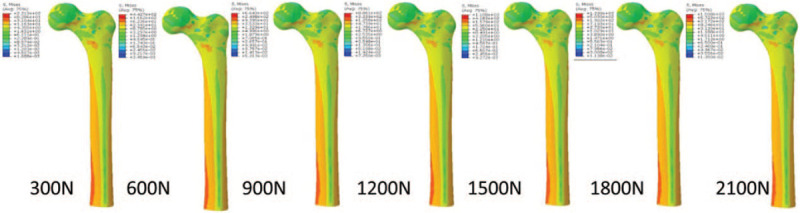
The femoral stress, implant stress and fracture site displacement of MSN-II was less than that of PFNA-II. The results indicated that the maximal femoral stress was 581 MPa for PFNA-II and 443 MPa for the MSN-II. The maximum stress values in the PFNA-II and MSN-II models were 291 and 241 MPa, respectively. The maximal displacements of the fracture site were 1.47 and 1.16 mm in the PFNA-II and MSN-II models, respectively.
Compared with PFNA-II for inter-trochanteric fracture (AO/OTA 31-A3.1), MSN-II which was designed with a triangular stability structure can provide better biomechanical stability. The MSN-II may be a feasible option for the treatment of reverse obliquity inter-trochanteric fracture.
反向斜行转子间骨折是一种独特的骨折类型,其力学特性与大多数转子间骨折不同,对其的最佳治疗方案仍存在争议。本研究旨在通过有限元分析比较一种新型髓内钉(内侧支撑钉[MSN-II])与股骨近端防旋髓内钉(PFNA-II)治疗反向斜行转子间骨折( Arbeitsgemeinschaft fur Osteosynthesfrogen/骨科创伤协会[AO/OTA] 31-A3.1)的疗效差异。
使用建模软件建立MSN-II和PFNA-II的三维模型以及A3.1转子间骨折模型。利用Abaqus软件施加不同的力载荷,比较有限元生物力学参数,如植入物中的最大应力和骨折部位的位移。
MSN-II的股骨应力、植入物应力和骨折部位位移均小于PFNA-II。结果表明,PFNA-II的最大股骨应力为581 MPa,MSN-II为443 MPa。PFNA-II和MSN-II模型中的最大应力值分别为291和241 MPa。PFNA-II和MSN-II模型中骨折部位的最大位移分别为1.47和1.16 mm。
与用于转子间骨折(AO/OTA 31-A3.1)的PFNA-II相比,设计具有三角形稳定结构的MSN-II能提供更好的生物力学稳定性。MSN-II可能是治疗反向斜行转子间骨折的一种可行选择。