Department of Psychology, Hunter College of the City University of New York (CUNY), New York, NY, USA; Health Psychology and Clinical Science Program, The Graduate Center, of the City University of New York, New York, NY, USA.
Department of Psychology, Hunter College of the City University of New York (CUNY), New York, NY, USA.
Drug Alcohol Depend. 2020 Nov 1;216:108260. doi: 10.1016/j.drugalcdep.2020.108260. Epub 2020 Aug 28.
Sexual minority men who use drugs have high sexual HIV transmission risk. Sexual interactions may also increase COVID-19 risk.This study compared marijuana use, other illegal drugs use (i.e. cocaine/crack, methamphetamine, MDMA/ecstasy, GHB, and ketamine) and sexual behavior with casual partners among sexual minority cismen active on social networking and dating applications before and during the COVID-19 epidemic.
This cohort-control study compared 455 adult respondents (surveyed May 6th to 17th, 2020) and a matched sample selected from 65,707 respondents surveyed pre-COVID. Participants were recruited on social networking and dating applications and completed surveys online.
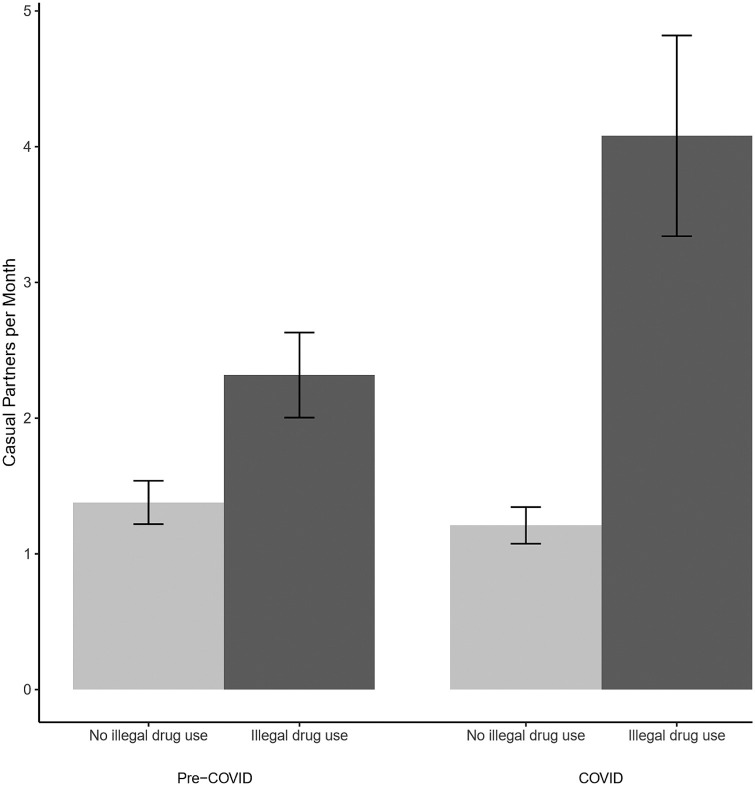
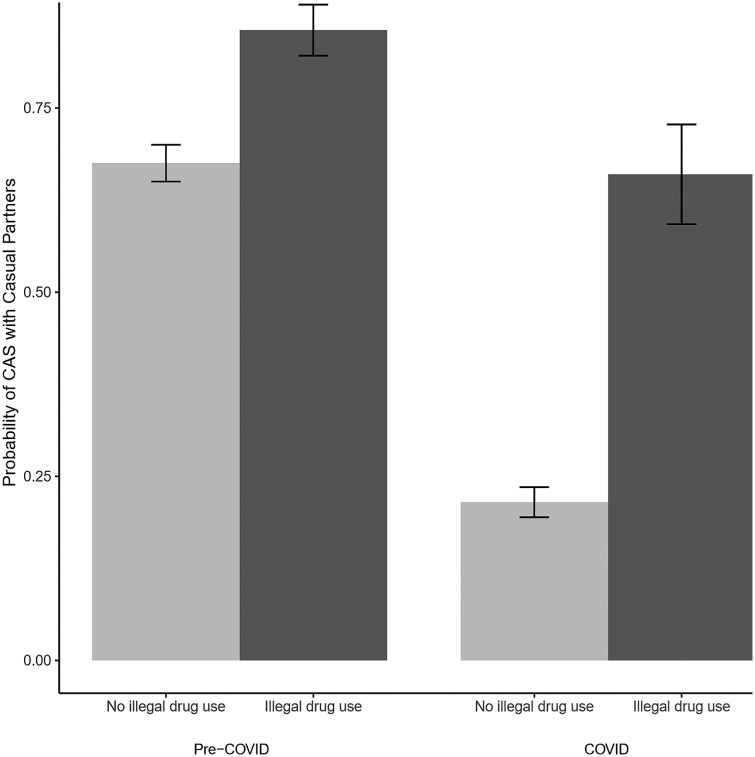
The proportion reporting marijuana use declined significantly in the COVID cohort (34.5 % versus 45.7 % pre-COVID,p < .001) as did their illegal drug use (11.0 % versus 22.9 % pre-COVID, p < .001). While the number of casual partners per month was stable, the proportion reporting condomless anal sex with casual partners declined significantly during COVID (26.4 % versus 71.6 % pre-COVID, p < .001). The effect of illegal drug use (excluding marijuana) on number of casual partners per month (aRR = 1.45 pre-COVID versus 2.84, p < .01) and odds of condomless anal sex (aOR = 2.00 pre-COVID versus 5.22, p = .04) were significantly greater in the COVID cohort.
While the proportion of participants reporting drug use and condomless anal sex with casual partners declined in the COVID cohort, the association between drug use and sexual behavior was magnified. Sexual minority men who use drugs are significantly more likely to engage in sexual behaviors that place them at risk for HIV and COVID-19 transmission.
使用毒品的性少数男性具有较高的性传播 HIV 风险。性接触也可能增加 COVID-19 的风险。本研究比较了性少数男性在社交网络和约会应用程序上活跃时,在 COVID-19 流行之前和期间与偶然伴侣的大麻使用、其他非法药物使用(即可卡因/快克、冰毒、摇头丸/摇头丸、GHB 和氯胺酮)和性行为。
这项队列对照研究比较了 455 名成年受访者(2020 年 5 月 6 日至 17 日调查)和从 COVID 前调查的 65707 名受访者中选择的匹配样本。参与者是在社交网络和约会应用程序上招募的,并在线完成了调查。
在 COVID 队列中,报告大麻使用的比例显著下降(34.5%比 COVID 前的 45.7%,p<0.001),非法药物使用的比例也显著下降(11.0%比 COVID 前的 22.9%,p<0.001)。虽然每月偶然伴侣的数量保持稳定,但报告与偶然伴侣无保护肛交的比例在 COVID 期间显著下降(26.4%比 COVID 前的 71.6%,p<0.001)。非法药物使用(不包括大麻)对每月偶然伴侣数量的影响(ARR=1.45 COVID 前 versus 2.84,p<0.01)和无保护肛交的几率(aOR=2.00 COVID 前 versus 5.22,p=0.04)在 COVID 队列中显著更大。
虽然在 COVID 队列中报告药物使用和与偶然伴侣无保护肛交的参与者比例下降,但药物使用与性行为之间的关联放大了。使用毒品的性少数男性更有可能从事使他们面临 HIV 和 COVID-19 传播风险的性行为。