Cerulli Irelli Emanuele, Orlando Biagio, Cocchi Enrico, Morano Alessandra, Fattapposta Francesco, Di Piero Vittorio, Toni Danilo, Ciardi Maria R, Giallonardo Anna T, Fabbrini Giovanni, Berardelli Alfredo, Di Bonaventura Carlo
Department of Human Neurosciences, Policlinico Umberto I, Sapienza University of Rome, Italy.
Department of Public Health and Pediatrics, University of Turin, Turin, Italy.
J Neurol Sci. 2020 Nov 15;418:117111. doi: 10.1016/j.jns.2020.117111. Epub 2020 Aug 29.
Hospital-acquired infections (HAIs) are frequent complications among acute patients hospitalized in neurological units, especially among those hospitalized for stroke. This study aimed to investigate if enhanced hygienic measures, including the systematic use of personal protective equipment (PPE), determined a decrease in HAI during the recent COVID-19 outbreak in "COVID-free" neurological units.
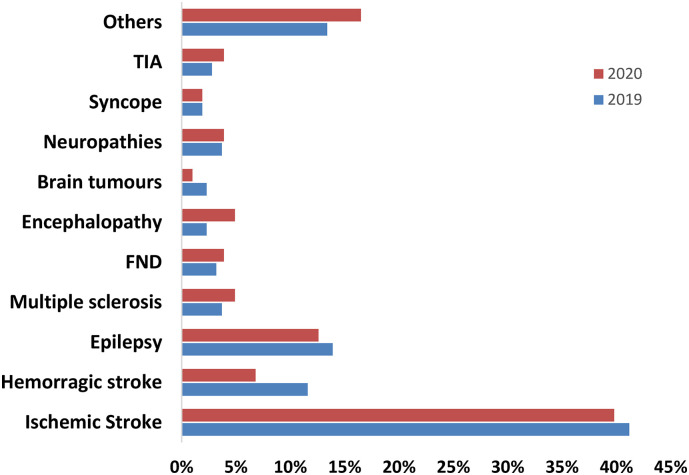
Patients hospitalized in neurology and stroke units of Policlinico Umberto I Hospital in Rome from March 8, 2020 and discharged prior to May 31, 2020 were included in the study and compared with patients hospitalized during the same period in 2019.
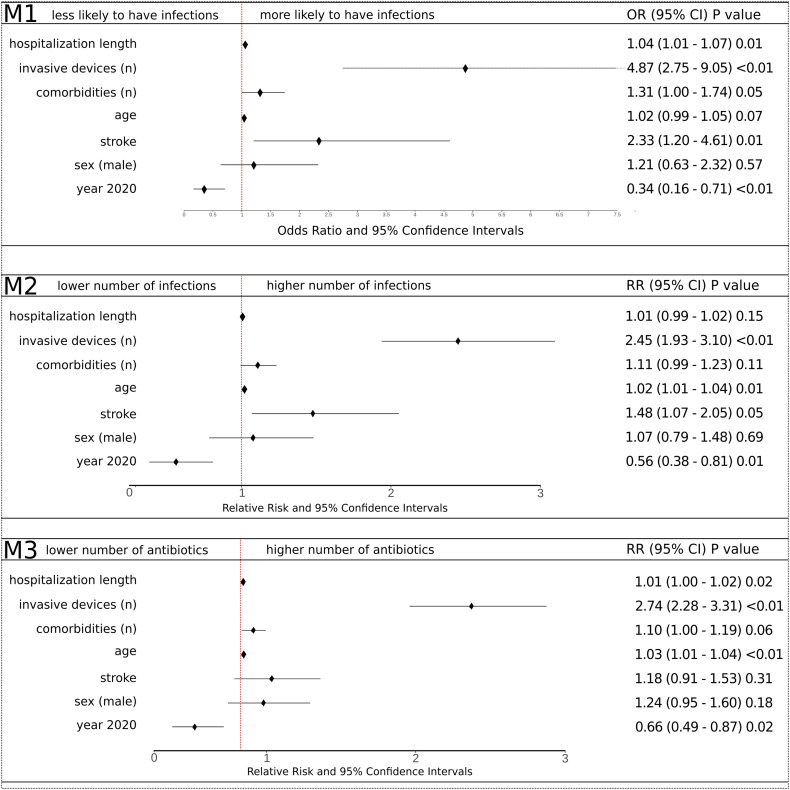
A total of 319 patients were included in the study (n = 103 in 2020, n = 216 in 2019). Among patients hospitalized in 2019, the incidence of HAIs was 31.5% (95% confidence interval (CI): 0.25-0.38), compared with 23.3% (95% CI: 0.15-0.32) in 2020 (p = 0.12). Multivariable logistic regression showed that hospitalization during 2020 was independently associated with a lower risk of HAIs (odds ratio: 0.34, 95% CI:0.16-0.71, p = 0.004). Poisson regression models showed that hospitalization during 2020 was also independently associated with both a lower number of HAIs (relative risk [RR]: 0.56, 95% CI:0.38-0.81, p = 0.01) and a lower number of prescribed antibiotics per patient (RR: 0.66, 95% CI: 0.49-0.87, p = 0.02).
Our study design provides evidence regarding the impact of stricter hygienic measures, such as increased PPE use, on HAIs. Larger studies are needed to support the extension of preventive measures even after the COVID-19 outbreak in order to limit the occurrence of HAIs.
医院获得性感染(HAIs)是神经内科住院急性患者常见的并发症,尤其是中风住院患者。本研究旨在调查在“无新冠”神经内科病房近期新冠疫情期间,包括系统使用个人防护装备(PPE)在内的强化卫生措施是否能降低医院获得性感染。
纳入2020年3月8日至2020年5月31日在罗马翁贝托一世综合医院神经内科和中风病房住院并出院的患者,并与2019年同期住院的患者进行比较。
本研究共纳入319例患者(2020年n = 103例,2019年n = 216例)。2019年住院患者的医院获得性感染发生率为31.5%(95%置信区间(CI):0.25 - 0.38),2020年为23.3%(95% CI:0.15 - 0.32)(p = 0.12)。多变量逻辑回归显示,2020年住院与医院获得性感染风险较低独立相关(比值比:0.34,95% CI:0.16 - 0.71,p = 0.004)。泊松回归模型显示,2020年住院也与医院获得性感染数量较少(相对风险[RR]:0.56,95% CI:0.38 - 0.81,p = 0.01)以及每位患者使用的抗生素处方数量较少独立相关(RR:0.66,95% CI:0.49 - 0.87,p = 0.02)。
我们的研究设计为更严格的卫生措施(如增加个人防护装备的使用)对医院获得性感染的影响提供了证据。需要开展更大规模的研究来支持即使在新冠疫情爆发后仍扩大预防措施,以限制医院获得性感染的发生。