Department of Periocdontology, Faculty of Odontology, University of Malmö, Malmö, Sweden.
Division of Oral Surgery, University Clinic of Dentistry, Medical University of Vienna, Vienna, Austria.
Clin Oral Investig. 2021 Apr;25(4):2203-2211. doi: 10.1007/s00784-020-03534-8. Epub 2020 Sep 7.
To assess whether the impact of implantoplasty (IP) on the maximum implant failure strength depends on implant type/design, diameter, or material.
Fourteen implants each of different type/design [bone (BL) and tissue level (TL)], diameter [narrow (3.3 mm) and regular (4.1 mm)], and material [titanium grade IV (Ti) and titanium-zirconium alloy (TiZr)] of one company were used. Half of the implants were subjected to IP in a computerized torn. All implants were subjected to dynamic loading prior to loading until failure to simulate regular mastication. Multiple linear regression analyses were performed with maximum implant failure strength as dependent variable and IP, implant type/design, diameter, and material as predictors.
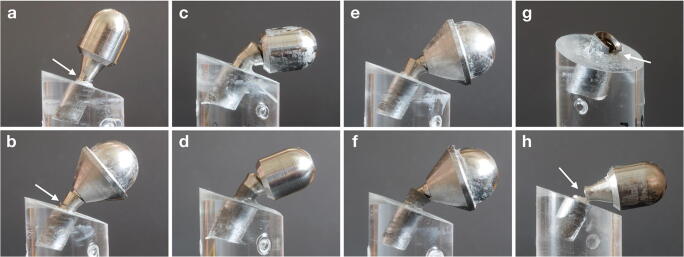
Implants subjected to IP and TL implants showed statistically significant reduced implant failure strength irrespective of the diameter compared with implants without IP and BL implants, respectively. Implant material had a significant impact for TL implants and for regular diameter implants, with TiZr being stronger than Ti. During dynamic loading, 1 narrow Ti TL implant without IP, 4 narrow Ti TL implants subjected to IP, and 1 narrow TiZr TL implant subjected to IP were fractured.
IP significantly reduced the maximum implant failure strength, irrespective implant type/design, diameter, or material, but the maximum implant failure strength of regular diameter implants and of narrow BL implants remained high.
IP seems to have no clinically relevant impact on the majority of cases, except from those of single narrow Ti TL implants, which may have an increased risk for mechanical complications. This should be considered for peri-implantitis treatment planning (e.g., communication of potential complications to the patient), but also in the planning of implant installation (e.g., choosing TiZr instead of Ti for narrow implants).
评估种植体表面处理(IP)对最大种植体失败强度的影响是否取决于种植体类型/设计、直径或材料。
使用同一公司的 14 种不同类型/设计[骨(BL)和组织水平(TL)]、直径[窄(3.3mm)和常规(4.1mm)]和材料[四级钛(Ti)和钛锆合金(TiZr)]的每种各 14 个种植体。一半的种植体在计算机化撕裂中进行 IP。所有种植体在加载前均进行动态加载直至失效,以模拟常规咀嚼。使用最大种植体失败强度作为因变量,IP、种植体类型/设计、直径和材料作为预测因子,进行多元线性回归分析。
与未进行 IP 和 BL 种植体相比,进行 IP 和 TL 种植体的种植体失败强度明显降低,无论直径如何。种植体材料对 TL 种植体和常规直径种植体有显著影响,TiZr 比 Ti 更强。在动态加载过程中,1 个未进行 IP 的窄 Ti TL 种植体、4 个进行 IP 的窄 Ti TL 种植体和 1 个进行 IP 的窄 TiZr TL 种植体发生了断裂。
IP 显著降低了最大种植体失败强度,与种植体类型/设计、直径或材料无关,但常规直径种植体和窄 BL 种植体的最大种植体失败强度仍然很高。
除了单个窄 Ti TL 种植体可能有更高的机械并发症风险外,IP 似乎对大多数病例没有临床相关影响。这应该在进行种植体周围炎治疗计划时(例如,向患者沟通潜在并发症)考虑,也应该在种植体安装计划中考虑(例如,对于窄种植体选择 TiZr 而不是 Ti)。