Department of Molecular Biosciences, University of Texas at Austin, Austin, TX, USA.
Institute for Cellular and Molecular Biology, University of Texas at Austin, Austin, TX, USA.
Nat Biotechnol. 2021 Jan;39(1):84-93. doi: 10.1038/s41587-020-0646-5. Epub 2020 Sep 7.
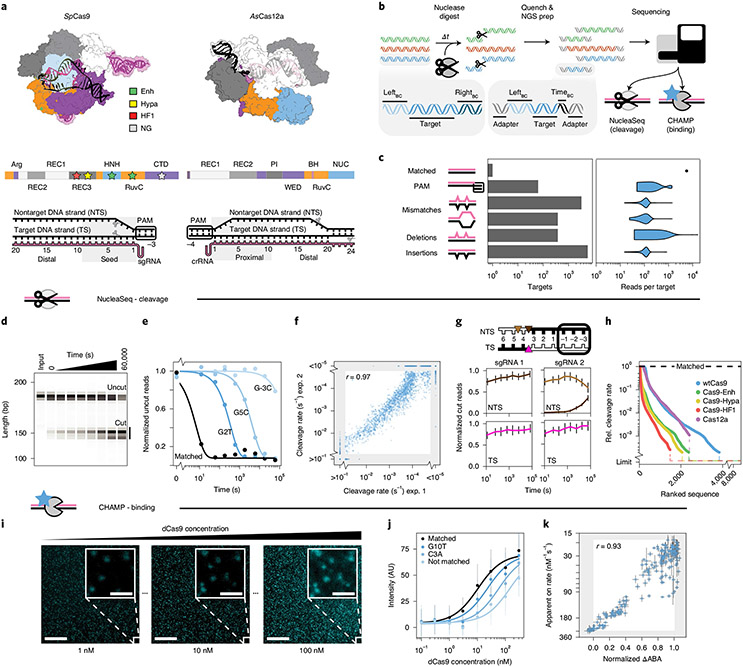
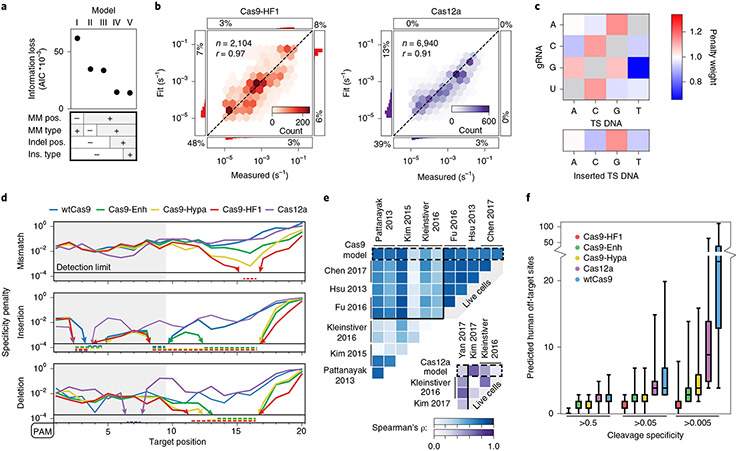
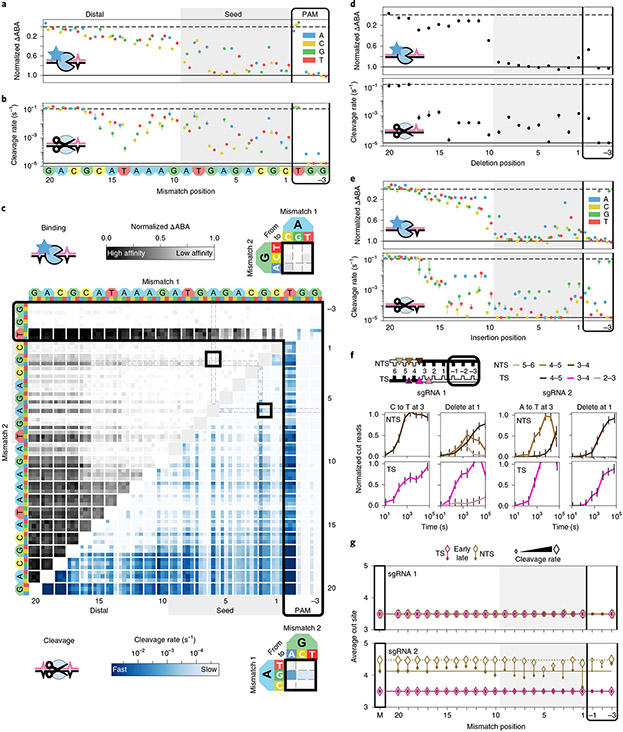
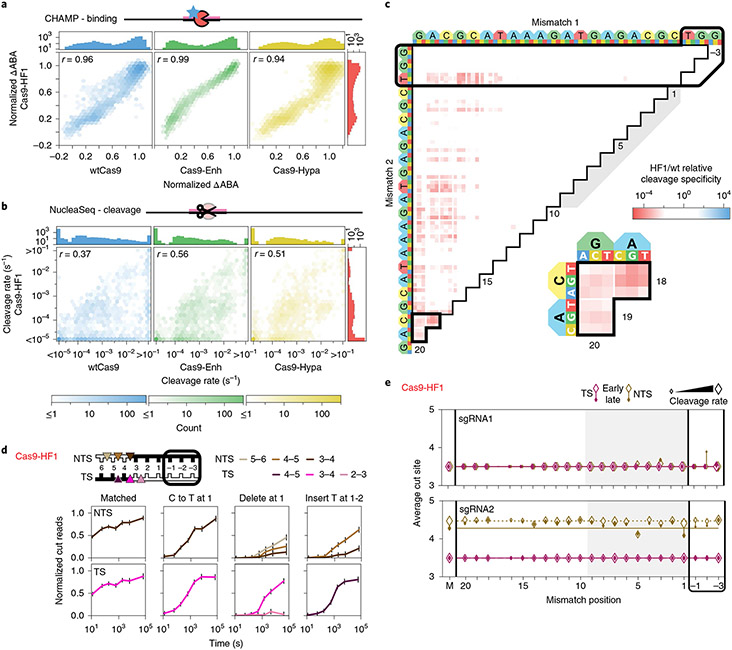
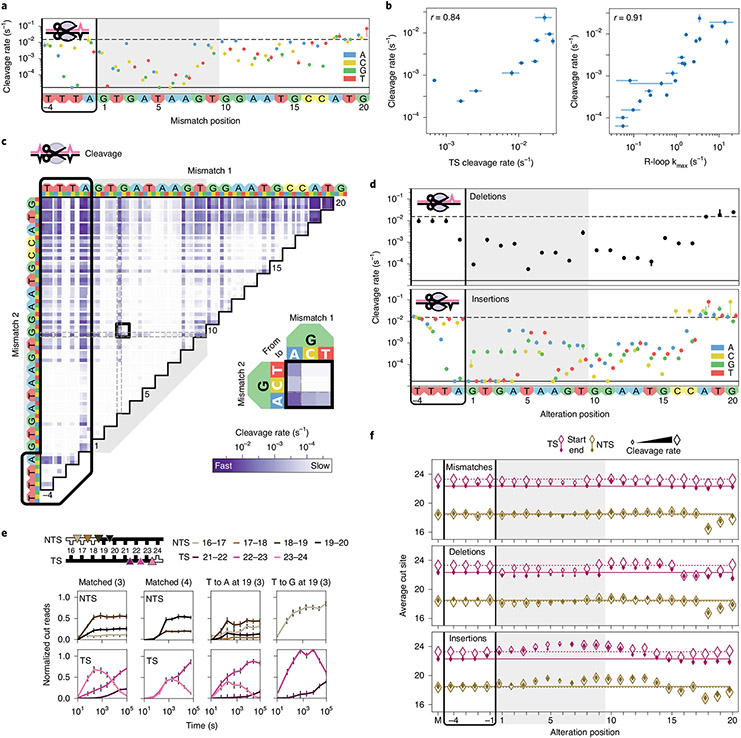
Engineered SpCas9s and AsCas12a cleave fewer off-target genomic sites than wild-type (wt) Cas9. However, understanding their fidelity, mechanisms and cleavage outcomes requires systematic profiling across mispaired target DNAs. Here we describe NucleaSeq-nuclease digestion and deep sequencing-a massively parallel platform that measures the cleavage kinetics and time-resolved cleavage products for over 10,000 targets containing mismatches, insertions and deletions relative to the guide RNA. Combining cleavage rates and binding specificities on the same target libraries, we benchmarked five SpCas9 variants and AsCas12a. A biophysical model built from these data sets revealed mechanistic insights into off-target cleavage. Engineered Cas9s, especially Cas9-HF1, dramatically increased cleavage specificity but not binding specificity compared to wtCas9. Surprisingly, AsCas12a cleavage specificity differed little from that of wtCas9. Initial DNA cleavage sites and end trimming varied by nuclease, guide RNA and the positions of mispaired nucleotides. More broadly, NucleaSeq enables rapid, quantitative and systematic comparisons of specificity and cleavage outcomes across engineered and natural nucleases.
工程化的 SpCas9s 和 AsCas12a 比野生型(wt)Cas9 对靶基因的脱靶切割更少。然而,要理解它们的保真度、机制和切割结果,需要在错配靶 DNA 上进行系统的分析。在这里,我们描述了 NucleaSeq-核酸酶消化和深度测序平台,该平台可大规模平行测量超过 10000 个相对于向导 RNA 存在错配、插入和缺失的靶基因的切割动力学和时分辨割产物。通过对同一靶基因文库中的切割速率和结合特异性进行组合,我们对 5 种 SpCas9 变体和 AsCas12a 进行了基准测试。从这些数据集构建的生物物理模型揭示了对非靶切割的机制见解。与 wtCas9 相比,工程化的 Cas9,特别是 Cas9-HF1,极大地提高了切割特异性,但结合特异性没有提高。令人惊讶的是,AsCas12a 的切割特异性与 wtCas9 差异不大。初始 DNA 切割位点和末端修剪因核酸酶、向导 RNA 和错配核苷酸的位置而异。更广泛地说,NucleaSeq 能够快速、定量和系统地比较工程化和天然核酸酶的特异性和切割结果。