Oncopathology Research Center, Iran University of Medical Sciences, Tehran, Iran.
Oncopathology Research Center, Iran University of Medical Sciences, Tehran, Iran; Department of Molecular Medicine, Faculty of Advanced Technologies in Medicine, Iran University of Medical Sciences, Tehran, Iran.
Int Immunopharmacol. 2020 Nov;88:106942. doi: 10.1016/j.intimp.2020.106942. Epub 2020 Aug 29.
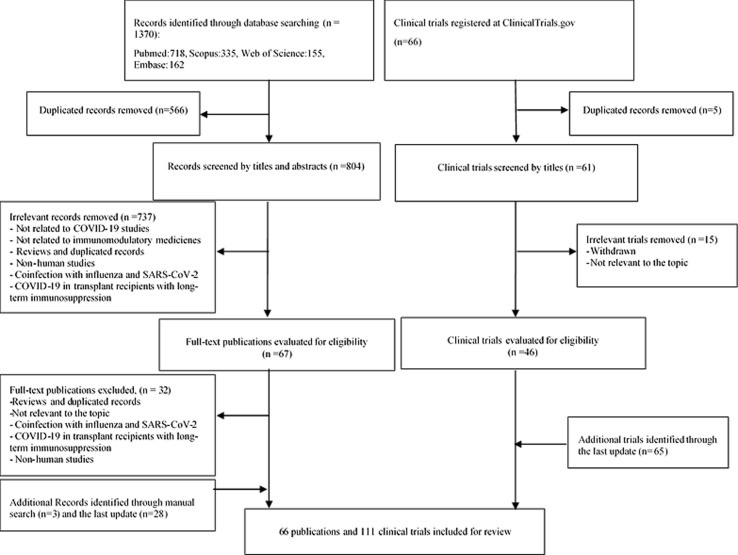
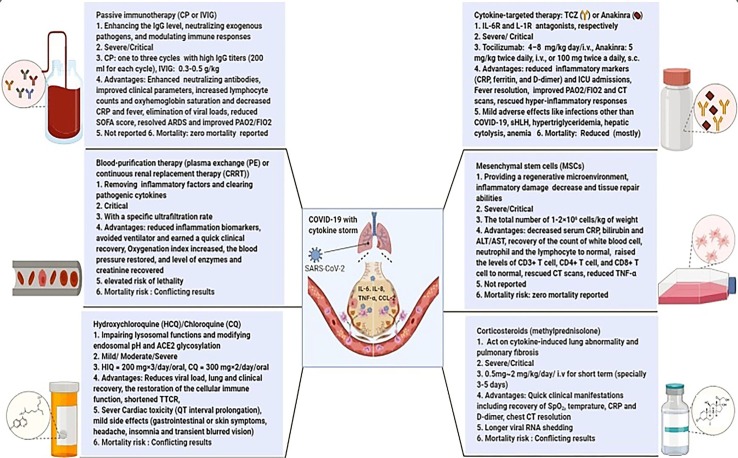
The global panic of the novel coronavirus disease 2019 (COVID-19) triggered by the severe acute respiratory syndrome coronavirus 2 (SARS-CoV-2) has led to an urgent requirement for effective therapy. COVID-19 infection, especially in severely ill patients, is likely to be associated with immune dysregulation, prompting the development of novel treatment approaches. Therefore, this systematic review was designed to assess the available data regarding the efficacy of the immunomodulatory drugs used to manage COVID-19. A systematic literature search was carried out up to May 27, 2020, in four databases (PubMed, Scopus, Web of Science, and Embase) and also Clinicaltrials.gov. Sixty-six publications and 111 clinical trials were recognized as eligible, reporting the efficacy of the immunomodulatory agents, including corticosteroids, hydroxychloroquine, passive and cytokine-targeted therapies, mesenchymal stem cells, and blood-purification therapy, in COVID-19 patients. The data were found to be heterogeneous, and the clinical trials were yet to post any findings. Medicines were found to regulate the immune system by boosting the innate responses or suppressing the inflammatory reactions. Passive and cytokine-targeted therapies and mesenchymal stem cells were mostly safe and could regulate the disease much better. These studies underscored the significance of severity profiling in COVID-19 patients, along with appropriate timing, duration, and dosage of the therapies. Therefore, this review indicates that immunomodulatory therapies are potentially effective for COVID-19 and provides comprehensive information for clinicians to fight this outbreak. However, there is no consensus on the optimal therapy for COVID-19, reflecting that the immunomodulatory therapies still warrant further investigations.
由严重急性呼吸综合征冠状病毒 2(SARS-CoV-2)引发的 2019 年新型冠状病毒病(COVID-19)的全球恐慌,导致对有效治疗方法的迫切需求。COVID-19 感染,尤其是在重症患者中,可能与免疫失调有关,促使开发新的治疗方法。因此,本系统评价旨在评估用于治疗 COVID-19 的免疫调节剂的疗效的现有数据。系统文献检索截至 2020 年 5 月 27 日,在四个数据库(PubMed、Scopus、Web of Science 和 Embase)和 Clinicaltrials.gov 中进行。认可了 66 项出版物和 111 项临床试验,报告了免疫调节剂,包括皮质类固醇、羟氯喹、被动和细胞因子靶向治疗、间充质干细胞和血液净化疗法,在 COVID-19 患者中的疗效。发现数据具有异质性,临床试验尚未得出任何发现。药物被发现通过增强先天反应或抑制炎症反应来调节免疫系统。被动和细胞因子靶向治疗和间充质干细胞大多是安全的,可以更好地调节疾病。这些研究强调了在 COVID-19 患者中进行严重程度分析的重要性,以及治疗的适当时机、持续时间和剂量。因此,本综述表明免疫调节剂治疗 COVID-19 具有潜在疗效,并为临床医生提供了抗击这一疫情的全面信息。然而,对于 COVID-19 的最佳治疗方法尚无共识,这反映出免疫调节剂仍需要进一步研究。