Achour Bilel, Attia Ghada, Zerrouki Chouki, Fourati Najla, Raoof Kosai, Yaakoubi Nourdin
LAUM, UMR CNRS 6613, Le Mans Université, Avenue Olivier Messiaen, CEDEX 9, 72085 Le Mans, France.
Cnam, SATIE, UMR CNRS 8029, 292 Rue Saint Martin, 75003 Paris, France.
Sensors (Basel). 2020 Sep 3;20(17):4994. doi: 10.3390/s20174994.
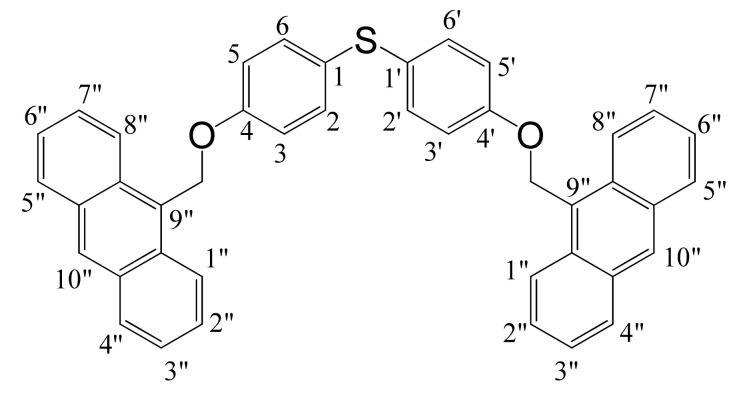
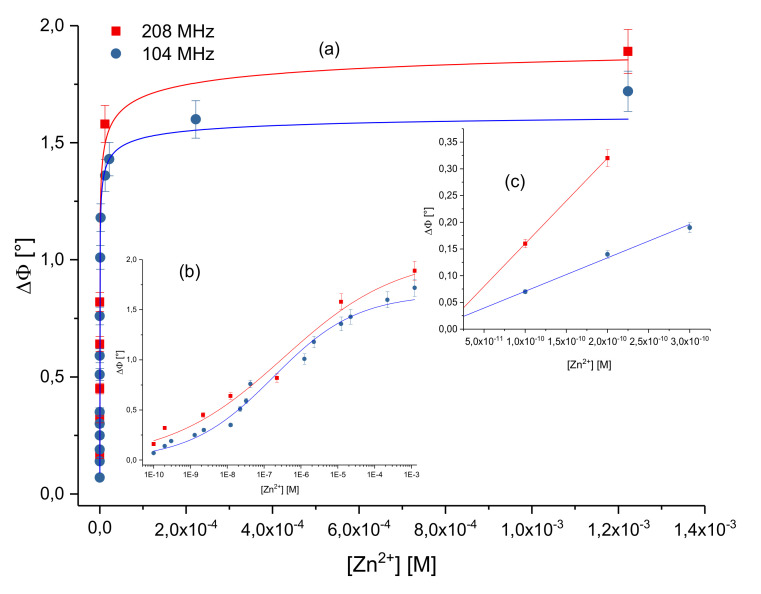
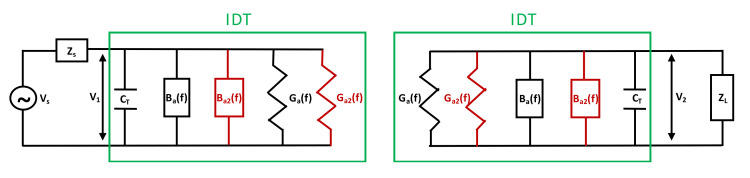
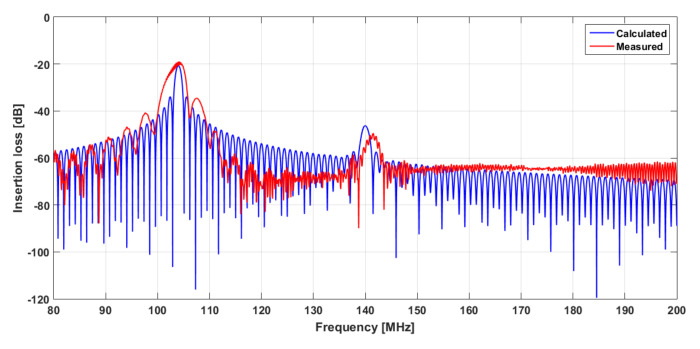
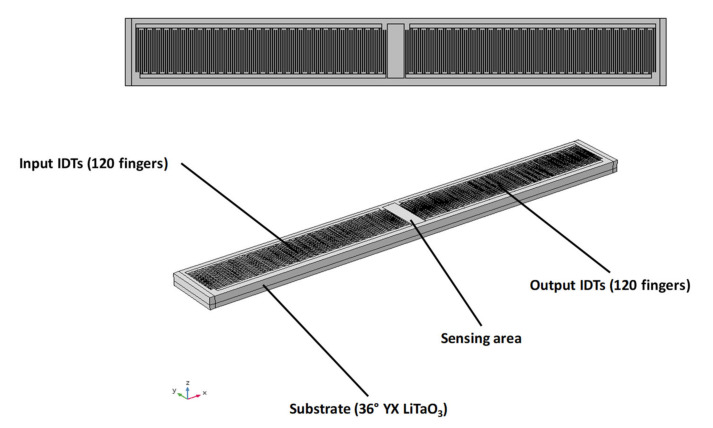
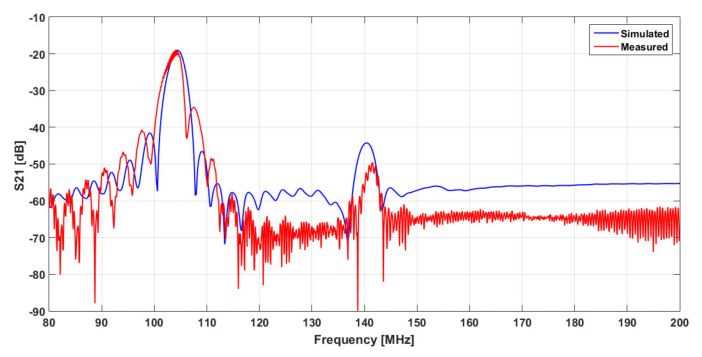
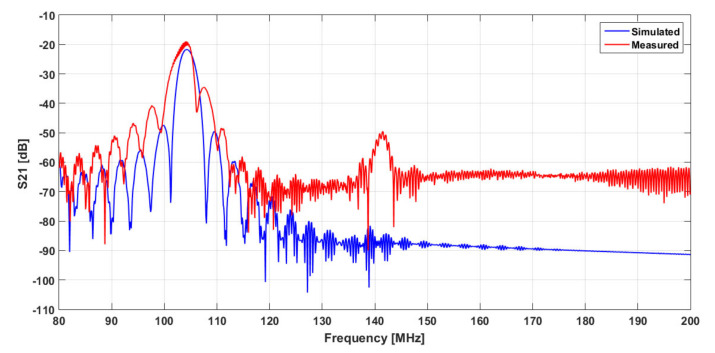
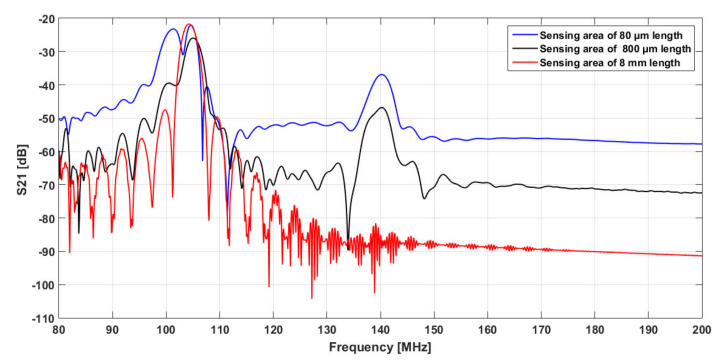
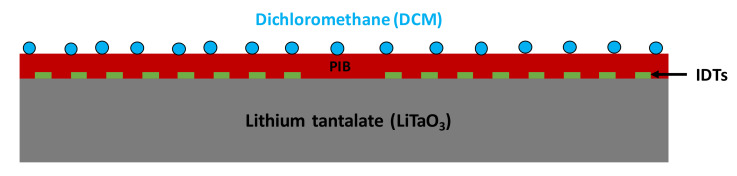
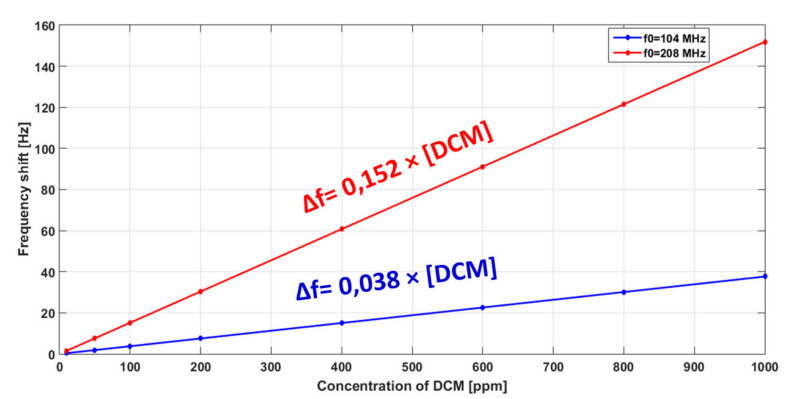
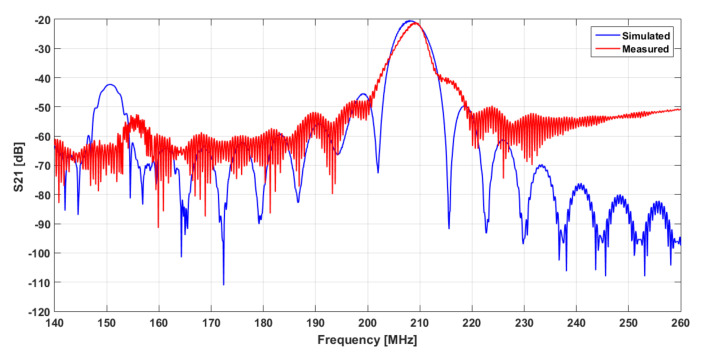
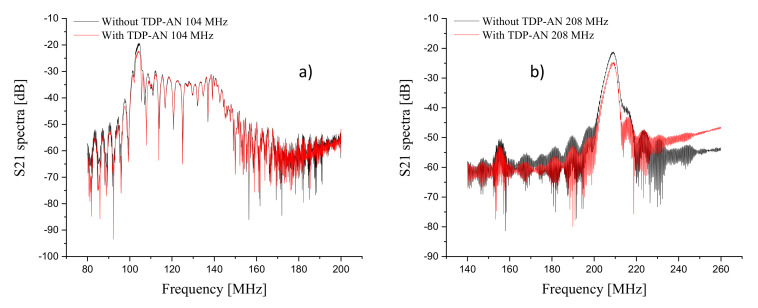
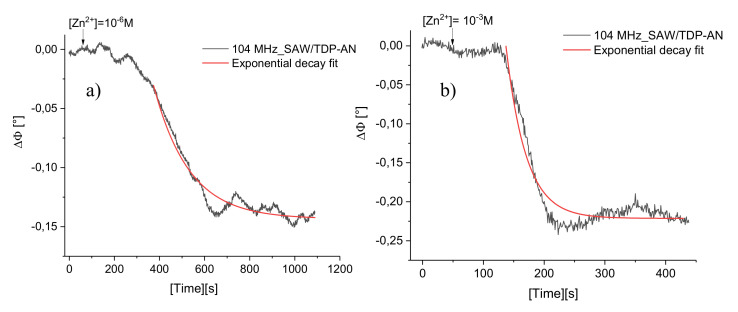
Sensitivity is one of the most important parameters to put in the foreground in all sensing applications. Its increase is therefore an ongoing challenge, particularly for surface acoustic wave (SAW) sensors. Herein, finite element method (FEM) simulation using COMSOL Multiphysics software is first used to simulate the physical and electrical properties of SAW delay line. Results indicate that 2D configuration permits to accurately obtain all pertinent parameters, as in 3D simulation, with very substantial time saving. A good agreement between calculation and experiment, in terms of transfer functions (S21 spectra), was also shown to evaluate the dependence of the SAW sensors sensitivity on the operating frequency; 2D simulations have been conducted on 104 MHz and 208 MHz delay lines, coated with a polyisobutylene (PIB) as sensitive layer to dichloromethane (DCM). A fourfold increase in sensitivity was obtained by doubling frequency. Both sensors were then realized and tested as chem-sensors to detect zinc ions in liquid media. 9-{[4-({[4-(9anthrylmethoxy)phenyl]sulfanyl} methyl)]methyl] anthracene (TDP-AN) was selected as the sensing layer. Results show a comparable response curves for both designed sensors, in terms of limit of detection and dissociation constants K values. On the other hand, experimental sensitivity values were of the order of [7.0 ± 2.8] × 10 [°/M] and [16.0 ± 7.6] × 10 [°/M] for 104 MHz and 208 MHz sensors, respectively, confirming that the sensitivity increases with frequency.
灵敏度是所有传感应用中需要重点关注的最重要参数之一。因此,提高灵敏度是一项持续面临的挑战,尤其是对于表面声波(SAW)传感器而言。在此,首先使用COMSOL Multiphysics软件进行有限元方法(FEM)模拟,以模拟SAW延迟线的物理和电学特性。结果表明,二维配置能够像三维模拟一样准确地获取所有相关参数,同时大幅节省时间。在传递函数(S21频谱)方面,计算结果与实验结果也显示出良好的一致性,从而评估了SAW传感器灵敏度对工作频率的依赖性;已对涂有聚异丁烯(PIB)作为二氯甲烷(DCM)敏感层的104 MHz和208 MHz延迟线进行了二维模拟。通过将频率翻倍,灵敏度提高了四倍。然后将这两种传感器制作成化学传感器,用于检测液体介质中的锌离子。选择9-{[4-({[4-(9-蒽基甲氧基)苯基]硫烷基}甲基)]甲基]蒽(TDP-AN)作为传感层。结果表明,就检测限和解离常数K值而言,两种设计的传感器具有可比的响应曲线。另一方面,104 MHz和208 MHz传感器的实验灵敏度值分别约为[7.0±2.8]×10[°/M]和[16.0±7.6]×10[°/M],证实了灵敏度随频率增加。