• 文献检索
  • 文档翻译
  • 深度研究
  • 学术资讯
  • Suppr Zotero 插件Zotero 插件
  • 邀请有礼
  • 套餐&价格
  • 历史记录
应用&插件
Suppr Zotero 插件Zotero 插件浏览器插件Mac 客户端Windows 客户端微信小程序
定价
高级版会员购买积分包购买API积分包
服务
文献检索文档翻译深度研究API 文档MCP 服务
关于我们
关于 Suppr公司介绍联系我们用户协议隐私条款
关注我们

Suppr 超能文献

核心技术专利:CN118964589B侵权必究
粤ICP备2023148730 号-1Suppr @ 2026

文献检索

告别复杂PubMed语法,用中文像聊天一样搜索,搜遍4000万医学文献。AI智能推荐,让科研检索更轻松。

立即免费搜索

文件翻译

保留排版,准确专业,支持PDF/Word/PPT等文件格式,支持 12+语言互译。

免费翻译文档

深度研究

AI帮你快速写综述,25分钟生成高质量综述,智能提取关键信息,辅助科研写作。

立即免费体验

一种雷达微多普勒能谱图恢复的深度学习方法。

A Deep-Learning Method for Radar Micro-Doppler Spectrogram Restoration.

机构信息

Key Laboratory of Trustworthy Distributed Computing and Service (BUPT), Beijing University of Posts and Telecommunications, Beijing 100876, China.

Faculty of Electrical Engineering, Mathematics and Computer Science (EEMCS), Delft University of Technology, 2628CD Delft, The Netherlands.

出版信息

Sensors (Basel). 2020 Sep 3;20(17):5007. doi: 10.3390/s20175007.

DOI:10.3390/s20175007
PMID:32899348
原文链接:https://pmc.ncbi.nlm.nih.gov/articles/PMC7506618/
Abstract

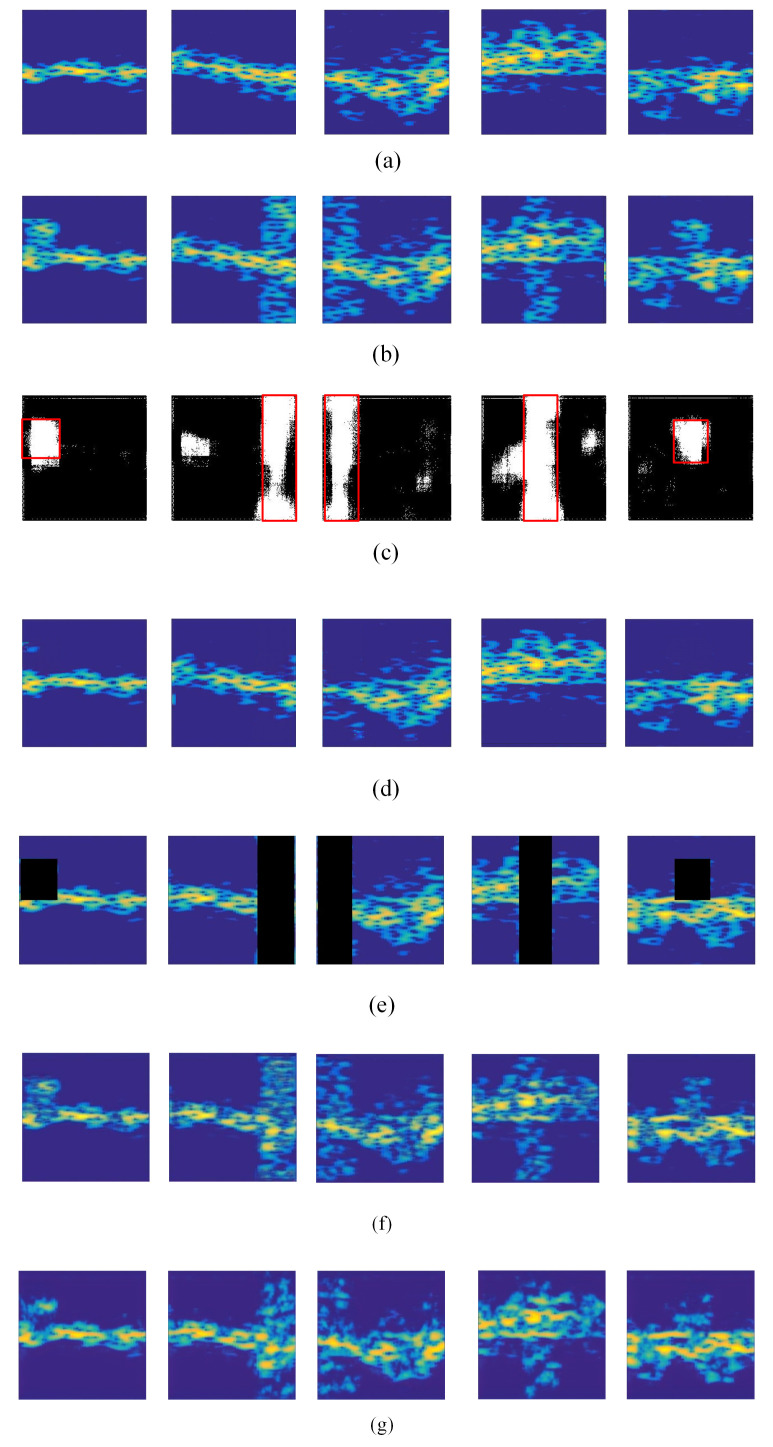
Radio frequency interference, which makes it difficult to produce high-quality radar spectrograms, is a major issue for micro-Doppler-based human activity recognition (HAR). In this paper, we propose a deep-learning-based method to detect and cut out the interference in spectrograms. Then, we restore the spectrograms in the cut-out region. First, a fully convolutional neural network (FCN) is employed to detect and remove the interference. Then, a coarse-to-fine generative adversarial network (GAN) is proposed to restore the part of the spectrogram that is affected by the interferences. The simulated motion capture (MOCAP) spectrograms and the measured radar spectrograms with interference are used to verify the proposed method. Experimental results from both qualitative and quantitative perspectives show that the proposed method can mitigate the interference and restore high-quality radar spectrograms. Furthermore, the comparison experiments also demonstrate the efficiency of the proposed approach.

摘要

射频干扰使得难以产生高质量的雷达频谱图,这是基于微多普勒的人体活动识别(HAR)的一个主要问题。在本文中,我们提出了一种基于深度学习的方法来检测和切除频谱图中的干扰。然后,我们恢复切除区域的频谱图。首先,我们使用全卷积神经网络(FCN)来检测和去除干扰。然后,我们提出了一种从粗到精的生成对抗网络(GAN)来恢复受干扰影响的频谱图部分。我们使用模拟运动捕捉(MOCAP)频谱图和带有干扰的实测雷达频谱图来验证所提出的方法。从定性和定量两个方面的实验结果表明,所提出的方法可以减轻干扰并恢复高质量的雷达频谱图。此外,对比实验也证明了所提出方法的有效性。

https://cdn.ncbi.nlm.nih.gov/pmc/blobs/e36e/7506618/c7e1fa35b4b9/sensors-20-05007-g006.jpg
https://cdn.ncbi.nlm.nih.gov/pmc/blobs/e36e/7506618/abb8cce9df4e/sensors-20-05007-g001.jpg
https://cdn.ncbi.nlm.nih.gov/pmc/blobs/e36e/7506618/53ab6fbdebfc/sensors-20-05007-g002.jpg
https://cdn.ncbi.nlm.nih.gov/pmc/blobs/e36e/7506618/155f53f03692/sensors-20-05007-g003.jpg
https://cdn.ncbi.nlm.nih.gov/pmc/blobs/e36e/7506618/a337937006fb/sensors-20-05007-g004.jpg
https://cdn.ncbi.nlm.nih.gov/pmc/blobs/e36e/7506618/a247b4eec02e/sensors-20-05007-g005.jpg
https://cdn.ncbi.nlm.nih.gov/pmc/blobs/e36e/7506618/c7e1fa35b4b9/sensors-20-05007-g006.jpg
https://cdn.ncbi.nlm.nih.gov/pmc/blobs/e36e/7506618/abb8cce9df4e/sensors-20-05007-g001.jpg
https://cdn.ncbi.nlm.nih.gov/pmc/blobs/e36e/7506618/53ab6fbdebfc/sensors-20-05007-g002.jpg
https://cdn.ncbi.nlm.nih.gov/pmc/blobs/e36e/7506618/155f53f03692/sensors-20-05007-g003.jpg
https://cdn.ncbi.nlm.nih.gov/pmc/blobs/e36e/7506618/a337937006fb/sensors-20-05007-g004.jpg
https://cdn.ncbi.nlm.nih.gov/pmc/blobs/e36e/7506618/a247b4eec02e/sensors-20-05007-g005.jpg
https://cdn.ncbi.nlm.nih.gov/pmc/blobs/e36e/7506618/c7e1fa35b4b9/sensors-20-05007-g006.jpg

相似文献

1
A Deep-Learning Method for Radar Micro-Doppler Spectrogram Restoration.一种雷达微多普勒能谱图恢复的深度学习方法。
Sensors (Basel). 2020 Sep 3;20(17):5007. doi: 10.3390/s20175007.
2
Generation of Human Micro-Doppler Signature Based on Layer-Reduced Deep Convolutional Generative Adversarial Network.基于层约简深度卷积生成对抗网络的人体微多普勒特征生成
Comput Intell Neurosci. 2022 Apr 12;2022:7365544. doi: 10.1155/2022/7365544. eCollection 2022.
3
Classification of Space Objects by Using Deep Learning with Micro-Doppler Signature Images.利用带有微多普勒特征图像的深度学习对空间物体进行分类
Sensors (Basel). 2021 Jun 25;21(13):4365. doi: 10.3390/s21134365.
4
Radar-Spectrogram-Based UAV Classification Using Convolutional Neural Networks.基于雷达-声谱图的卷积神经网络无人机分类。
Sensors (Basel). 2020 Dec 31;21(1):210. doi: 10.3390/s21010210.
5
Augmentation of Doppler Radar Data Using Generative Adversarial Network for Human Motion Analysis.使用生成对抗网络增强多普勒雷达数据用于人体运动分析
Healthc Inform Res. 2019 Oct;25(4):344-349. doi: 10.4258/hir.2019.25.4.344. Epub 2019 Oct 31.
6
Comparative Analysis of Audio Processing Techniques on Doppler Radar Signature of Human Walking Motion Using CNN Models.基于卷积神经网络模型的人类行走运动多普勒雷达信号音频处理技术的比较分析。
Sensors (Basel). 2023 Oct 26;23(21):8743. doi: 10.3390/s23218743.
7
FMCW Radar Human Action Recognition Based on Asymmetric Convolutional Residual Blocks.基于非对称卷积残差块的 FMCW 雷达人体动作识别。
Sensors (Basel). 2024 Jul 15;24(14):4570. doi: 10.3390/s24144570.
8
Radar Human Activity Recognition with an Attention-Based Deep Learning Network.基于注意力深度学习网络的雷达人体活动识别。
Sensors (Basel). 2023 Mar 16;23(6):3185. doi: 10.3390/s23063185.
9
AI Radar Sensor: Creating Radar Depth Sounder Images Based on Generative Adversarial Network.人工智能雷达传感器:基于生成对抗网络的雷达深度探测图像生成。
Sensors (Basel). 2019 Dec 12;19(24):5479. doi: 10.3390/s19245479.
10
Space Target Classification Improvement by Generating Micro-Doppler Signatures Considering Incident Angle.考虑入射角的微多普勒特征生成对空间目标分类的改进
Sensors (Basel). 2022 Feb 20;22(4):1653. doi: 10.3390/s22041653.

引用本文的文献

1
Computationally Efficient Implementation of Joint Detection and Parameters Estimation of Signals with Dispersive Distortions on a GPU.基于 GPU 的具有色散失真信号的联合检测和参数估计的计算高效实现。
Sensors (Basel). 2022 Apr 19;22(9):3105. doi: 10.3390/s22093105.

本文引用的文献

1
An application of cascaded 3D fully convolutional networks for medical image segmentation.级联三维全卷积网络在医学图像分割中的应用。
Comput Med Imaging Graph. 2018 Jun;66:90-99. doi: 10.1016/j.compmedimag.2018.03.001. Epub 2018 Mar 16.
2
Deep learning of the sectional appearances of 3D CT images for anatomical structure segmentation based on an FCN voting method.基于 FCN 投票方法的三维 CT 图像节段外观的深度学习用于解剖结构分割。
Med Phys. 2017 Oct;44(10):5221-5233. doi: 10.1002/mp.12480. Epub 2017 Aug 31.