Department of Physiology & Biophysics, Rush University, Chicago IL.
Institut für Physiologie und Pathophysiologie, Paracelsus Medizinische Privatuniversität, Nürnberg, Germany.
J Gen Physiol. 2020 Oct 5;152(10). doi: 10.1085/jgp.202012664.
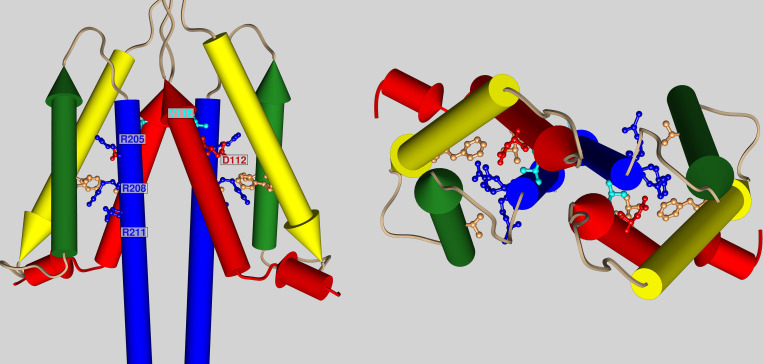
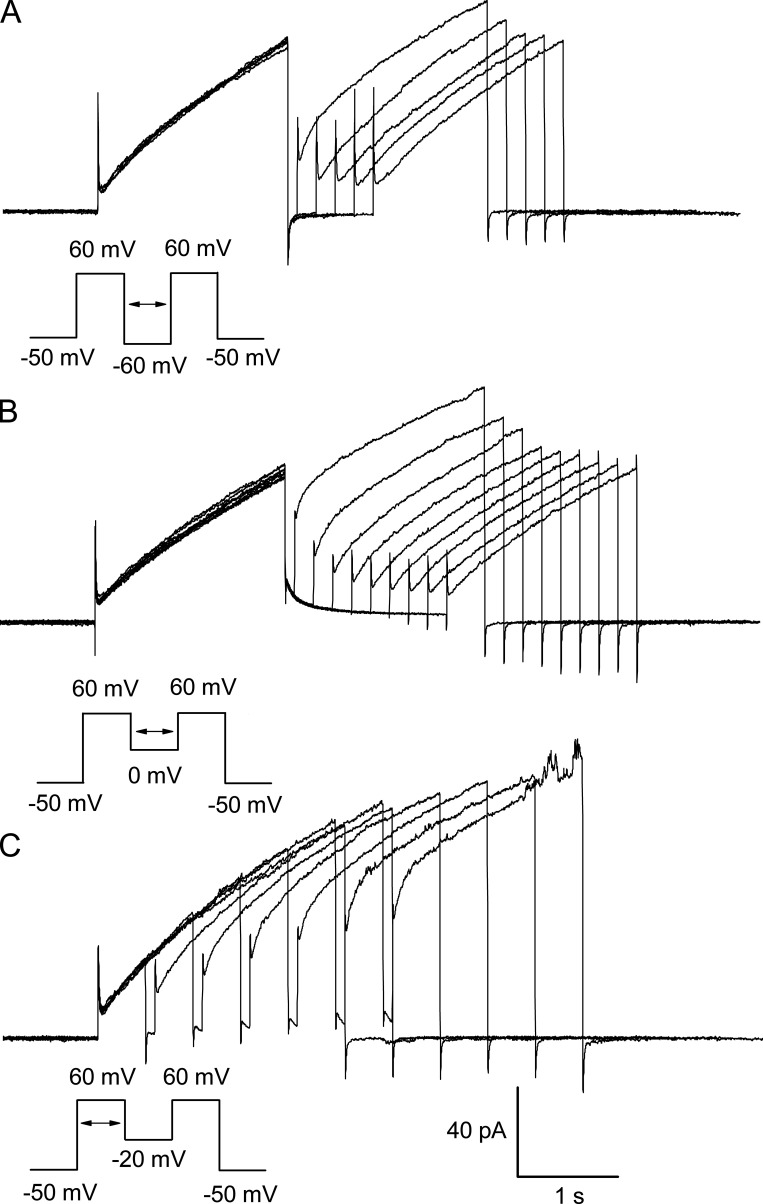
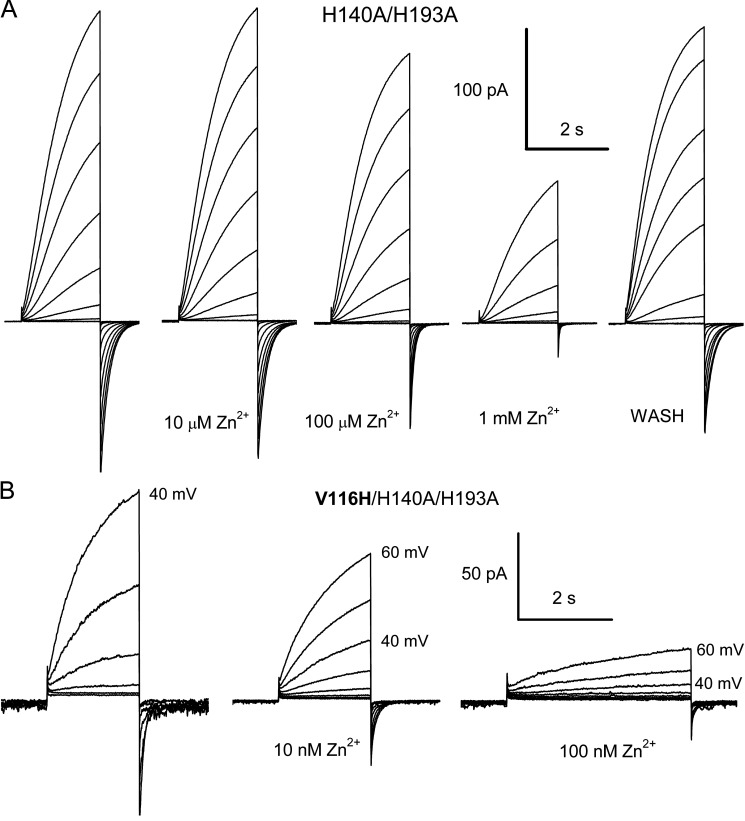
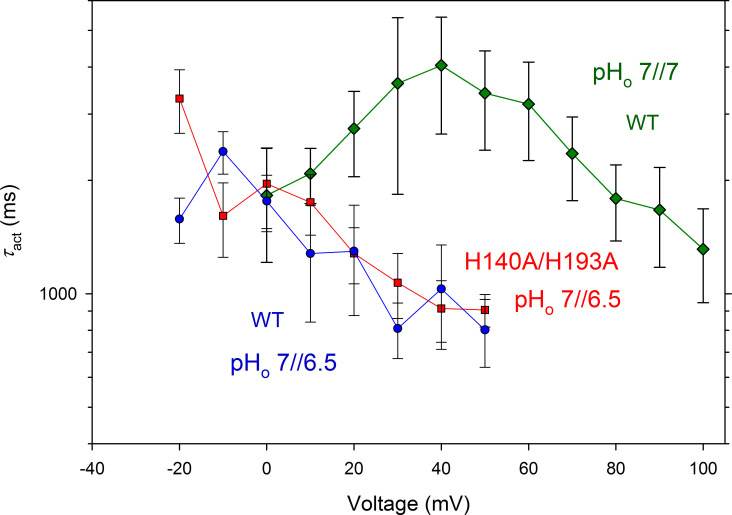
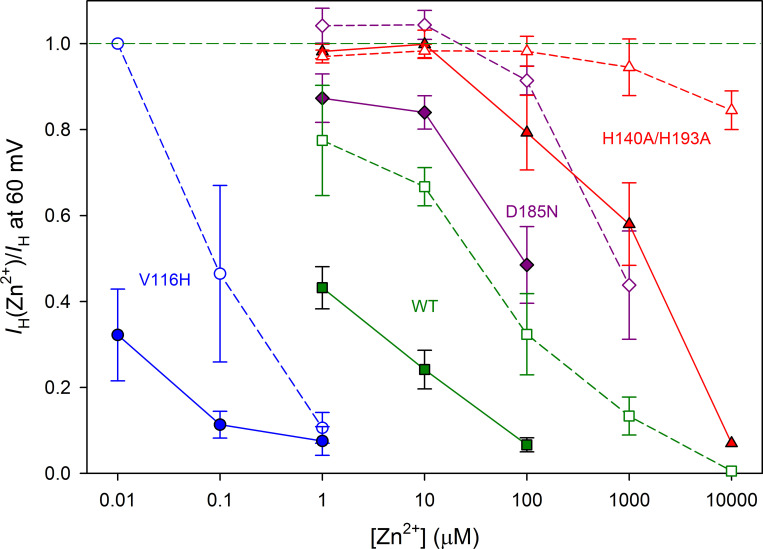
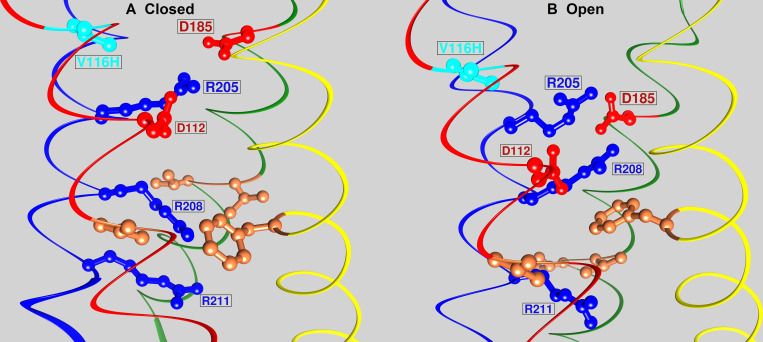
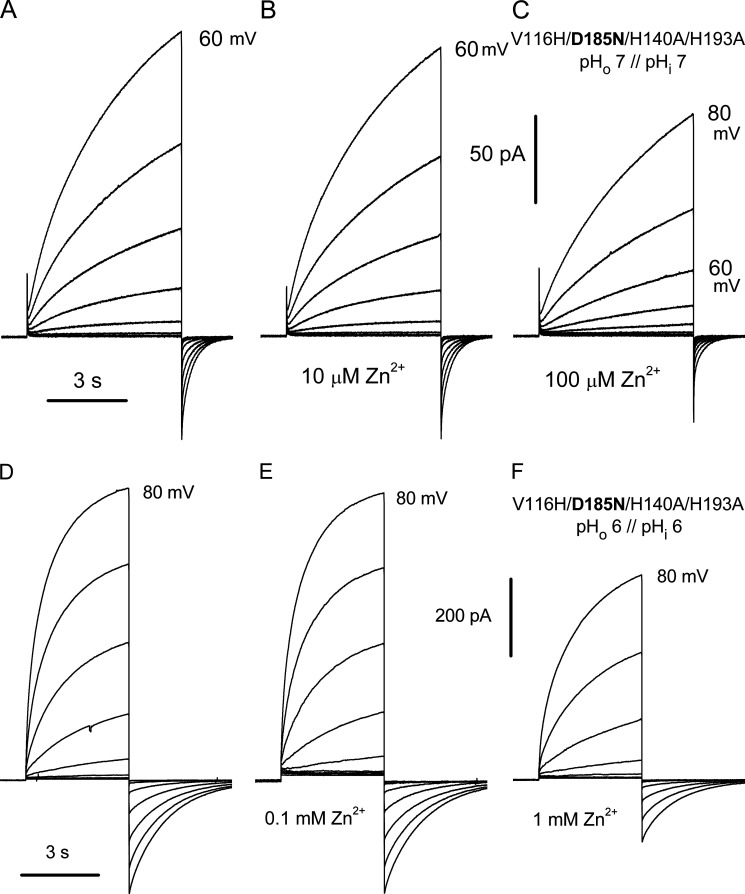
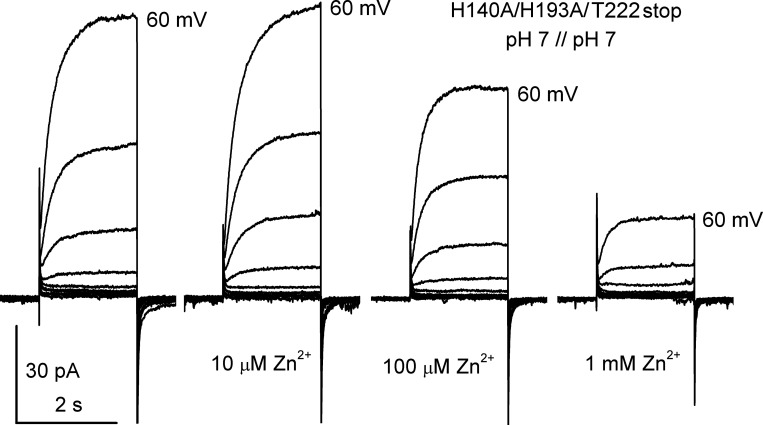
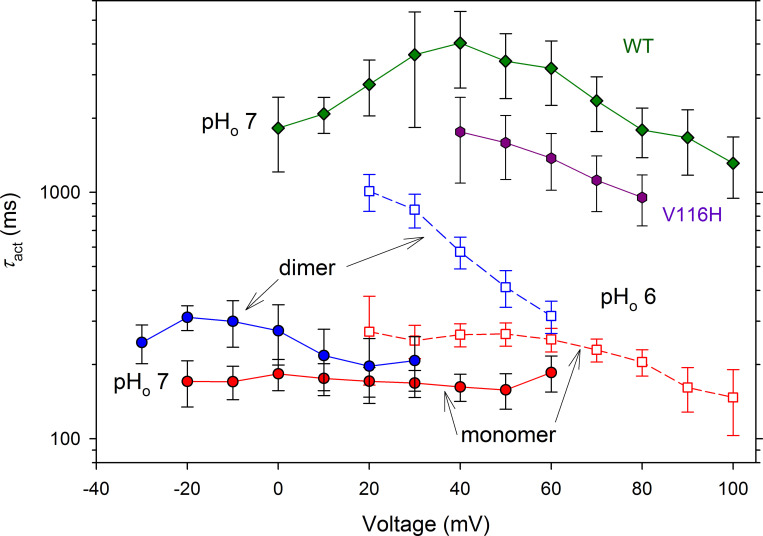
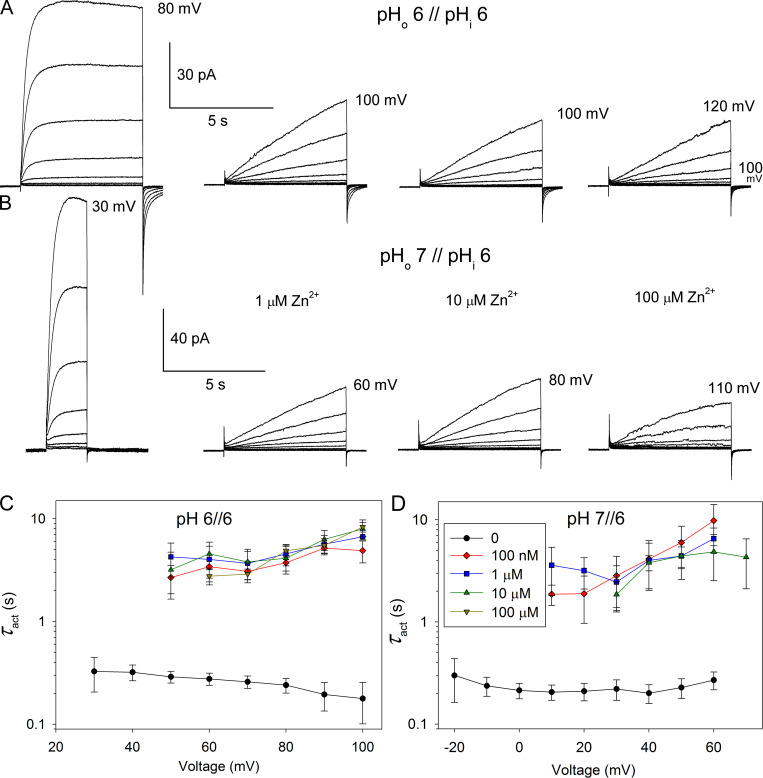
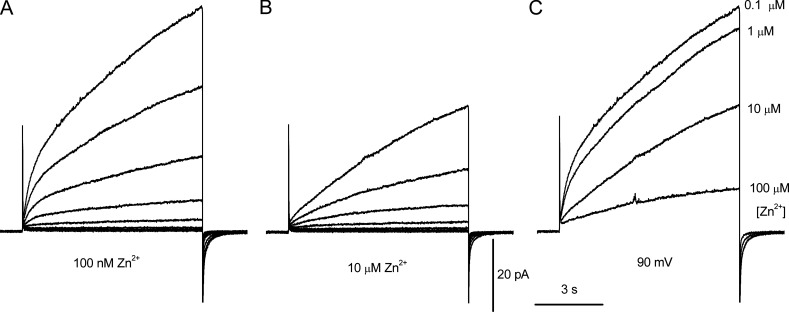
The voltage-gated proton channel (HV1) is a voltage sensor that also conducts protons. The singular ability of protons to penetrate proteins complicates distinguishing closed and open channels. When we replaced valine with histidine at position 116 in the external vestibule of hHV1, current was potently inhibited by externally applied Zn2+ in a construct lacking the two His that bind Zn2+ in WT channels. High-affinity binding with profound effects at 10 nM Zn2+ at pHo 7 suggests additional groups contribute. We hypothesized that Asp185, which faces position 116 in our closed-state model, contributes to Zn2+ chelation. Confirming this prediction, V116H/D185N abolished Zn2+ binding. Studied in a C-terminal truncated monomeric construct, V116H channels activated rapidly. Anomalously, Zn2+ slowed activation, producing a time constant independent of both voltage and Zn2+ concentration. We hypothesized that slow turn-on of H+ current in the presence of Zn2+ reflects the rate of Zn2+ unbinding from the channel, analogous to drug-receptor dissociation reactions. This behavior in turn suggests that the affinity for Zn2+ is greater in the closed state of hHV1. Supporting this hypothesis, pulse pairs revealed a rapid component of activation whose amplitude decreased after longer intervals at negative voltages as closed channels bound Zn2+. The lower affinity of Zn2+ in open channels is consistent with the idea that structural rearrangements within the transmembrane region bring Arg205 near position 116, electrostatically expelling Zn2+. This phenomenon provides direct evidence that Asp185 opposes position 116 in closed channels and that Arg205 moves between them when the channel opens.
电压门控质子通道(HV1)是一种既能传导质子又能充当电压传感器的蛋白质。由于质子能够穿透蛋白质,因此很难区分闭合和开放的通道。当我们在 hHV1 外部前庭的 116 位用组氨酸替换缬氨酸时,在缺乏与 WT 通道中两个 His 结合的锌离子的构建体中,外部施加的锌离子会强烈抑制电流。在 pHo 7 时,10 nM Zn2+ 具有高亲和力并产生深远影响,表明其他基团也有贡献。我们假设,在我们的闭状态模型中面向 116 位的 Asp185 有助于锌离子螯合。证实了这一预测,V116H/D185N 消除了锌离子结合。在 C 端截断的单体构建体中研究时,V116H 通道快速激活。异常的是,锌离子减缓了激活,产生的时间常数既不依赖于电压也不依赖于锌离子浓度。我们假设,在锌离子存在下,H+电流的缓慢开启反映了锌离子从通道中脱离的速率,类似于药物-受体解离反应。这种行为反过来表明,在 hHV1 的闭态下,锌离子的亲和力更高。支持这一假说,脉冲对显示出快速激活成分,其幅度在负电压下随着时间的延长而减小,因为闭通道结合了锌离子。锌离子在开放通道中的亲和力较低,这与结构重排使 Arg205 靠近 116 位、静电排斥锌离子的观点一致。这种现象提供了直接证据,证明 Asp185 在闭通道中与 116 位相对抗,而 Arg205 在通道打开时在它们之间移动。