Institute for Community Health Research, University of Medicine and Pharmacy, Hue University, Hue, Vietnam.
Faculty of Public Health, University of Medicine and Pharmacy, Hue University, Hue, Vietnam.
PLoS One. 2020 Sep 9;15(9):e0238830. doi: 10.1371/journal.pone.0238830. eCollection 2020.
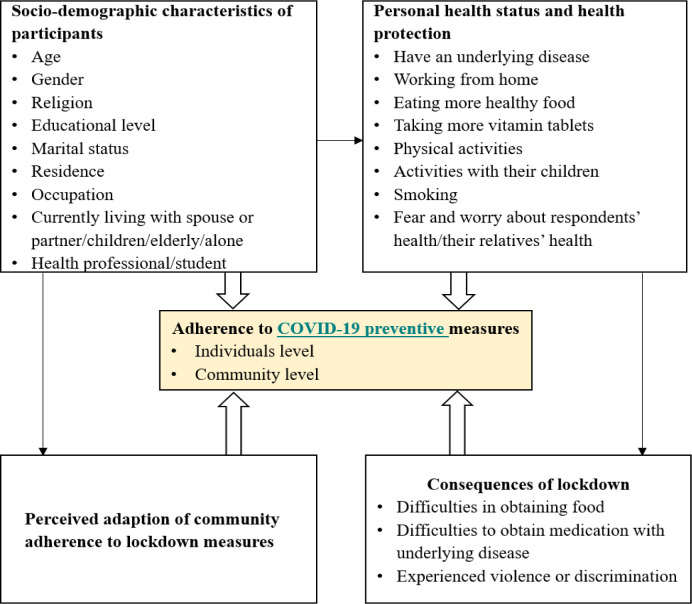
We sought to evaluate the adherence of Vietnamese adults to Coronavirus Disease 2019 (COVID-19) preventive measures, and gain insight into the effects of the epidemic on the daily lives of Vietnamese people. An online questionnaire was administered from March 31 to April 6, 2020. The questionnaire assessed personal preventive behavior (such as physical distancing, wearing a face mask, cough etiquette, regular handwashing and using an alcohol hand sanitizer, body temperature check, and disinfecting mobile phones) and community preventive behavior (such as avoiding meetings, large gatherings, going to the market, avoiding travel in a vehicle/bus with more than 10 persons, and not traveling outside of the local area during the lockdown). A total adherence score was calculated by summing the scores of the 9 personal and the 11 community prevention questions. In total, 2175 respondents completed the questionnaire; mean age: 31.4 ± 10.7; (range: 18-69); 66.9% were women; 54.2% were health professionals and 22.8% were medical students. The mean adherence scores for personal and community preventive measures were 7.23 ± 1.63 (range 1-9) and 9.57 ± 1.12 (range 1-11), respectively. Perceived adaptation of the community to lockdown (Beta (β) = 2.64, 95% Confidence Interval (CI) 1.25-4.03), fears/worries concerning one's health (β = 2.87, 95% CI 0.04-5.70), residing in large cities (β = 19.40, 95% CI 13.78-25.03), access to official COVID-19 information sources (β = 16.45, 95% CI 6.82-26.08), and working in healthcare/medical students (β = 22.53, 95% CI 16.00-29.07) were associated with a higher adherence score to anti-COVID instructions. In conclusion, this study confirmed a high degree of adherence to personal and community preventive behavior among Vietnamese people. Our findings are consistent with the epidemiology of COVID-19 in Vietnam, where there have been few infections and no recorded deaths up to the first week of July 2020.
我们旨在评估越南成年人对 2019 年冠状病毒病(COVID-19)预防措施的遵守情况,并深入了解该流行病对越南人民日常生活的影响。我们于 2020 年 3 月 31 日至 4 月 6 日进行了在线问卷调查。问卷评估了个人预防行为(例如保持身体距离、戴口罩、咳嗽礼仪、定期洗手和使用酒精洗手液、体温检查和手机消毒)和社区预防行为(例如避免会议、大型集会、去市场、避免乘坐 10 人以上的车辆/公共汽车旅行以及在封锁期间不前往外地旅行)。通过将 9 项个人预防问题和 11 项社区预防问题的得分相加来计算总得分。共有 2175 名受访者完成了问卷;平均年龄为 31.4 ± 10.7(范围:18-69);66.9%为女性;54.2%为卫生专业人员,22.8%为医学生。个人和社区预防措施的平均得分分别为 7.23 ± 1.63(范围为 1-9)和 9.57 ± 1.12(范围为 1-11)。社区对封锁的适应程度(β=2.64,95%置信区间(CI)1.25-4.03)、对健康的担忧(β=2.87,95%CI 0.04-5.70)、居住在大城市(β=19.40,95%CI 13.78-25.03)、获得官方 COVID-19 信息来源(β=16.45,95%CI 6.82-26.08)和从事医疗保健/医学生工作(β=22.53,95%CI 16.00-29.07)与对反 COVID 指令的高度遵守相关。总之,本研究证实了越南人对个人和社区预防行为的高度遵守。我们的研究结果与越南 COVID-19 的流行病学情况一致,截至 2020 年 7 月的第一周,越南感染人数很少,无死亡记录。