Li Qi, Zhao Fengyuan, Li Zong, Duan Xiaoning, Cheng Jin, Zhang Jiahao, Fu Xin, Zhang Jiying, Shao Zhenxing, Guo Qinwei, Hu Xiaoqing, Ao Yingfang
Institute of Sports Medicine, Beijing Key Laboratory of Sports Injuries, Peking University Third Hospital, Beijing, China.
Front Cell Dev Biol. 2020 Jul 31;8:694. doi: 10.3389/fcell.2020.00694. eCollection 2020.
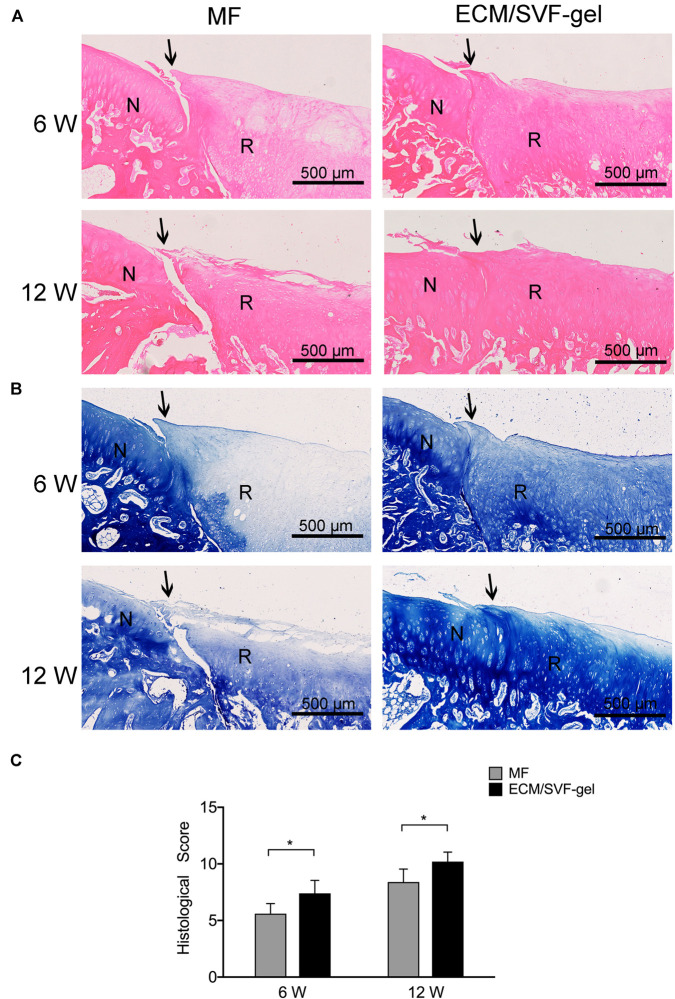
Articular cartilage damage remains a tough challenge for clinicians. Stem cells have emerged promising biologics in regenerative medicine. Previous research has widely demonstrated that adipose-derived mesenchymal stem cells (ADSCs) can promote cartilage repair due to their multipotency. However, enzymatic isolation and monolayer expansion of ADSCs decrease their differentiation potential and limit their clinical application. Here, a novel adipose tissue-derived product, extracellular matrix/stromal vascular fraction gel (ECM/SVF-gel), was obtained by simple mechanical shifting and centrifugation to separate the fat oil and concentrate the effective constituents. This study aimed to evaluate the therapeutic effect of this natural biomaterial on the repair of articular cartilage defects. Scanning electron microscopy showed that the fibrous structure in the ECM/SVF-gel was preserved. ADSCs sprouted from the ECM/SVF-gel were characterized by their ability of differentiation into chondrocytes, osteoblasts, and adipocytes. In a rabbit model, critical-sized cartilage defects (diameter, 4 mm; depth, 1.5 mm) were created and treated with microfracture (MF) or a combination of autologous ECM/SVF-gel injection. The knee joints were evaluated at 6 and 12 weeks through magnetic resonance imaging, macroscopic observation, histology, and immunohistochemistry. The International Cartilage Repair Society score and histological score were significantly higher in the ECM/SVF-gel group than those in the MF-treated group. The ECM/SVF-gel distinctly improved cartilage regeneration, integration with surrounding normal cartilage, and the expression of hyaline cartilage marker, type II collagen, in comparison with the MF treatment alone. Overall, the ready-to-use ECM/SVF-gel is a promising therapeutic strategy to facilitate articular cartilage regeneration. Moreover, due to the simple, time-sparing, cost-effective, enzyme-free, and minimally invasive preparation process, this gel provides a valuable alternative to stem cell-based therapy for clinical translation.
关节软骨损伤对临床医生来说仍然是一个严峻的挑战。干细胞已成为再生医学中很有前景的生物制剂。先前的研究广泛表明,脂肪来源的间充质干细胞(ADSCs)因其多能性可促进软骨修复。然而,ADSCs的酶法分离和单层扩增会降低其分化潜能并限制其临床应用。在此,通过简单的机械转移和离心获得了一种新型脂肪组织衍生产品,细胞外基质/基质血管成分凝胶(ECM/SVF-凝胶),以分离脂肪油并浓缩有效成分。本研究旨在评估这种天然生物材料对关节软骨缺损修复的治疗效果。扫描电子显微镜显示ECM/SVF-凝胶中的纤维结构得以保留。从ECM/SVF-凝胶中萌出的ADSCs具有分化为软骨细胞、成骨细胞和脂肪细胞的能力。在兔模型中,制造临界尺寸的软骨缺损(直径4mm;深度1.5mm),并用微骨折(MF)或自体ECM/SVF-凝胶注射联合治疗。在6周和12周时通过磁共振成像、宏观观察、组织学和免疫组织化学对膝关节进行评估。ECM/SVF-凝胶组的国际软骨修复协会评分和组织学评分显著高于MF治疗组。与单独的MF治疗相比,ECM/SVF-凝胶明显改善了软骨再生、与周围正常软骨的整合以及透明软骨标志物II型胶原的表达。总体而言,即用型ECM/SVF-凝胶是促进关节软骨再生的一种有前景的治疗策略。此外,由于其制备过程简单、省时、经济高效、无酶且微创,这种凝胶为基于干细胞的治疗临床转化提供了一种有价值的替代方案。