Lin Wei, Jia Danyun, Fu Changchang, Zheng Yihui, Lin Zhenlang
Department of Pediatrics, The Second Affiliated Hospital and Yuying Children's Hospital of Wenzhou Medical University, Wenzhou, Zhejiang, 325000, People's Republic of China.
Department of Anesthesiology, The First Affiliated Hospital of Wenzhou Medical University, Wenzhou, Zhejiang Province 325000, People's Republic of China.
J Inflamm Res. 2020 Aug 24;13:465-470. doi: 10.2147/JIR.S264093. eCollection 2020.
Electro-acupuncture (EA) can significantly improve inflammatory response, but the specific mechanism is not clear. Limb ischemia-reperfusion (I/R) first produces inflammatory reactions in the lungs. In this study, EA on Zusanli (ST36) and Sanyinjiao (SP6) were used to explore the mechanism of improving tissue inflammation by sciatic nerve disconnection.
A total of 56 male Sprague-Dawley rats were randomly divided into sham group, model group, EA group, SEA group, SNC+EA group, TNC+EA group and PNC+EA group. The sham groups were not given any treatment. Rats in the model group were treated with limb I/R without acupuncture intervention. In the EA group, ST36 and SP6 were given EA treatment for 30min before modeling. No electric current was given in the SEA group, and other operations were the same as those in the EA group. The SNC+EA group, TNC+EA group and PNC+EA group were respectively given sciatic nerve, tibial nerve or peroneal nerve amputation 72h before modeling, and the others were the same as the model group.
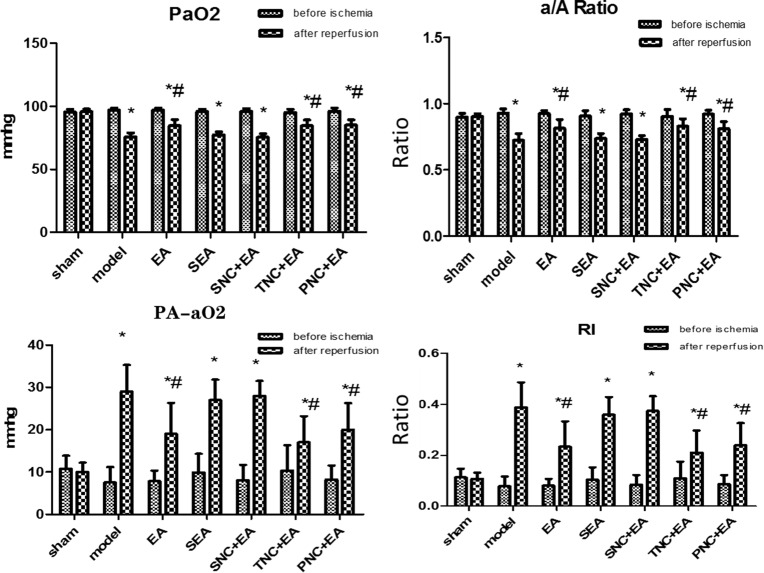
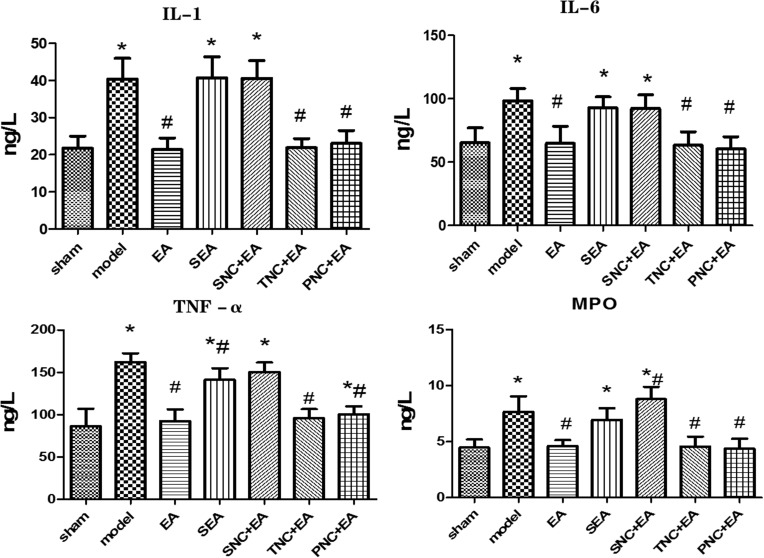
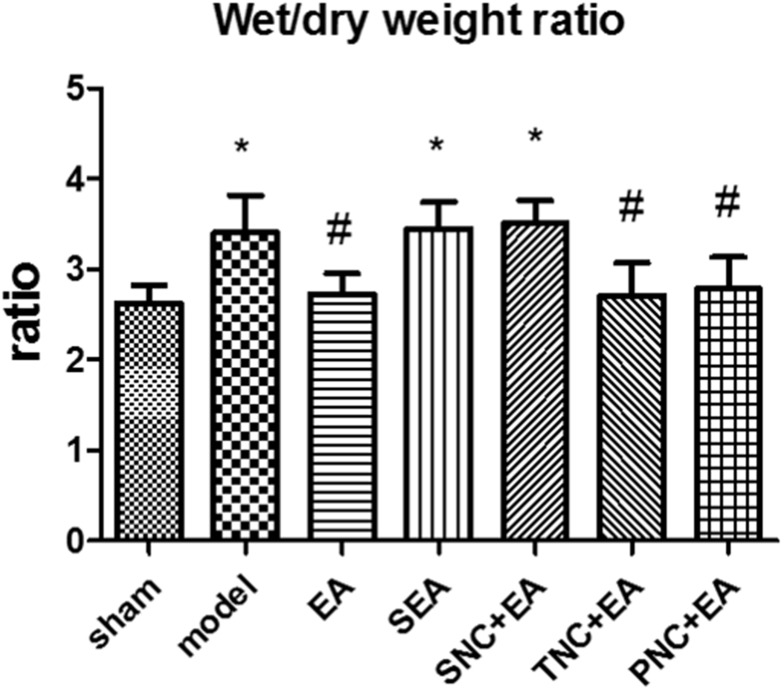
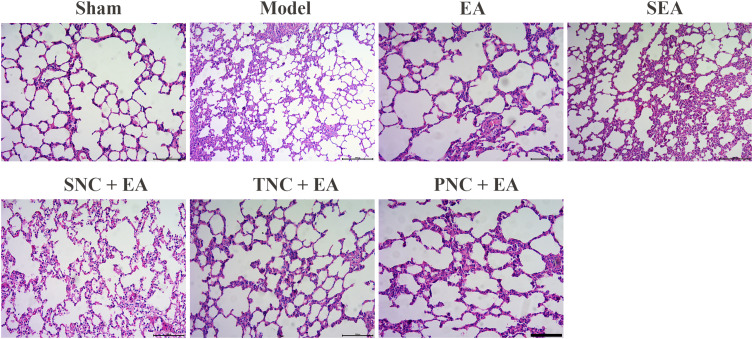
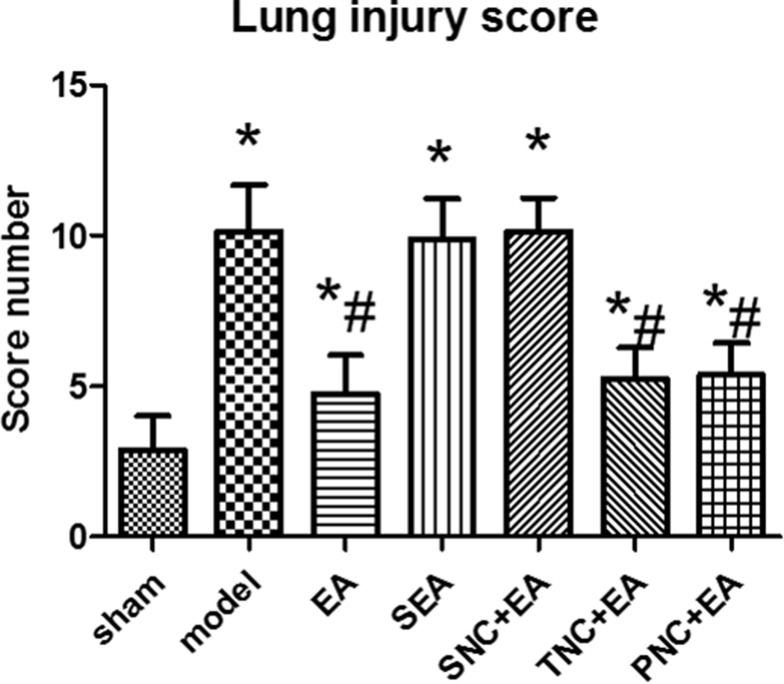
Compared with the sham group, PaO2 and a/A ratios decreased significantly in the model group (P <0.05), while PA-aO2, RI, the ratio of wet to dry, lung injury value and inflammatory factor TNF-α, IL-1, IL-6, and MPO increased significantly (P <0.05). Compared with the model group, PaO2, a/A ratios increased significantly in the EA group (P <0.05), while PA-aO2, RI, the ratio of wet to dry lung, lung injury value, and TNF-α, IL-1, IL-6, and MPO decreased significantly (P <0.05). After transection of the sciatic nerve, the protective effect of EA disappeared. However, when the peroneal or tibial nerve was severed, EA continued to maintain the protective effect.
EA on ST36 and SP6 can alleviate lung injury caused by limb I/R through the sciatic nerve.
电针可显著改善炎症反应,但其具体机制尚不清楚。肢体缺血再灌注(I/R)首先会在肺部产生炎症反应。在本研究中,采用针刺足三里(ST36)和三阴交(SP6)来探讨通过切断坐骨神经改善组织炎症的机制。
将56只雄性Sprague-Dawley大鼠随机分为假手术组、模型组、电针组、模拟电针组、坐骨神经切断+电针组、胫神经切断+电针组和腓总神经切断+电针组。假手术组不进行任何处理。模型组大鼠进行肢体I/R处理,不进行针刺干预。电针组在建模前对ST36和SP6进行30分钟的电针治疗。模拟电针组不给予电流,其他操作与电针组相同。坐骨神经切断+电针组、胫神经切断+电针组和腓总神经切断+电针组在建模前72小时分别进行坐骨神经、胫神经或腓总神经切断术,其他操作与模型组相同。
与假手术组相比,模型组的PaO2和a/A比值显著降低(P<0.05),而PA-aO2, RI, 湿干比、肺损伤值以及炎症因子TNF-α、IL-1、IL-6和MPO显著升高(P<0.05)。与模型组相比,电针组的PaO2、a/A比值显著升高(P<0.05),而PA-aO2、RI、肺湿干比、肺损伤值以及TNF-α、IL-1、IL-6和MPO显著降低(P<0.05)。切断坐骨神经后,电针的保护作用消失。然而,当切断腓总神经或胫神经时,电针仍能维持其保护作用。
针刺ST36和SP6可通过坐骨神经减轻肢体I/R所致的肺损伤。