Priyamvada P S, Jaswanth Challa, Zachariah Bobby, Haridasan Satish, Parameswaran Sreejith, Swaminathan Rathinam Palamalai
Department of Nephrology, Jawaharlal Institute of Post Graduate Medical Education and Research, Puducherry 605006, India.
Department of Biochemistry, Jawaharlal Institute of Post Graduate Medical Education and Research, Puducherry 605006, India.
Clin Kidney J. 2019 Jun 3;13(4):564-570. doi: 10.1093/ckj/sfz055. eCollection 2020 Aug.
Snakebite is a common occupational hazard in tropical countries. To date, the literature on snakebite-related acute kidney injury (AKI) has been limited by retrospective study designs, lack of uniformity in case definitions of AKI and limited follow-up. This study aims to identify the in-hospital outcomes and long-term changes in kidney function that follow haemotoxic envenomation.
All adult patients admitted with AKI following haemotoxic envenomation from January 2016 to June 2017 were recruited and followed up until July 2018. Predictors of in-hospital mortality was assessed. Long-term follow-up data on kidney function were collected from survivors.
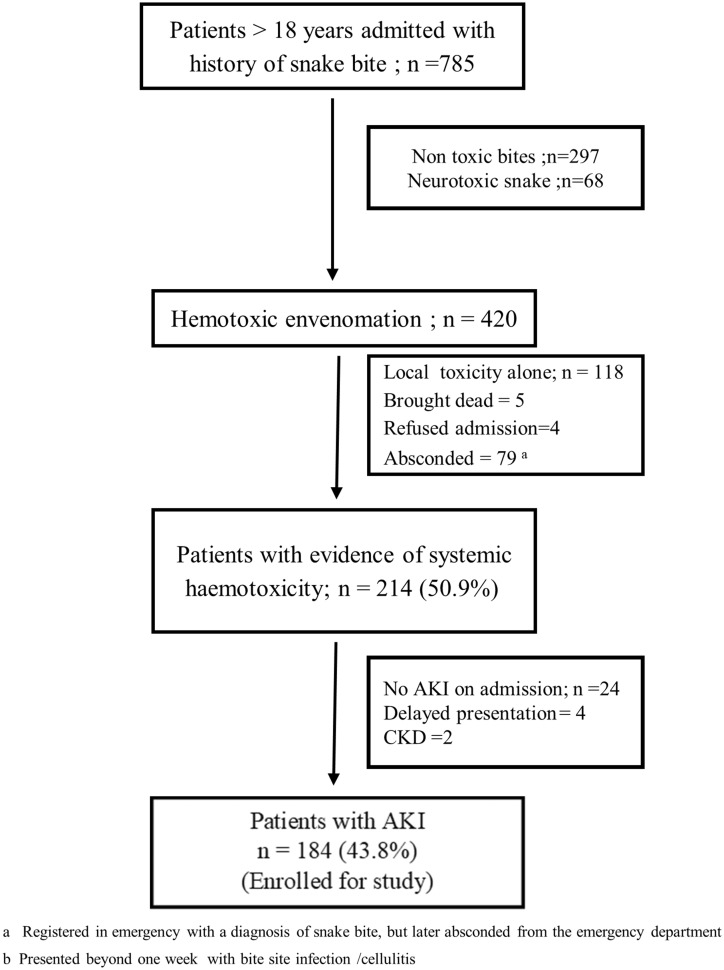
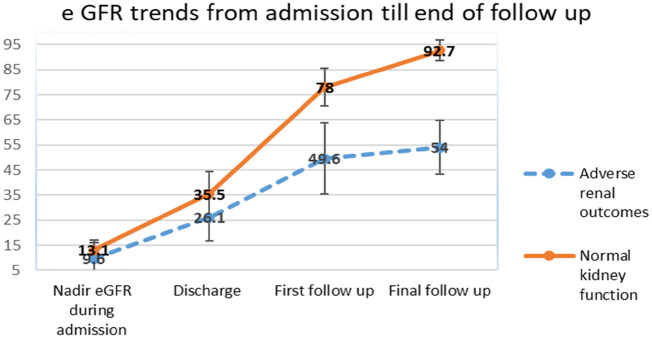
In total, 184 patients with haemotoxic envenomation and AKI were recruited. The mean age of the subjects was 42.2 years [95% confidence interval (CI) 40.3-44.7]. The majority were male (71.2%). The mortality of patients with haemotoxic envenomation was 21.5%. The mortality was considerably higher in patients with Kidney Disease: Improving Global Outcomes (KDIGO) Stage 3 AKI [relative risk (RR) 4.45 (95% CI 1.14-17.42)] and those who met KDIGO urine output criteria [RR 20.45 (95% CI 2.84-147.23)]. A Cox regression model identified mechanical ventilation [odds ratio (OR) 5.59 (95% CI 2.90-10.81)], hypotension [OR 2.48 (95% CI 1.31-4.72)] and capillary leak syndrome [OR 2.02 (95% CI 1.05-3.88)] as independent predictors of mortality. Long-term follow-up data were available for 73 patients. A total of 21 patients (28.7%) developed adverse renal outcomes (glomerular filtration rate <60 mL/min/1.73 m, urine albumin excretion >30 mg/g and new-onset hypertension or prehypertension).
AKI resulting from snake envenomation is associated with considerable risk of mortality. The greater the AKI stage the greater the likelihood of mortality. One-third of patients with AKI developed long-term complications like chronic kidney disease, prehypertension and hypertension over the follow-up period.
蛇咬伤是热带国家常见的职业危害。迄今为止,关于蛇咬伤相关急性肾损伤(AKI)的文献受到回顾性研究设计、AKI病例定义缺乏一致性以及随访有限的限制。本研究旨在确定血液毒性蛇毒中毒后的院内结局和肾功能的长期变化。
招募2016年1月至2017年6月因血液毒性蛇毒中毒后发生AKI入院的所有成年患者,并随访至2018年7月。评估院内死亡的预测因素。从幸存者中收集肾功能的长期随访数据。
共招募了184例血液毒性蛇毒中毒合并AKI的患者。受试者的平均年龄为42.2岁[95%置信区间(CI)40.3 - 44.7]。大多数为男性(71.2%)。血液毒性蛇毒中毒患者的死亡率为21.5%。肾脏病:改善全球预后(KDIGO)3期AKI患者的死亡率显著更高[相对危险度(RR)4.45(95%CI 1.14 - 17.42)],以及符合KDIGO尿量标准的患者死亡率更高[RR 20.45(95%CI 2.84 - 147.23)]。Cox回归模型确定机械通气[比值比(OR)5.59(95%CI 2.90 - 10.81)]、低血压[OR 2.48(95%CI 1.31 - 4.72)]和毛细血管渗漏综合征[OR 2.02(95%CI 1.05 - 3.88)]为死亡的独立预测因素。73例患者可获得长期随访数据。共有21例患者(28.7%)出现不良肾脏结局(肾小球滤过率<60 mL/min/1.73 m²、尿白蛋白排泄>30 mg/g以及新发高血压或高血压前期)。
蛇毒中毒导致的AKI与相当大的死亡风险相关。AKI分期越高,死亡可能性越大。在随访期间,三分之一的AKI患者出现了慢性肾脏病、高血压前期和高血压等长期并发症。