Ibrahim Mahmoud A A, Moussa Nayra A M
Computational Chemistry Laboratory, Chemistry Department, Faculty of Science, Minia University, Minia 61519, Egypt.
ACS Omega. 2020 Aug 19;5(34):21824-21835. doi: 10.1021/acsomega.0c02887. eCollection 2020 Sep 1.
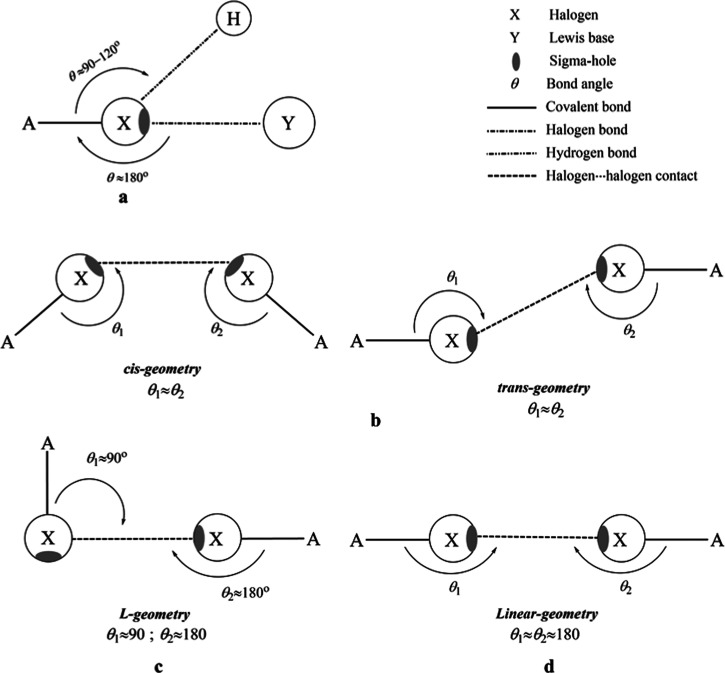
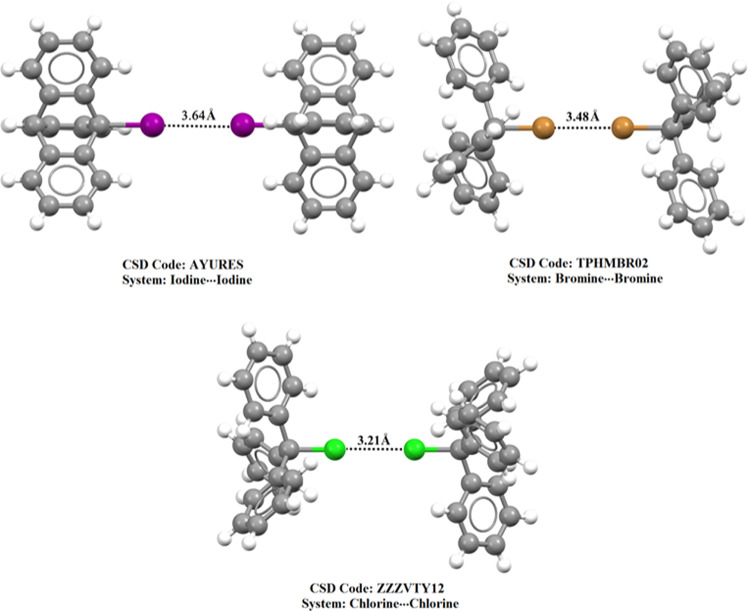
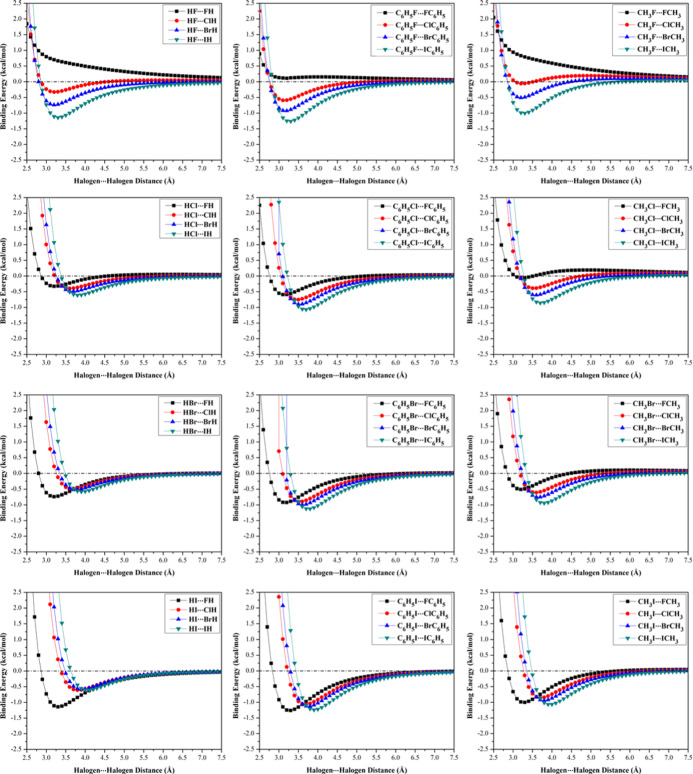
Herein, two unconventional type III halogen···halogen interactions, namely, σ-hole···σ-hole and di-σ-hole interactions, were reported in a series of halogenated complexes. In type III, the A-halogen···halogen angles are typically equal to 180°, and the occurrence of σ-hole on halogen atoms is mandatory. Using diverse quantum mechanical calculations, it was demonstrated that the occurrence of such interactions with binding energies varied from -0.35 to -1.30 kcal/mol. Symmetry-adapted perturbation theory-based energy decomposition analysis (SAPT-EDA) revealed that type III interactions are dominated by dispersion forces, while electrostatic forces are unfavorable. Cambridge Structure Database (CSD) survey unveiled the experimental evidence for the manifestation of σ-hole···σ-hole interactions in crystal structures. This work might be deemed as a foundation for a vast number of forthcoming crystal engineering and materials science studies.
在此,在一系列卤化配合物中报道了两种非常规的III型卤素···卤素相互作用,即σ-空穴···σ-空穴和双σ-空穴相互作用。在III型中,A-卤素···卤素角通常等于180°,并且卤素原子上σ-空穴的出现是必需的。使用各种量子力学计算表明,这种相互作用的结合能在-0.35至-1.30 kcal/mol之间变化。基于对称适应微扰理论的能量分解分析(SAPT-EDA)表明,III型相互作用以色散力为主,而静电力则不利。剑桥结构数据库(CSD)调查揭示了晶体结构中σ-空穴···σ-空穴相互作用表现的实验证据。这项工作可能被视为大量即将开展的晶体工程和材料科学研究的基础。