Tullo Edgar, Lerea María Jose, González Rosa, Galeano Julio, Insfrán María Delasnieve, Muñoz Mara, Aragón Miguel, Sanhueza Antonio
Dirección General de Información Estratégica en Salud, Ministerio de Salud Pública y Bienestar Social Paraguay Dirección General de Información Estratégica en Salud, Ministerio de Salud Pública y Bienestar Social, Paraguay.
Dirección General de Problemas de Salud, Ministerio de Salud Pública y Bienestar Social Paraguay Dirección General de Problemas de Salud, Ministerio de Salud Pública y Bienestar Social, Paraguay.
Rev Panam Salud Publica. 2020 Sep 4;44:e107. doi: 10.26633/RPSP.2020.107. eCollection 2020.
To describe health and social inequalities in maternal and child health indicators defined in Sustainable Development Goal (SDG) 3.1 and SDG 3.2 targets based on administrative data among the departments of Paraguay in 2017.
Quantitative descriptive study with ecological design. Simple gap measures and complex gradient measures based on the adjustment of negative binomial and logistic regression models were used.
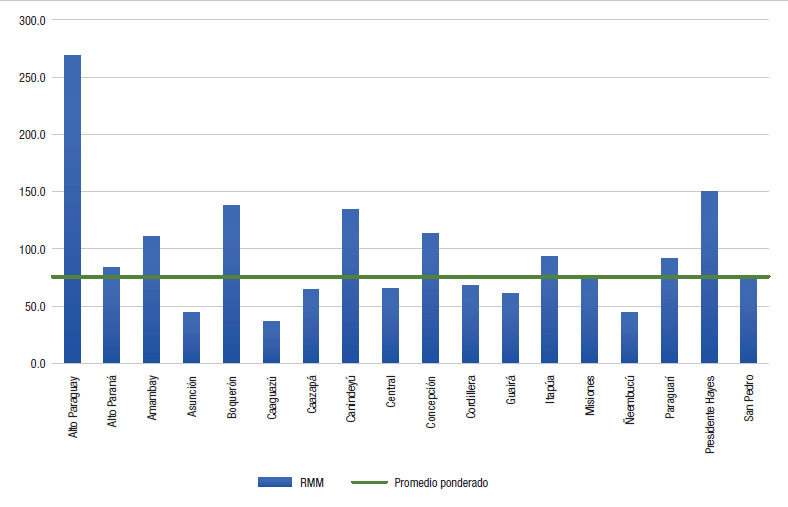
Fifty percent of Paraguay's departments have estimated maternal mortality ratio (MMR) values higher than the national value. The percentage of births attended by a qualified professional in the country is 98.1%, with a range between 82.4% and 99.9%. In 13 of 18 departments, under-five mortality rate (U5MR) is higher than the national average, ranging from 4.2 to 49.2 deaths per 1 000 live births. Neonatal mortality rates (NMR) in the departments vary from 2.6 to 45.1 deaths per 1 000 live births. There are major health and social inequalities in the MMR, U5MR and NMR between the departments. There are no high inequalities in the percentage of births attended by a qualified professional between the departments.
Paraguay needs to make significant efforts to reduce the health and social inequalities that exist in the MMR, U5MR and NMR between departments. Numerical targets must be established to improve national values and reduce inequalities in these indicators, which will allow for accountability on the commitment to "leave no one behind" established in the SDG, and will help generate strategies to improve the health of women and children in Paraguay.
基于2017年巴拉圭各部门的行政数据,描述可持续发展目标(SDG)3.1和SDG 3.2目标中所定义的孕产妇和儿童健康指标方面的健康与社会不平等情况。
采用生态设计的定量描述性研究。使用基于负二项式和逻辑回归模型调整的简单差距测量和复杂梯度测量方法。
巴拉圭50%的部门估计孕产妇死亡率(MMR)值高于全国水平。该国由合格专业人员接生的分娩比例为98.1%,范围在82.4%至99.9%之间。在18个部门中的13个部门,五岁以下儿童死亡率(U5MR)高于全国平均水平,每1000例活产死亡人数在4.2至49.2人之间。各部门的新生儿死亡率(NMR)每1000例活产死亡人数在2.6至45.1人之间。各部门之间在MMR、U5MR和NMR方面存在重大的健康与社会不平等。各部门之间在由合格专业人员接生的分娩比例方面不存在高度不平等。
巴拉圭需要做出重大努力,以减少各部门之间在MMR、U5MR和NMR方面存在的健康与社会不平等。必须设定数值目标,以提高全国水平并减少这些指标方面的不平等,这将有助于对可持续发展目标中“不让任何一个人掉队”的承诺进行问责,并有助于制定改善巴拉圭妇女和儿童健康的战略。