Jie Ran, Zhu Pengpeng, Zhong Jiao, Zhang Yan, Wu Hongyan
Department of Endocrinology, First People's Hospital of Jingzhou, Shashi District, No. 8 Hangkong Road, Jingzhou, 434000 Hubei China.
Department of Anesthesiology, First People's Hospital of Jingzhou, Jingzhou, 434000 Hubei China.
Diabetol Metab Syndr. 2020 Sep 3;12:77. doi: 10.1186/s13098-020-00585-5. eCollection 2020.
It has been reported that long non-coding RNAs (lncRNAs) play vital roles in diabetic nephropathy (DN). Our study aims to research the function of lncRNA KCNQ1OT1 in DN cells and the molecular mechanism.
Human glomerular mesangial cells (HGMCs) and human renal glomerular endothelial cells (HRGECs) were cultured in high glucose (30 mM) condition as models of DN cells. KCNQ1 opposite strand/antisense transcript 1 (KCNQ1OT1) and miR-18b-5p levels were detected by quantitative real-time polymerase chain reaction (qRT-PCR). The mRNA and protein levels of Sorbin and SH3 domain-containing protein 2 (SORBS2), Type IV collagen (Col-4), fibronectin (FN), transcriptional regulatory factor-beta 1 (TGF-β1), Twist, NF-κB and STAT3 were measured by qRT-PCR and western blot. Cell viability was detected by cell counting kit-8 (CCK-8) assay for selecting the proper concentration of glucose treatment. Additionally, 3-(4,5-dimethyl-2-thiazolyl)-2,5-diphenyl-2-H-tetrazolium bromide (MTT) and flow cytometry assay were employed to determine cell proliferation and apoptosis, respectively. The targets of KCNQ1OT1 was predicted by online software and confirmed by dual-luciferase reporter assay.
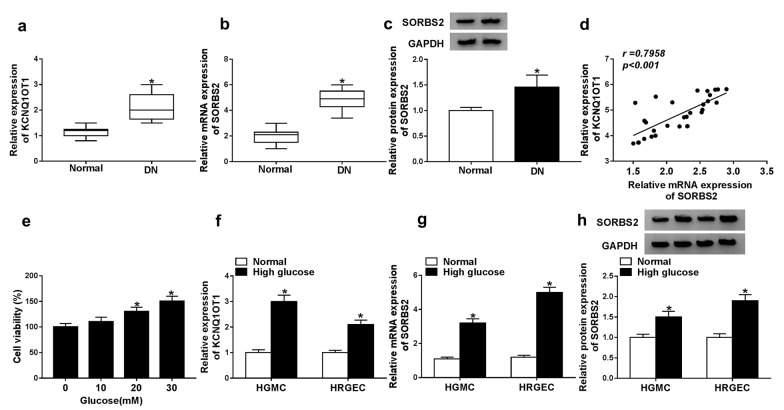
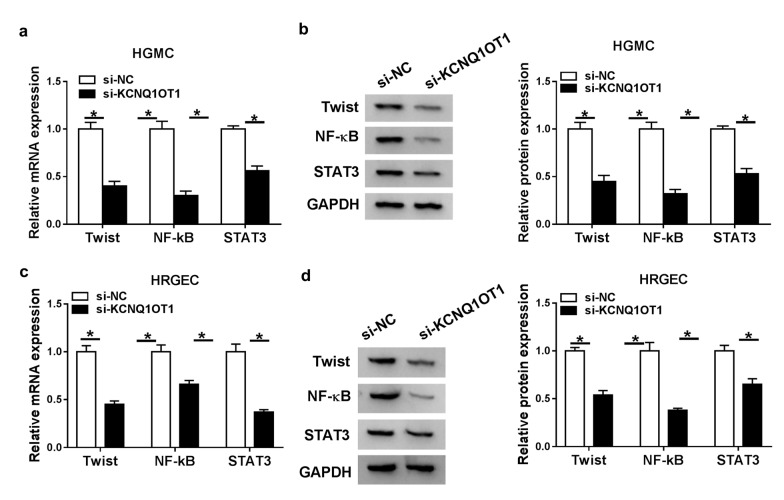
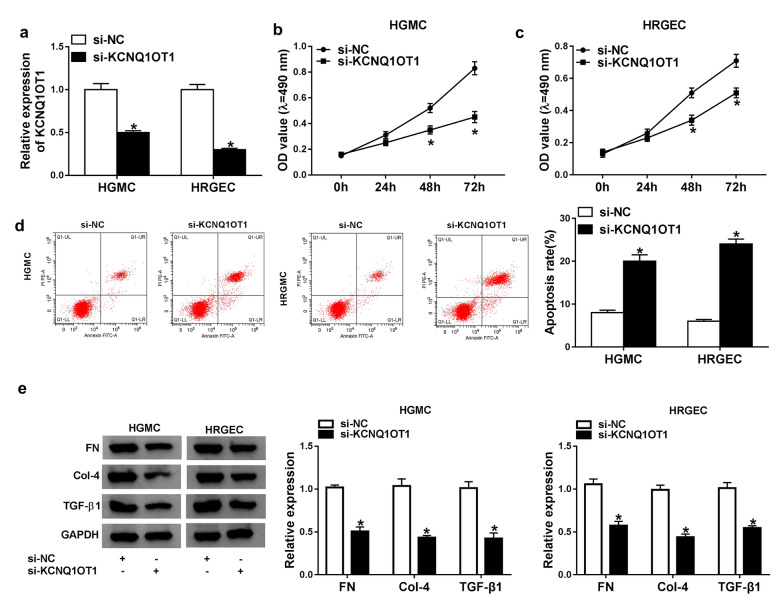
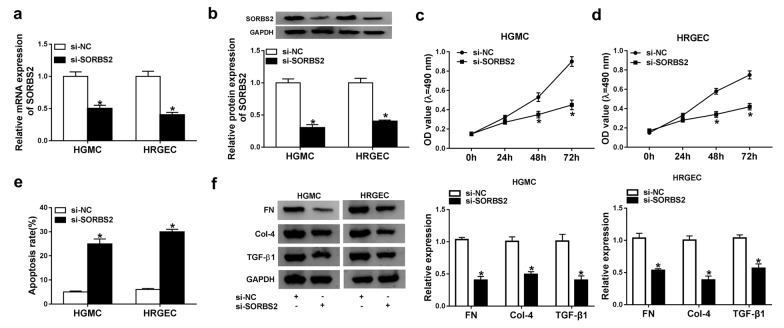
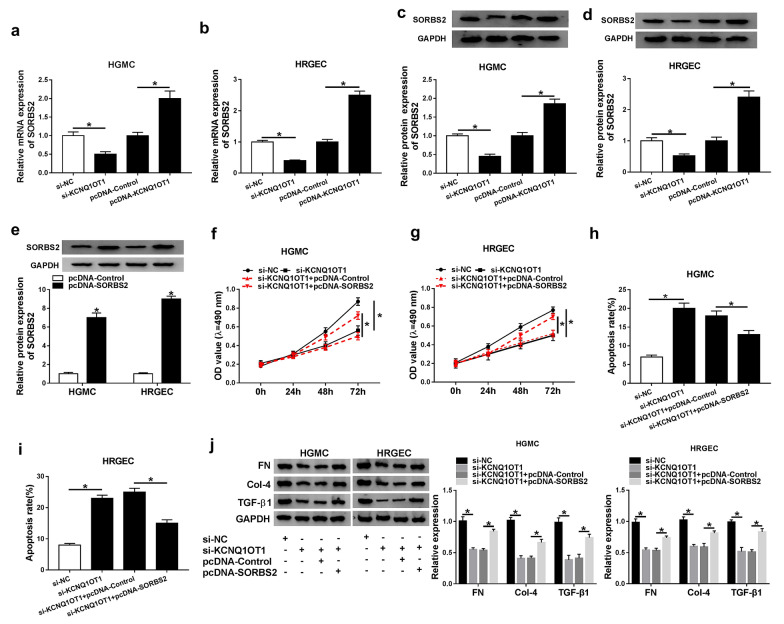
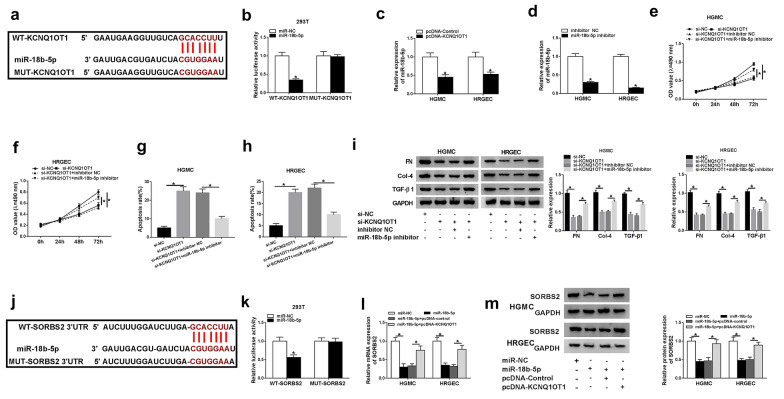
KCNQ1OT1 and SORBS2 were elevated in DN. Both knockdown of KCNQ1OT1 and silencing of SORBS2 restrained proliferation and fibrosis and induced apoptosis in DN cells. Besides, Overexpression of SORBS2 restored the KCNQ1OT1 knockdown-mediate effects on proliferation, apoptosis and fibrosis in DN cells. In addition, miR-18b-5p served as a target of KCNQ1OT1 as well as targeted SORBS2. KCNQ1OT1 knockdown repressed NF-ĸB pathway.
KCNQ1OT1 regulated DN cells proliferation, apoptosis and fibrosis via KCNQ1OT1/miR-18b-5p/SORBS2 axis and NF-ĸB pathway.
据报道,长链非编码RNA(lncRNAs)在糖尿病肾病(DN)中发挥着重要作用。我们的研究旨在探究lncRNA KCNQ1OT1在DN细胞中的功能及其分子机制。
将人肾小球系膜细胞(HGMCs)和人肾小球内皮细胞(HRGECs)在高糖(30 mM)条件下培养,作为DN细胞模型。通过定量实时聚合酶链反应(qRT-PCR)检测KCNQ1反义链/反义转录本1(KCNQ1OT1)和miR-18b-5p的水平。采用qRT-PCR和蛋白质印迹法检测含Sorbin和SH3结构域蛋白2(SORBS2)、IV型胶原(Col-4)、纤连蛋白(FN)、转录调节因子-β1(TGF-β1)、Twist、NF-κB和STAT3的mRNA和蛋白水平。通过细胞计数试剂盒-8(CCK-8)检测细胞活力,以选择合适的葡萄糖处理浓度。此外,分别采用3-(4,5-二甲基-2-噻唑基)-2,5-二苯基-2-H-四氮唑溴盐(MTT)法和流式细胞术检测细胞增殖和凋亡。通过在线软件预测KCNQ1OT1的靶标,并通过双荧光素酶报告基因检测进行验证。
KCNQ1OT1和SORBS2在DN中升高。敲低KCNQ1OT1和沉默SORBS2均抑制DN细胞的增殖和纤维化,并诱导其凋亡。此外,过表达SORBS2可恢复KCNQ1OT1敲低介导的对DN细胞增殖、凋亡和纤维化的影响。此外,miR-18b-5p是KCNQ1OT1的靶标,同时也靶向SORBS2。敲低KCNQ1OT1可抑制NF-κB通路。
KCNQ1OT1通过KCNQ1OT1/miR-18b-5p/SORBS2轴和NF-κB通路调节DN细胞的增殖、凋亡和纤维化。