Department of Chemistry & Nanoscience Center, University of Copenhagen, Thorvaldsensvej 40, C 1871 Frederiksberg, Denmark.
Department of Chemistry, University of Akron, Akron, OH 44325, USA.
Biomolecules. 2020 Sep 7;10(9):1291. doi: 10.3390/biom10091291.
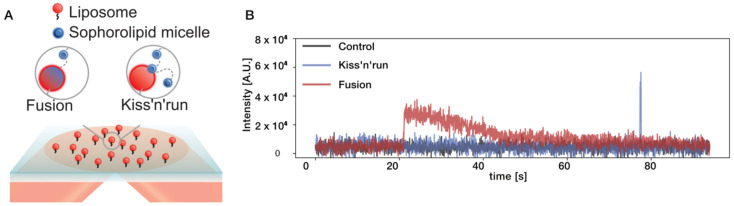
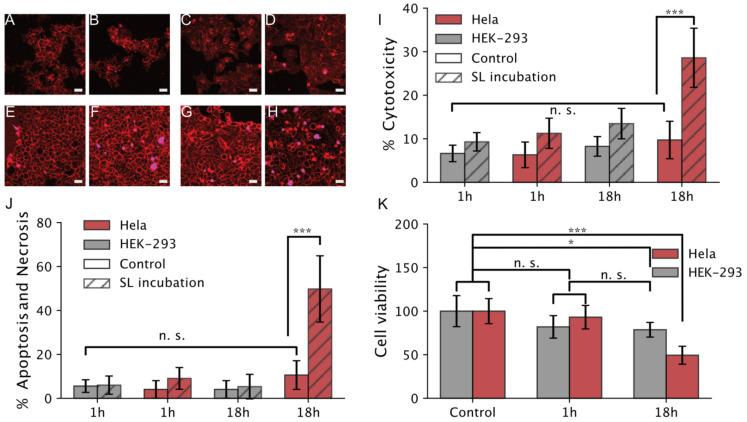
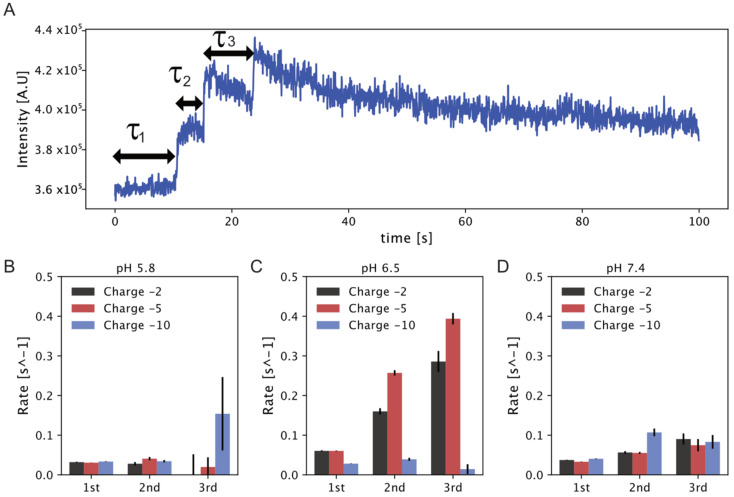
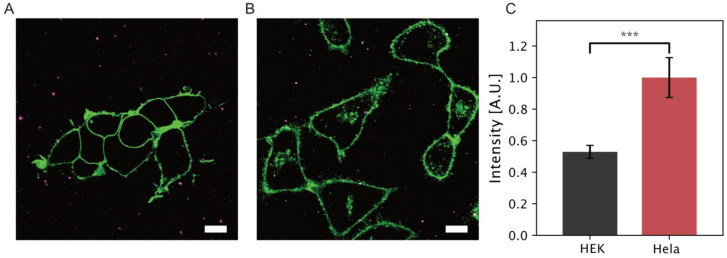
Sophorolipids (SLs) are naturally produced glycolipids that acts as drug delivery for a spectrum of biomedical applications, including as an antibacterial antifungal and anticancer agent, where they induce apoptosis selectively in cancerous cells. Despite their utility, the mechanisms underlying their membrane interactions, and consequently cell entry, remains unknown. Here, we combined a single liposome assay to observe directly and quantify the kinetics of interaction of SL micelles with model membrane systems, and single particle studies on live cells to record their interaction with cell membranes and their cytotoxicity. Our single particle readouts revealed several repetitive docking events on individual liposomes and quantified how pH and membrane charges, which are known to vary in cancer cells, affect the docking of SL micelles on model membranes. Docking of sophorolipids micelles was found to be optimal at pH 6.5 and for membranes with -5% negatively charge lipids. Single particle studies on mammalian cells reveled a two-fold increased interaction on Hela cells as compared to HEK-293 cells. This is in line with our cell viability readouts recording an approximate two-fold increased cytotoxicity by SLs interactions for Hela cells as compared to HEK-293 cells. The combined in vitro and cell assays thus support the increased cytotoxicity of SLs on cancer cells to originate from optimal charge and pH interactions between membranes and SL assemblies. We anticipate studies combining quantitative single particle studies on model membranes and live cell may reveal hitherto unknown molecular insights on the interactions of sophorolipid and additional nanocarriers mechanism.
槐糖脂(SLs)是一种天然产生的糖脂,可作为多种生物医学应用的药物输送载体,包括作为抗菌、抗真菌和抗癌剂,在这些应用中,它选择性地诱导癌细胞凋亡。尽管它们具有实用性,但它们与膜相互作用的机制,以及因此细胞进入的机制,仍然未知。在这里,我们结合了单个脂质体测定法,直接观察和量化了 SL 胶束与模型膜系统相互作用的动力学,并在活细胞上进行了单颗粒研究,以记录它们与细胞膜的相互作用及其细胞毒性。我们的单颗粒读出结果显示,单个脂质体上发生了几次重复对接事件,并定量说明了 pH 值和膜电荷(已知在癌细胞中会发生变化)如何影响 SL 胶束在模型膜上的对接。发现槐糖脂胶束的对接在 pH 值为 6.5 时最佳,并且对于带负电荷脂质为-5%的膜最佳。对哺乳动物细胞的单颗粒研究表明,与 HEK-293 细胞相比,Hela 细胞的相互作用增加了一倍。这与我们的细胞活力读数记录一致,即与 HEK-293 细胞相比,SL 相互作用使 Hela 细胞的细胞毒性增加了大约两倍。因此,体外和细胞联合测定支持 SLs 对癌细胞的增加的细胞毒性源自膜和 SL 组装之间的最佳电荷和 pH 相互作用。我们预计,结合对模型膜和活细胞的定量单颗粒研究的研究可能会揭示槐糖脂和其他纳米载体机制相互作用的迄今未知的分子见解。