Interdisciplinary Nanoscience Center, Aarhus University, Aarhus C, 8000, Denmark.
Department of Chemistry & Nanoscience Center, University of Copenhagen, Universitetsparken 5, Copenhagen, 2100, Denmark.
Nat Commun. 2019 Dec 11;10(1):5655. doi: 10.1038/s41467-019-13284-1.
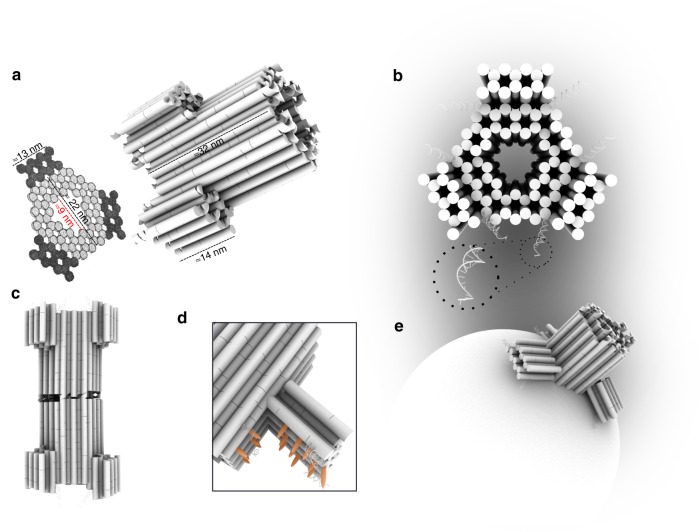
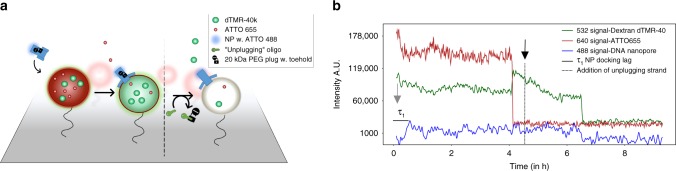
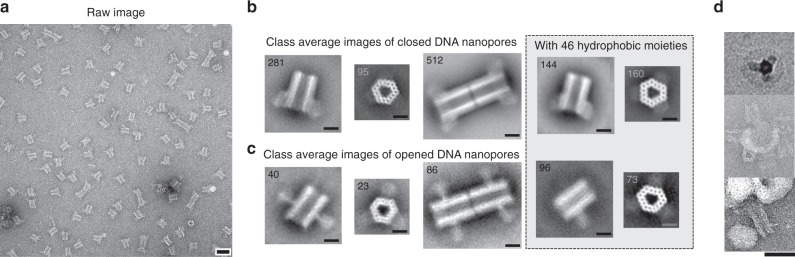
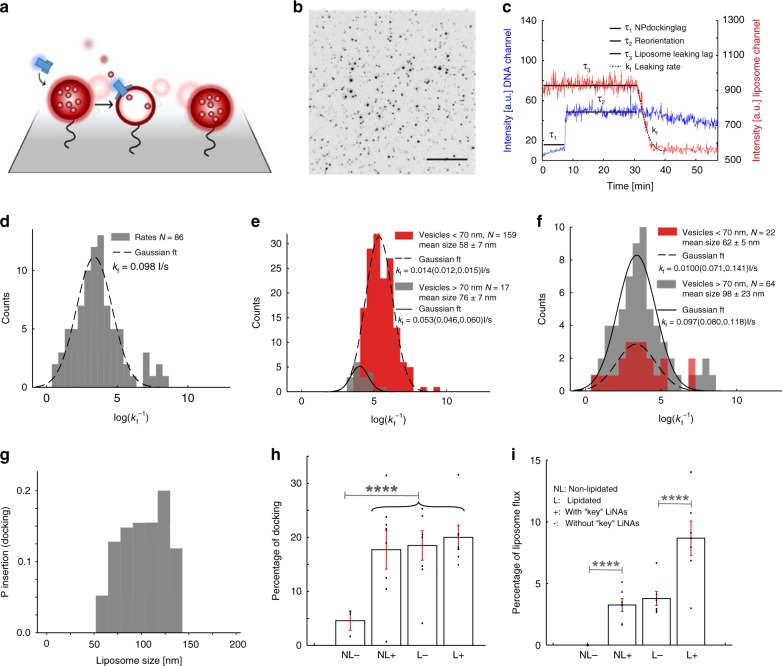
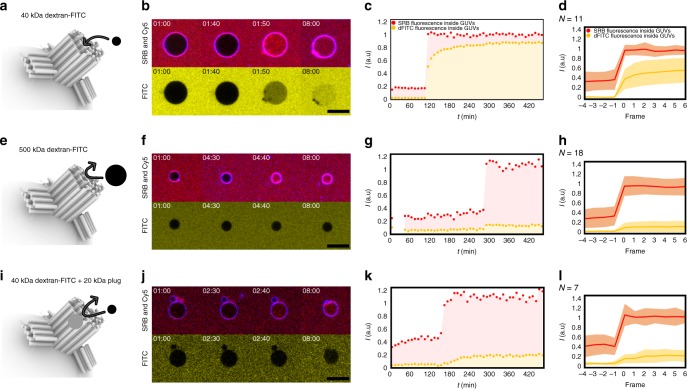
Transmembrane nanostructures like ion channels and transporters perform key biological functions by controlling flow of molecules across lipid bilayers. Much work has gone into engineering artificial nanopores and applications in selective gating of molecules, label-free detection/sensing of biomolecules and DNA sequencing have shown promise. Here, we use DNA origami to create a synthetic 9 nm wide DNA nanopore, controlled by programmable, lipidated flaps and equipped with a size-selective gating system for the translocation of macromolecules. Successful assembly and insertion of the nanopore into lipid bilayers are validated by transmission electron microscopy (TEM), while selective translocation of cargo and the pore mechanosensitivity are studied using optical methods, including single-molecule, total internal reflection fluorescence (TIRF) microscopy. Size-specific cargo translocation and oligonucleotide-triggered opening of the pore are demonstrated showing that the DNA nanopore can function as a real-time detection system for external signals, offering potential for a variety of highly parallelized sensing applications.
跨膜纳米结构,如离子通道和转运蛋白,通过控制分子在脂质双层中的流动来执行关键的生物学功能。人们在工程人工纳米孔及其在分子选择性门控、无标记生物分子检测/传感和 DNA 测序方面的应用方面做了大量工作,这些工作都显示出了前景。在这里,我们使用 DNA 折纸术创建了一个由可编程的脂化瓣控制的合成 9nm 宽 DNA 纳米孔,并配备了一个用于大分子易位的大小选择性门控系统。纳米孔成功地组装并插入脂质双层,这通过透射电子显微镜(TEM)得到了验证,而货物的选择性易位和孔的机械敏感性则使用光学方法进行了研究,包括单分子、全内反射荧光(TIRF)显微镜。展示了具有尺寸特异性的货物易位和寡核苷酸触发的孔打开,表明 DNA 纳米孔可以作为外部信号的实时检测系统,为各种高度并行化的传感应用提供了潜力。