Department of Pediatric Endocrinology, VU University Medical Center, 1081 HV Amsterdam, & Leiden University Medical Center, ZA Leiden, the Netherlands.
Department of Pediatric Endocrinology, VU University Medical Center, HV Amsterdam, the Netherlands.
J Clin Endocrinol Metab. 2020 Dec 1;105(12):e4252-63. doi: 10.1210/clinem/dgaa604.
Hormonal interventions in adolescents with gender dysphoria may have adverse effects, such as reduced bone mineral accrual.
To describe bone mass development in adolescents with gender dysphoria treated with gonadotropin-releasing hormone analogues (GnRHa), subsequently combined with gender-affirming hormones.
Observational prospective study.
51 transgirls and 70 transboys receiving GnRHa and 36 transgirls and 42 transboys receiving GnRHa and gender-affirming hormones, subdivided into early- and late-pubertal groups.
Bone mineral apparent density (BMAD), age- and sex-specific BMAD z-scores, and serum bone markers.
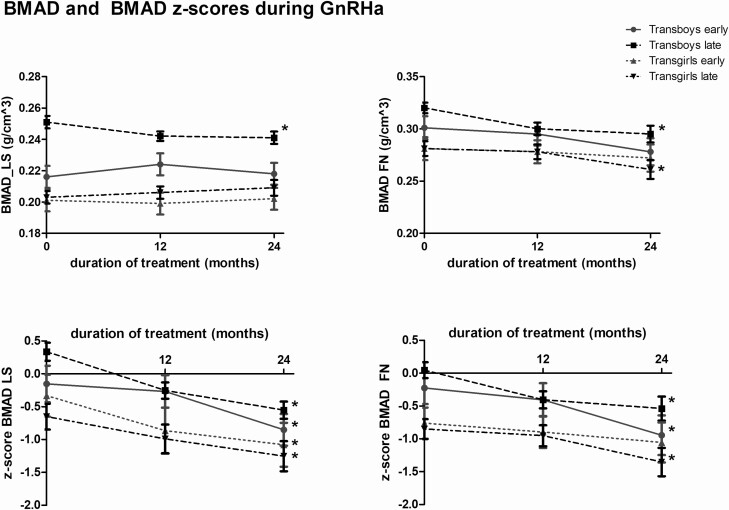
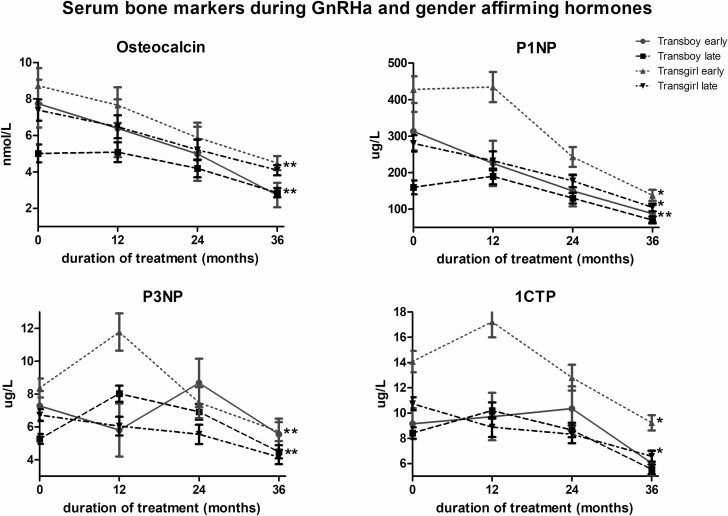
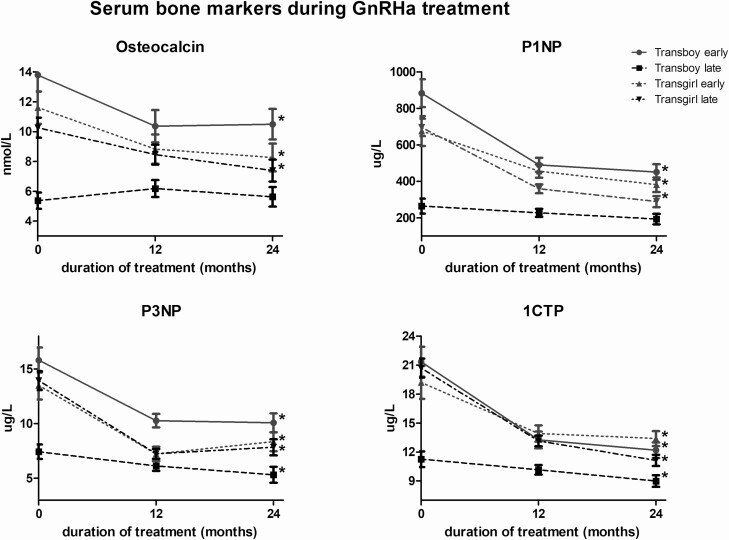
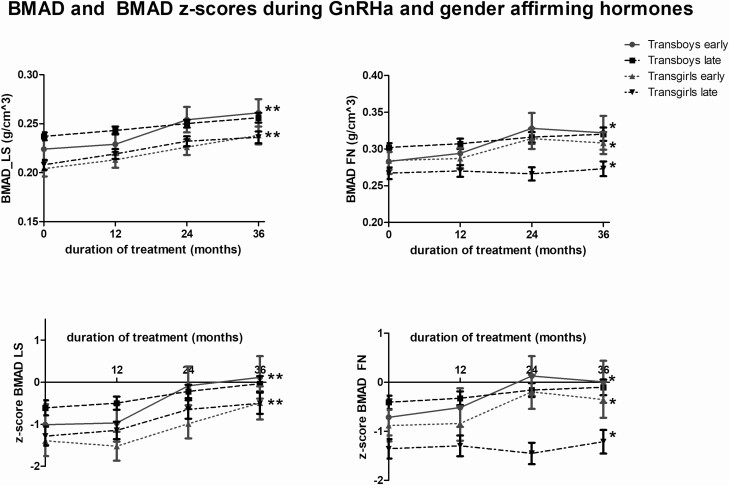
At the start of GnRHa treatment, mean areal bone mineral density (aBMD) and BMAD values were within the normal range in all groups. In transgirls, the mean z-scores were well below the population mean. During 2 years of GnRHa treatment, BMAD stabilized or showed a small decrease, whereas z-scores decreased in all groups. During 3 years of combined administration of GnRHa and gender-affirming hormones, a significant increase of BMAD was found. Z-scores normalized in transboys but remained below zero in transgirls. In transgirls and early pubertal transboys, all bone markers decreased during GnRHa treatment.
BMAD z-scores decreased during GnRHa treatment and increased during gender-affirming hormone treatment. Transboys had normal z-scores at baseline and at the end of the study. However, transgirls had relatively low z-scores, both at baseline and after 3 years of estrogen treatment. It is currently unclear whether this results in adverse outcomes, such as increased fracture risk, in transgirls as they grow older.
青春期性别焦虑症患者的激素干预可能会产生不良影响,如骨矿物质积累减少。
描述接受促性腺激素释放激素类似物(GnRHa)治疗后,随后联合性别肯定激素治疗的性别焦虑症青少年的骨量发育情况。
观察性前瞻性研究。
51 名跨性别女性和 70 名跨性别男性接受 GnRHa 治疗,36 名跨性别女性和 42 名跨性别男性接受 GnRHa 和性别肯定激素治疗,分为早、晚青春期组。
骨矿物质表观密度(BMAD)、年龄和性别特异性 BMAD z 评分和血清骨标志物。
在 GnRHa 治疗开始时,所有组的平均面积骨密度(aBMD)和 BMAD 值均在正常范围内。在跨性别女性中,平均 z 评分远低于人群平均值。在 GnRHa 治疗的 2 年内,BMAD 稳定或略有下降,而所有组的 z 评分均下降。在 GnRHa 和性别肯定激素联合治疗的 3 年内,发现 BMAD 显著增加。跨性别男性的 z 评分正常化,但跨性别女性仍低于零。在跨性别女性和早青春期的跨性别男性中,所有骨标志物在 GnRHa 治疗期间均减少。
在 GnRHa 治疗期间,BMAD z 评分下降,在性别肯定激素治疗期间增加。在研究开始和结束时,跨性别男性的 z 评分均正常。然而,跨性别女性的 z 评分相对较低,无论是在基线时还是在 3 年雌激素治疗后。目前尚不清楚这是否会导致跨性别女性随着年龄增长出现不良后果,例如骨折风险增加。