Center for Care Delivery and Outcomes Research.
Department of Psychology.
Dev Psychol. 2020 Nov;56(11):2152-2166. doi: 10.1037/dev0001106. Epub 2020 Sep 10.
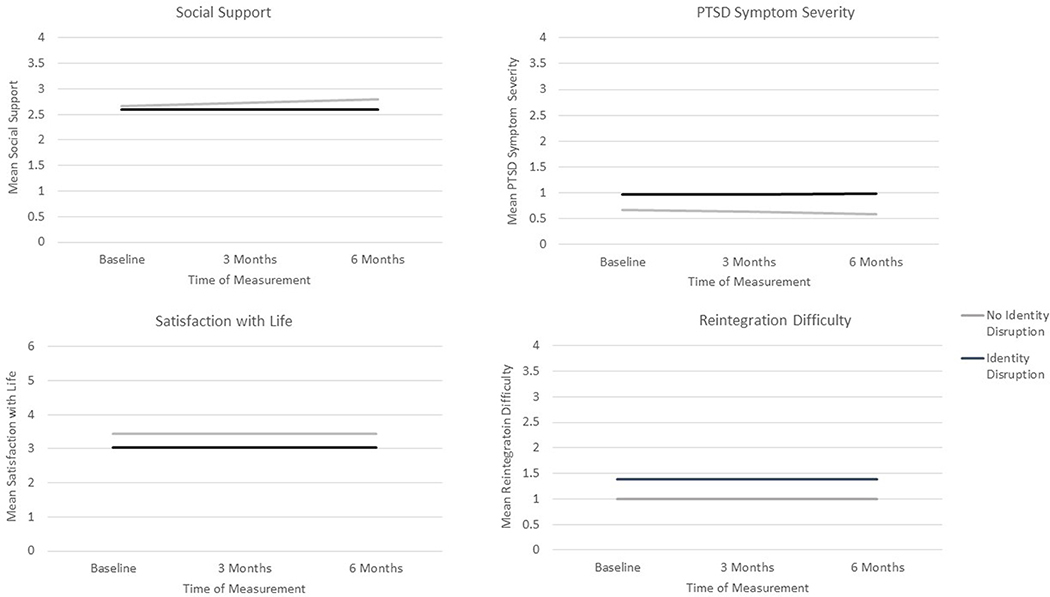
Most research and theory on identity integration focuses on adolescents and young adults under age 30, and relatively little is known about how identity adjusts to major life events later in life. The purpose of the present study was to operationalize and investigate , or a loss of temporal identity integration following a disruptive life event, within the developmental context of established adulthood and midlife. We used a mixed-methods approach to examine identity disruption among 244 Afghanistan and Iraq war veterans with reintegration difficulty who participated in an expressive writing intervention. Participants completed measures of social support, posttraumatic stress disorder (PTSD) symptom severity, satisfaction with life, and reintegration difficulty at baseline right before writing, and 3 and 6 months after the expressive writing intervention. The expressive writing samples were coded for identity disruption using thematic analysis. We hypothesized that identity disruption would be associated with lower social support, more severe PTSD symptoms, lower satisfaction with life, and greater reintegration difficulty at baseline. Forty-nine percent ( = 121) of the sample indicated identity disruption in their writing samples. Identity disruption was associated with more severe PTSD symptoms, lower satisfaction with life, and greater reintegration difficulty at baseline, and with less improvement in social support. The findings suggest that identity disruption is a meaningful construct for extending the study of identity development to established adult and midlife populations, and for understanding veterans' adjustment to civilian life. (PsycInfo Database Record (c) 2020 APA, all rights reserved).
大多数关于身份整合的研究和理论都集中在 30 岁以下的青少年和年轻人身上,而对于身份如何适应晚年的重大生活事件,相对知之甚少。本研究的目的是在成年和中年的发展背景下,对重大生活事件发生后身份的暂时整合丧失进行操作化和研究。我们采用混合方法,对 244 名患有再融入障碍的阿富汗和伊拉克战争退伍军人进行了研究,这些退伍军人参加了表达性写作干预。参与者在基线时(即写作前)、表达性写作干预后 3 个月和 6 个月,完成了社会支持、创伤后应激障碍(PTSD)症状严重程度、生活满意度和再融入障碍的测量。使用主题分析对表达性写作样本进行身份混乱编码。我们假设身份混乱与较低的社会支持、更严重的 PTSD 症状、较低的生活满意度和更大的再融入障碍有关。样本中有 49%(=121)的人在写作样本中表现出身份混乱。身份混乱与 PTSD 症状严重程度较高、生活满意度较低和再融入障碍较大有关,与社会支持改善较少有关。研究结果表明,身份混乱是一个有意义的概念,它可以将身份发展的研究扩展到成年和中年人群,也可以帮助我们理解退伍军人适应平民生活。