Department of Surgical, Medical, Molecular Pathology and Critical Area, University of Pisa, Via Savi 10, 56126, Pisa, Italy.
Department of Laboratory Medicine, Section of Pathology, University Hospital of Pisa, Via Roma 57, 56126, Pisa, Italy.
Endocrine. 2021 Apr;72(1):140-146. doi: 10.1007/s12020-020-02434-x. Epub 2020 Sep 11.
The 8th edition of the American Joint Committee on Cancer (AJCC) staging led to a significant downstaging of well differentiated thyroid cancer patients. However, some patients who had been downstaged still experienced death. By using data from the thyroid cancer dataset of The Cancer Genome Atlas (TCGA), we aimed to find molecular features that could improve survival prediction.
TCGA data were downloaded from cBioPortal. Restaging of cases was performed according to the pathological reports.
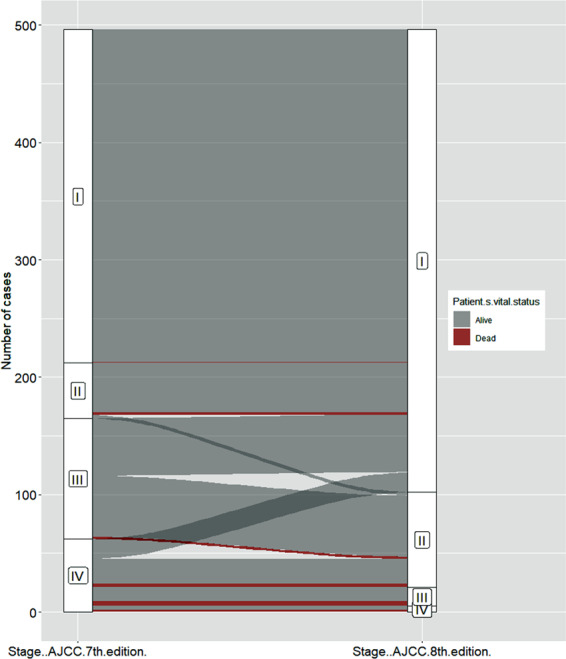
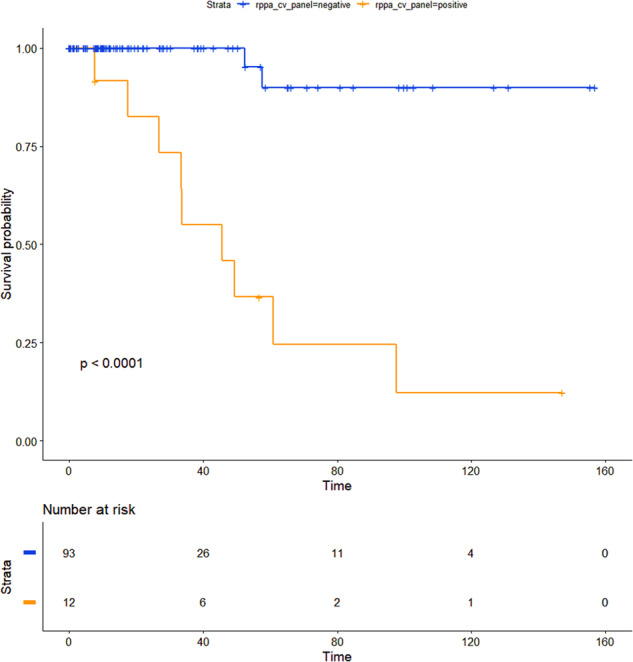
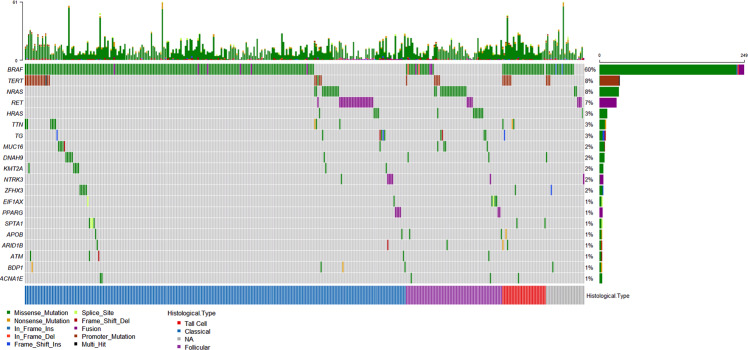
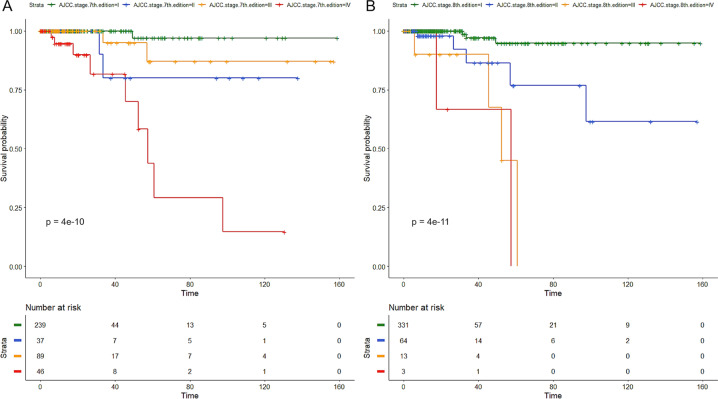
Out of 496 cases, 204 (41.1%) were downstaged, and the proportion of deaths increased in stages III and IV. TERT promoter mutations were no longer enriched in stage IV only, but significantly redistributed also in stages II and III. TERT mutation was the only alteration predictive of poor survival; however, in this series it was not independent from the AJCC staging. Five proteins (4E-BP1_pT70, Chk1_pS345, Snail, STAT5 alpha and PAI-1) were significantly associated with survival, and their use as a panel refined the risk stratification independently from the AJCC staging, with a hazard ratio for a positive result of 21.2 (95%CI 3.7-122.2, P = 0.0006).
In the TCGA series, the proportion of deaths is in line with the expected survival of the latest AJCC staging, with a neat separation of risk among stages. Nevertheless, the use of protein expression can be useful in refining the stratification. Finally, after the restaging, a considerable number of tumors with TERT mutations will be allocated in lower stages; hence, dedicated studies should define the prognostic usefulness of these mutations in low-stage diseases.
第 8 版美国癌症联合委员会(AJCC)分期导致分化良好的甲状腺癌患者分期明显降低。然而,一些被降级的患者仍有死亡。本研究利用癌症基因组图谱(TCGA)甲状腺癌数据集的数据,旨在寻找能提高生存预测的分子特征。
从 cBioPortal 下载 TCGA 数据。根据病理报告对病例进行重新分期。
在 496 例病例中,204 例(41.1%)降级,III 期和 IV 期的死亡率增加。TERT 启动子突变不再局限于 IV 期,而且在 II 期和 III 期也有明显的重新分布。TERT 突变是唯一预测不良生存的改变;然而,在本系列中,它并不独立于 AJCC 分期。有 5 种蛋白(4E-BP1_pT70、Chk1_pS345、Snail、STAT5alpha 和 PAI-1)与生存显著相关,它们作为一个面板的使用独立于 AJCC 分期进行风险分层,阳性结果的危险比为 21.2(95%CI 3.7-122.2,P=0.0006)。
在 TCGA 系列中,死亡比例与最新 AJCC 分期的预期生存率一致,各期之间风险明显分离。然而,蛋白质表达的使用有助于细化分层。最后,在重新分期后,相当多的 TERT 突变肿瘤将被分配到较低的分期;因此,应专门研究这些突变在低分期疾病中的预后作用。