Institute of Digestive Diseases, Xijing Hospital, Fourth Military Medical University, Xi'an, China.
State Key Laboratory of Cancer Biology, Department of Biochemistry and Molecular Biology, Fourth Military Medical University, Xi'an, China.
J Clin Lab Anal. 2020 Nov;34(11):e23501. doi: 10.1002/jcla.23501. Epub 2020 Sep 11.
Ursodeoxycholic acid (UDCA) has been widely recommended as the first-line drug for primary biliary cholangitis (PBC) in the current guidelines. However, its therapeutic effects are poor in nearly one-third of patients. The early identification and intervention of these patients is crucial for delaying disease progression. Therefore, we explored risk factors for inadequate biochemical response and constructed a nomogram to predict the potential risk.
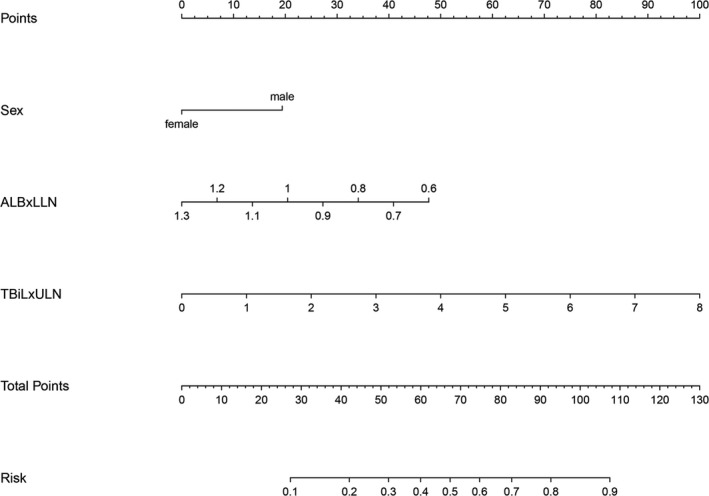
We enrolled 356 patients and randomly divided them into training (70%) and validation groups (30%). We defined inadequate biochemical response as the study endpoint. Logistic analysis was used to identify the independent predictors of poor biochemical response. Based on these factors, a predictive nomogram was finally constructed. Then, discrimination and calibration were evaluated by internal validation. Additionally, the association between the model predictions and prognosis was further analyzed.
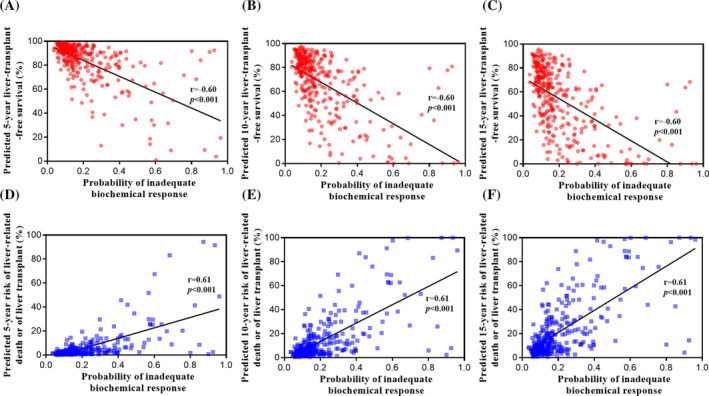
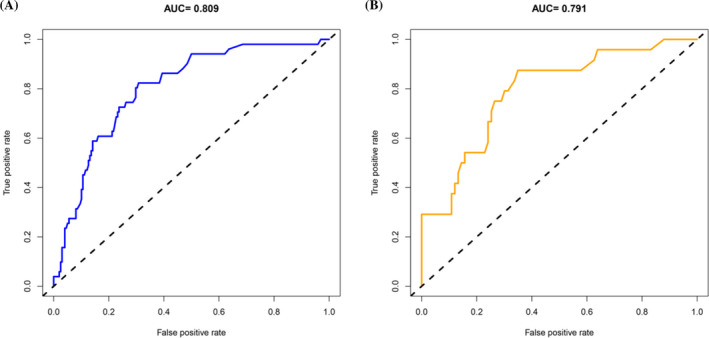
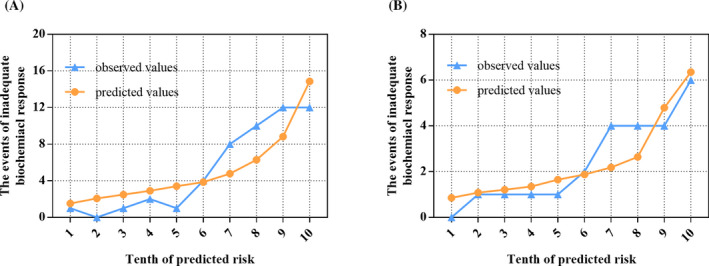
Female sex, and albumin and bilirubin concentrations were identified as risk factors, and a nomogram was built based on these factors. The areas under the ROC curves of the training and validation groups were 0.809 and 0.791, respectively. Moreover, calibration curves showed that predictions of the nomogram had good concordance with the actual outcomes. The correlation analysis demonstrated that PBC patients with a high probability of a suboptimal biochemical response were more likely to have adverse outcomes.
We constructed a nomogram, which can accurately predict the risk of inadequate biochemical response to UDCA, facilitating the early screening of high-risk patients with PBC who should be prioritized for additional therapy.
熊去氧胆酸(UDCA)已被广泛推荐为原发性胆汁性胆管炎(PBC)的一线药物。然而,近三分之一的患者治疗效果不佳。早期识别和干预这些患者对于延缓疾病进展至关重要。因此,我们探讨了生化缓解不良的危险因素,并构建了一个列线图来预测潜在风险。
我们纳入了 356 名患者,并将其随机分为训练(70%)和验证组(30%)。我们将生化缓解不良定义为研究终点。使用逻辑分析来确定生化缓解不良的独立预测因素。基于这些因素,最终构建了一个预测列线图。然后,通过内部验证评估了区分度和校准度。此外,还进一步分析了模型预测与预后之间的关系。
女性、白蛋白和胆红素浓度被确定为危险因素,并基于这些因素构建了一个列线图。训练组和验证组的 ROC 曲线下面积分别为 0.809 和 0.791。此外,校准曲线表明,列线图的预测与实际结果具有良好的一致性。相关性分析表明,UDCA 生化缓解不良可能性较高的 PBC 患者更有可能出现不良结局。
我们构建了一个列线图,可以准确预测 UDCA 治疗生化缓解不良的风险,有助于早期筛选出需要额外治疗的 PBC 高危患者。