Human Anatomy and Cell Differentiation Lab, Department of Medicine and Aging Sciences, University "G. D'Annunzio" of Chieti-Pescara, 66100 Chieti, Italy.
Department of Experimental Diagnostic and Speciality Medicine, Unit of Histology, Embriology and Applied Biology, University of Bologna, 40126 Bologna, Italy.
Int J Mol Sci. 2020 Sep 9;21(18):6589. doi: 10.3390/ijms21186589.
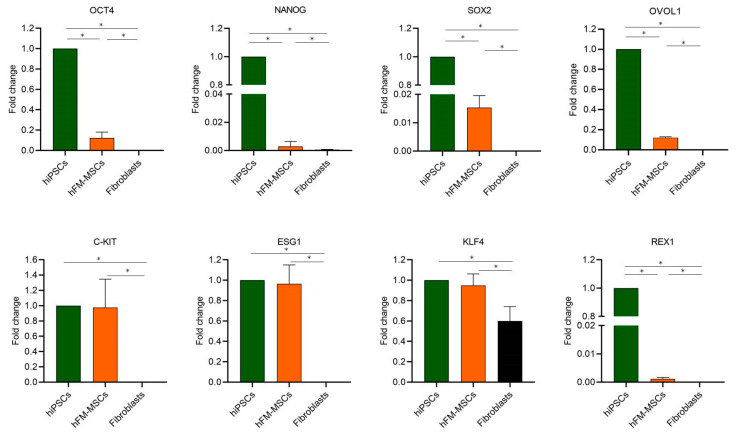
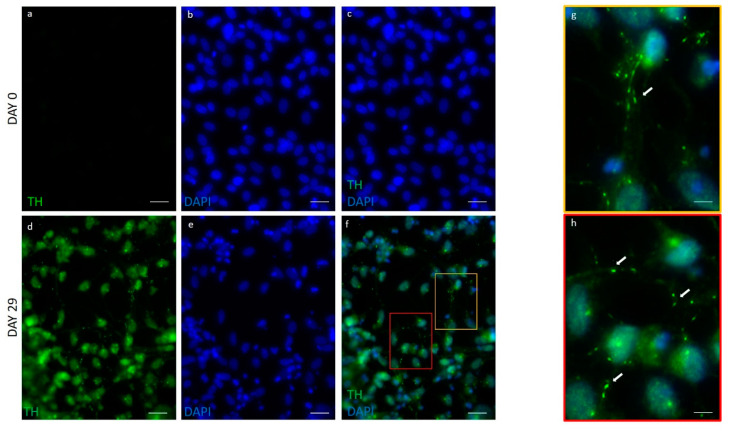
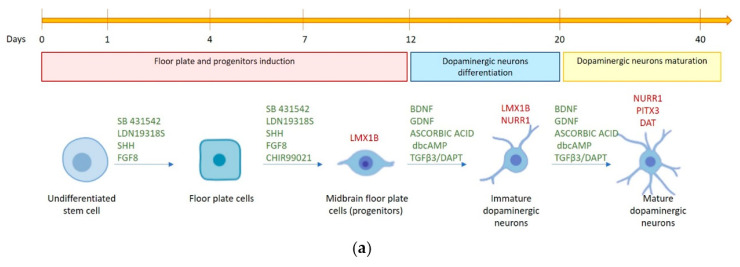
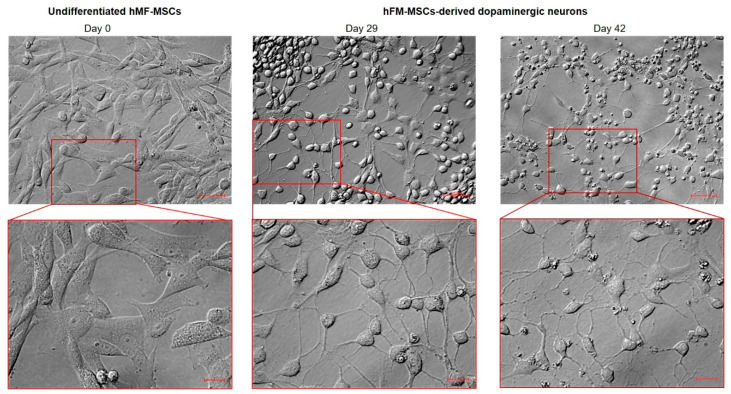
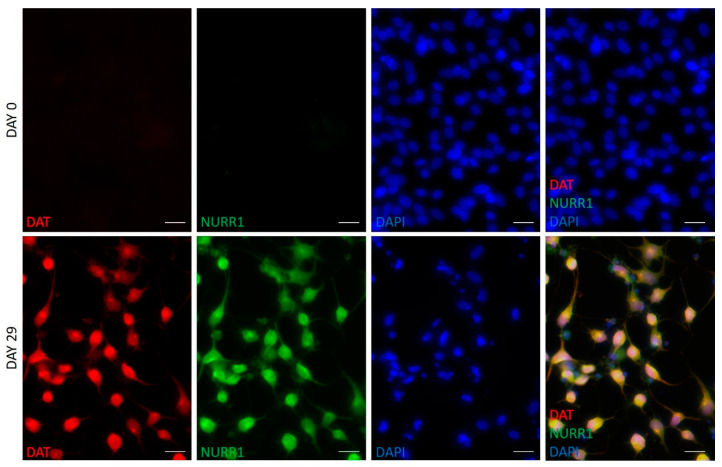
Degeneration of dopaminergic neurons represents the cause of many neurodegenerative diseases, with increasing incidence worldwide. The replacement of dead cells with new healthy ones may represent an appealing therapeutic approach to these pathologies, but currently, only pluripotent stem cells can generate dopaminergic neurons with high efficiency. However, with the use of these cells arises safety and/or ethical issues. Human mesenchymal stromal cells (hFM-MSCs) are perinatal stem cells that can be easily isolated from the amniochorionic membrane after delivery. Generally considered multipotent, their real differentiative potential is not completely elucidated. The aim of this study was to analyze their stemness characteristics and to evaluate whether they may overcome their mesenchymal fate, generating dopaminergic neurons. We demonstrated that hFM-MSCs expressed embryonal genes OCT4, NANOG, SOX2, KLF4, OVOL1, and ESG1, suggesting they have some features of pluripotency. Moreover, hFM-MSCs that underwent a dopaminergic differentiation protocol gradually increased the transcription of dopaminergic markers LMX1b, NURR1, PITX3, and DAT. We finally obtained a homogeneous population of cells resembling the morphology of primary midbrain dopaminergic neurons that expressed the functional dopaminergic markers TH, DAT, and Nurr1. In conclusion, our results suggested that hFM-MSCs retain the expression of pluripotency genes and are able to differentiate not only into mesodermal cells, but also into neuroectodermal dopaminergic neuron-like cells.
多巴胺能神经元的退化是许多神经退行性疾病的病因,其全球发病率正在上升。用新的健康细胞替代死亡细胞可能代表了治疗这些疾病的一种有吸引力的方法,但目前只有多能干细胞才能有效地产生多巴胺能神经元。然而,使用这些细胞会带来安全和/或伦理问题。人间质基质细胞(hFM-MSCs)是围产期干细胞,可在分娩后从羊膜绒毛膜中轻易分离。它们通常被认为具有多能性,但它们的真正分化潜能尚未完全阐明。本研究旨在分析其干性特征,并评估其是否可以克服其间质命运,产生多巴胺能神经元。我们证明 hFM-MSCs 表达胚胎基因 OCT4、NANOG、SOX2、KLF4、OVOL1 和 ESG1,表明它们具有一些多能性特征。此外,经过多巴胺能分化方案处理的 hFM-MSCs 逐渐增加了多巴胺能标志物 LMX1b、NURR1、PITX3 和 DAT 的转录。我们最终获得了一种类似于原代中脑多巴胺能神经元形态的同源细胞群,其表达功能性多巴胺能标志物 TH、DAT 和 Nurr1。总之,我们的研究结果表明 hFM-MSCs 保留了多能性基因的表达,不仅能分化为中胚层细胞,还能分化为神经外胚层多巴胺能神经元样细胞。