Emergency Department, Fondazione Policlinico Universitario A. Gemelli, IRCCS, Rome, Italy.
Department of Intensive Care, Emergency Medicine and Anaesthesiology, Fondazione Policlinico Universitario A. Gemelli-IRCCS, Rome, Italy; Institute of Anaesthesiology and Intensive Care Medicine, Università Cattolica del Sacro Cuore, Rome, Italy.
Resuscitation. 2020 Nov;156:84-91. doi: 10.1016/j.resuscitation.2020.08.124. Epub 2020 Sep 9.
To identify the most accurate early warning score (EWS) for predicting an adverse outcome in COVID-19 patients admitted to the emergency department (ED).
In adult consecutive patients admitted (March 1-April 15, 2020) to the ED of a major referral centre for COVID-19, we retrospectively calculated NEWS, NEWS2, NEWS-C, MEWS, qSOFA, and REMS from physiological variables measured on arrival. Sensitivity, specificity, positive (PPV) and negative predictive value (NPV), and the area under the receiver operating characteristic (AUROC) curve of each EWS for predicting admission to the intensive care unit (ICU) and death at 48 h and 7 days were calculated.
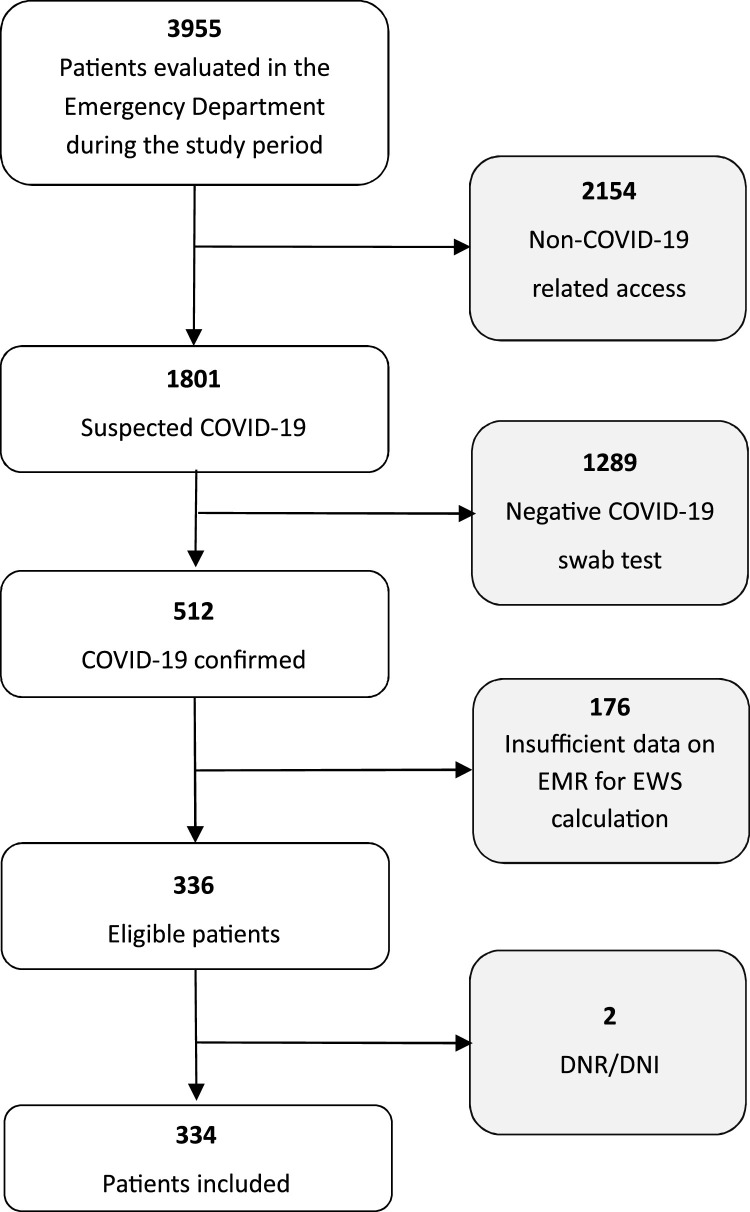
We included 334 patients (119 [35.6%] females, median age 66 [54-78] years). At 7 days, the rates of ICU admission and death were 56/334 (17%) and 26/334 (7.8%), respectively. NEWS was the most accurate predictor of ICU admission within 7 days (AUROC 0.783 [95% CI, 0.735-0.826]; sensitivity 71.4 [57.8-82.7]%; NPV 93.1 [89.8-95.3]%), while REMS was the most accurate predictor of death within 7 days (AUROC 0.823 [0.778-0.863]; sensitivity 96.1 [80.4-99.9]%; NPV 99.4[96.2-99.9]%). Similar results were observed for ICU admission and death at 48 h. NEWS and REMS were as accurate as the triage system used in our ED. MEWS and qSOFA had the lowest overall accuracy for both outcomes.
In our single-centre cohort of COVID-19 patients, NEWS and REMS measured on ED arrival were the most sensitive predictors of 7-day ICU admission or death. EWS could be useful to identify patients with low risk of clinical deterioration.
确定最准确的早期预警评分(EWS),以预测因 COVID-19 入住急诊科(ED)的患者的不良结局。
我们回顾性地计算了 2020 年 3 月 1 日至 4 月 15 日在我们的 COVID-19 主要转诊中心的 ED 连续收治的成年患者的 NEWS、NEWS2、NEWS-C、MEWS、qSOFA 和 REMS,这些评分基于入院时测量的生理变量。计算了每个 EWS 预测入住 ICU 和 48 小时和 7 天内死亡的敏感性、特异性、阳性预测值(PPV)和阴性预测值(NPV),以及接收器操作特征(ROC)曲线下面积(AUROC)。
我们纳入了 334 例患者(119 例[35.6%]为女性,中位年龄 66 [54-78]岁)。7 天时,入住 ICU 和死亡的比例分别为 56/334(17%)和 26/334(7.8%)。NEWS 是预测 7 天内入住 ICU 的最准确指标(AUROC 0.783 [95%CI,0.735-0.826];敏感性 71.4 [57.8-82.7]%;NPV 93.1 [89.8-95.3]%),而 REMS 是预测 7 天内死亡的最准确指标(AUROC 0.823 [0.778-0.863];敏感性 96.1 [80.4-99.9]%;NPV 99.4[96.2-99.9]%)。在 48 小时内,ICU 入住和死亡的结果相似。NEWS 和 REMS 与我们 ED 使用的分诊系统一样准确。MEWS 和 qSOFA 对两种结局的整体准确性最低。
在我们的 COVID-19 患者单中心队列中,入院时测量的 NEWS 和 REMS 是预测 7 天内 ICU 入住或死亡的最敏感预测指标。EWS 可用于识别临床恶化风险较低的患者。