Department of Exercise and Sport Science, University of North Carolina at Chapel Hill, Chapel Hill, NC 27599-8700, USA; Matthew Gfeller Sport-Related Traumatic Brain Injury Research Center, University of North Carolina, Chapel Hill, NC 27599-8700, USA; Injury Prevention Research Center, University of North Carolina, Chapel Hill, NC 27510, USA.
Department of Exercise and Sport Science, University of North Carolina at Chapel Hill, Chapel Hill, NC 27599-8700, USA; Matthew Gfeller Sport-Related Traumatic Brain Injury Research Center, University of North Carolina, Chapel Hill, NC 27599-8700, USA; Human Movement Science Curriculum, University of North Carolina, Chapel Hill, NC 27599-8700, USA.
J Sport Health Sci. 2021 Mar;10(2):113-121. doi: 10.1016/j.jshs.2020.09.001. Epub 2020 Sep 10.
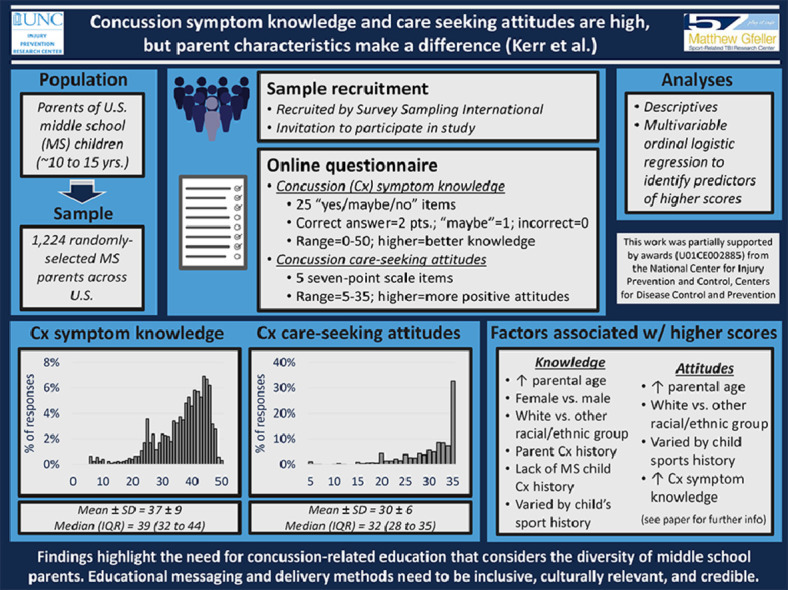
Developing appropriate concussion prevention and management paradigms in middle school (MS) settings requires understanding parents' general levels of concussion-related knowledge and attitudes. This study examined factors associated with concussion-symptom knowledge and care-seeking attitudes among parents of MS children (aged 10-15 years).
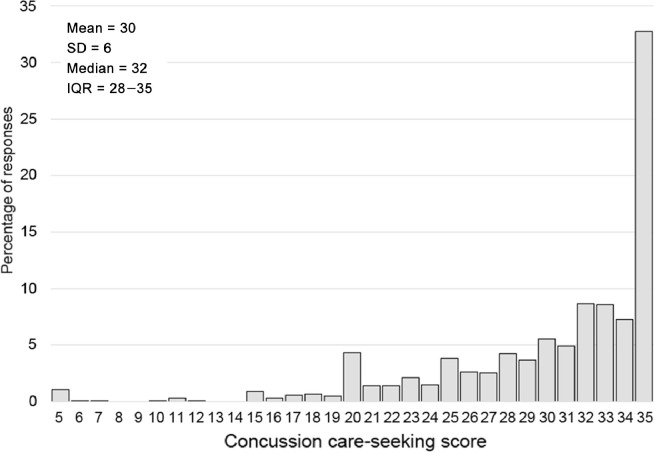
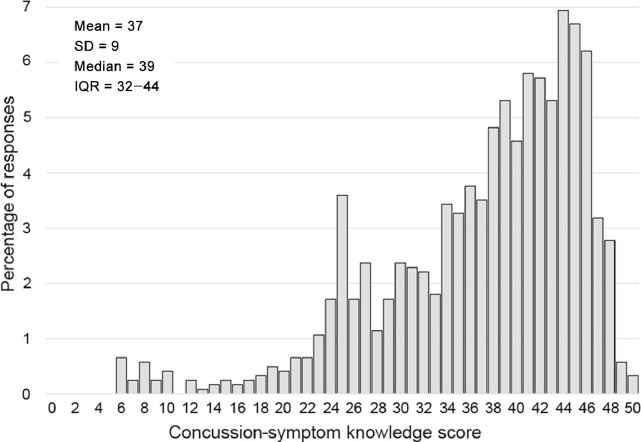
A panel of 1224 randomly selected U.S. residents, aged ≥ 18 years and identifying as parents of MS children, completed an online questionnaire capturing parental and child characteristics. The parents' concussion-symptom knowledge was measured using 25 questions, with possible answers being "yes", "maybe", and "no". Correct answers earned 2 points, "maybe" answers earned 1 point, and incorrect answers earned 0 point (range: 0-50; higher scores = better knowledge). Concussion care-seeking attitudes were also collected using five 7-point scale items (range: 5-35; higher scores = more positive attitudes). Multivariable ordinal logistic regression models identified predictors of higher scores. Models met proportional odds assumptions. Adjusted odds ratios (aORs) with 95% confidence intervals (95%CIs) (excluding 1.00) were deemed statistically significant.
Median scores were 39 (interquartile range: 32-44) for symptom knowledge and 32 (interquartile range: 28-35) for care-seeking attitude. In multivariable models, odds of better symptom knowledge were higher in women vs. men (aOR = 2.28; 95%CI: 1.71-3.05), white/non-Hispanics vs. other racial or ethnic groups (aOR = 1.88; 95%CI: 1.42-2.49), higher parental age (10-year-increase aOR = 1.47; 95%CI: 1.26-1.71), and greater competitiveness (10%-scale-increase aOR = 1.24; 95%CI: 1.13-1.36). Odds of more positive care-seeking attitudes were higher in white/non-Hispanics vs. other racial or ethnic groups (aOR = 1.45; 95%CI: 1.06-1.99) and in older parental age (10-year-increase aOR = 1.24; 95%CI: 1.05-1.47).
Characteristics of middle school children's parents (e.g., sex, race or ethnicity, age) are associated with their concussion-symptom knowledge and care-seeking attitudes. Parents' variations in concussion knowledge and attitudes warrant tailored concussion education and prevention.
在中学(MS)环境中制定适当的脑震荡预防和管理模式,需要了解家长对脑震荡相关知识和态度的普遍水平。本研究调查了与中学生父母(年龄在 10-15 岁之间)的脑震荡症状知识和寻求治疗态度相关的因素。
一个由 1224 名随机选择的美国≥18 岁且自认为是中学生父母的居民,完成了一份在线问卷,该问卷捕获了父母和孩子的特征。父母的脑震荡症状知识通过 25 个问题进行衡量,答案可能是“是”、“可能”和“否”。正确答案得 2 分,“可能”答案得 1 分,错误答案得 0 分(范围:0-50;分数越高表示知识越好)。还使用五个 7 分制量表项目收集了脑震荡治疗态度(范围:5-35;分数越高表示态度越积极)。多变量有序逻辑回归模型确定了较高分数的预测因素。模型符合比例优势假设。调整后的优势比(aOR)及其 95%置信区间(95%CI)(不包括 1.00)被认为具有统计学意义。
症状知识的中位数为 39(四分位距:32-44),治疗态度的中位数为 32(四分位距:28-35)。在多变量模型中,女性比男性(aOR=2.28;95%CI:1.71-3.05)、白人/非西班牙裔与其他种族或族裔群体(aOR=1.88;95%CI:1.42-2.49)、父母年龄较高(每增加 10 岁,aOR=1.47;95%CI:1.26-1.71)、竞争意识较强(每增加 10%的分数,aOR=1.24;95%CI:1.13-1.36),其脑震荡症状知识较好的可能性更高。白人/非西班牙裔比其他种族或族裔群体(aOR=1.45;95%CI:1.06-1.99)以及父母年龄较大(每增加 10 岁,aOR=1.24;95%CI:1.05-1.47),其寻求治疗的态度更为积极。
中学生父母的特征(例如,性别、种族或民族、年龄)与他们的脑震荡症状知识和治疗态度有关。家长对脑震荡的知识和态度存在差异,需要有针对性地进行脑震荡教育和预防。