Uy Jessica P, Galván Adriana
Department of Psychology, University of California, Los Angeles, Los Angeles, CA, 90095, USA.
Department of Psychology, University of California, Los Angeles, Los Angeles, CA, 90095, USA.
Dev Cogn Neurosci. 2020 Oct;45:100859. doi: 10.1016/j.dcn.2020.100859. Epub 2020 Sep 8.
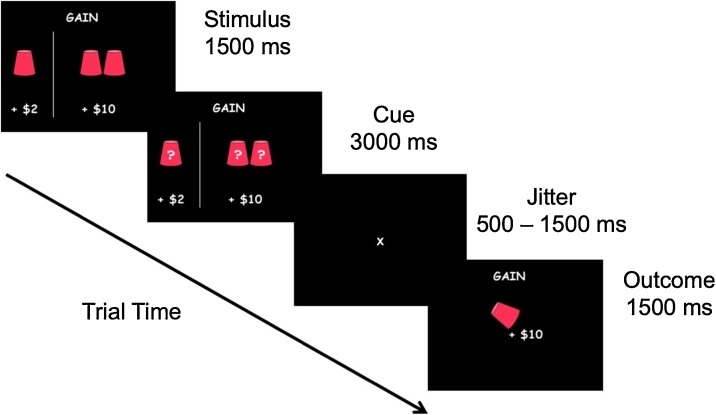
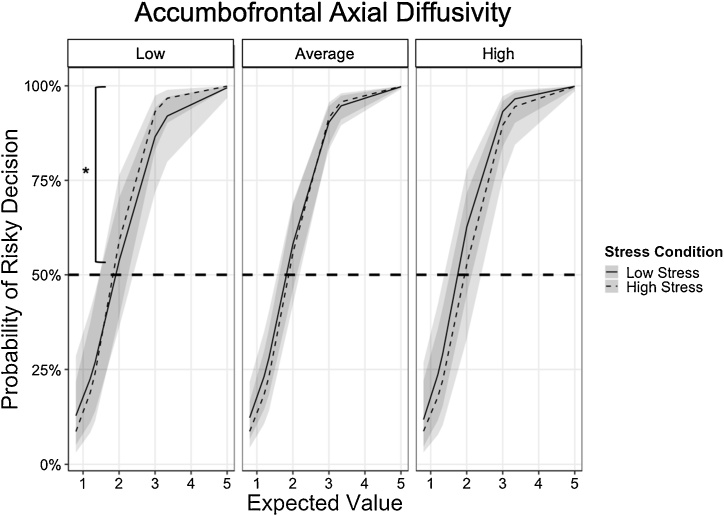
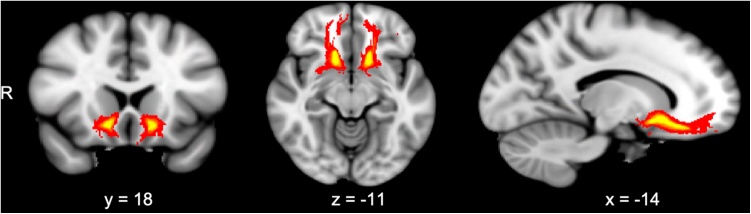
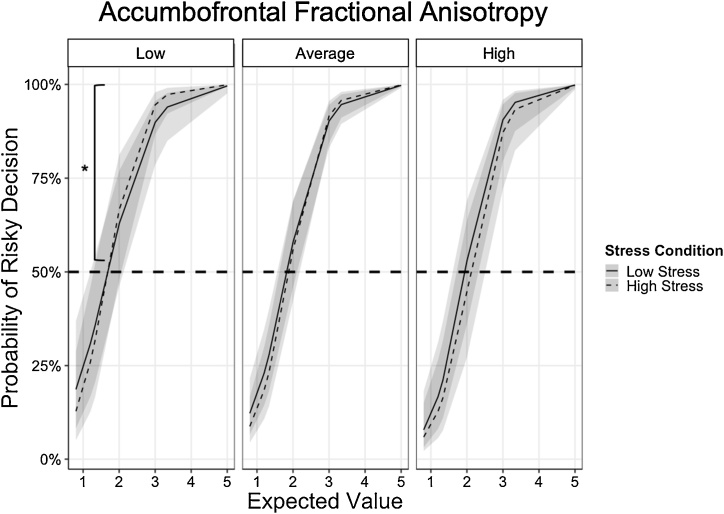
Psychosocial stress increases risky decision-making (DM). It is widely accepted that individual variation in neural phenotypes underlie variability in this behavioral tendency in adults, but is less examined in adolescents. Our goal was to test the hypothesis that the relation between neural phenotypes and stress-related risky DM is better characterized by individual variation than by age. Using diffusion tensor imaging (DTI) tractography to characterize the accumbofrontal tract, we determined if it uniquely moderated how stress affects risky DM, over and above age. A daily diary design monitored participants' daily stress for two weeks. Participants completed a DTI scan and performed a task in which decisions varied by expected value, once each on a day when they endorsed feeling higher (and lower) than usual levels of stress. Multilevel logistic regression analyses revealed that all participants were more likely to take risks as expected reward value increased; this behavior was greater under high versus low stress for individuals with low accumbofrontal tract integrity, whereas DM was less influenced by stress for individuals with high accumbofrontal tract integrity, regardless of age. Results suggest that individual differences in brain structure may be more germane to characterizing risky decisions in adolescents, rather than ontogeny.
心理社会压力会增加冒险决策(DM)。人们普遍认为,成人群体中这种行为倾向的变异性源于神经表型的个体差异,但在青少年中对此的研究较少。我们的目标是检验这样一个假设:与压力相关的冒险决策与神经表型之间的关系,用个体差异来描述比用年龄来描述更为恰当。我们使用扩散张量成像(DTI)纤维束成像来描绘伏隔额叶束,确定它是否能在年龄之外,独特地调节压力对冒险决策的影响。采用每日日记设计,对参与者的日常压力进行了为期两周的监测。参与者完成了一次DTI扫描,并执行了一项任务,其中决策因预期价值而异,在他们认可感觉压力高于(或低于)平常水平的日子里各进行一次。多层次逻辑回归分析显示,随着预期奖励价值的增加,所有参与者都更有可能冒险;对于伏隔额叶束完整性较低的个体,在高压力与低压力情况下这种行为更为明显,而对于伏隔额叶束完整性较高的个体,决策受压力的影响较小,无论其年龄如何。结果表明,大脑结构的个体差异可能比个体发育更能准确描述青少年的冒险决策。