Department of Oncology, People's Hospital of Xindu District, Chengdu, Sichuan 610500, People's Republic of China.
Department of Oncology, The Affiliated Hospital of Southwest Medical University Luzhou, Sichuan 646000, People's Republic of China.
Int J Nanomedicine. 2020 Aug 25;15:6409-6420. doi: 10.2147/IJN.S246659. eCollection 2020.
Tumor cell-derived microparticles (MP) can function as a targeted delivery carrier for anti-tumor drugs. Here, we aimed to generate paclitaxel-loaded microparticles (MP-PTX) from HeLa cells and examined its therapeutic potential on human cervical carcinoma.
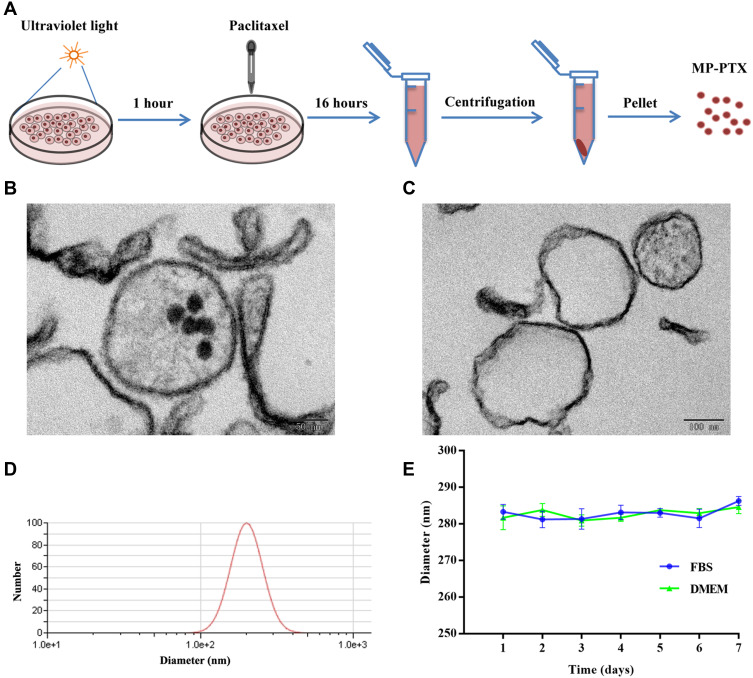
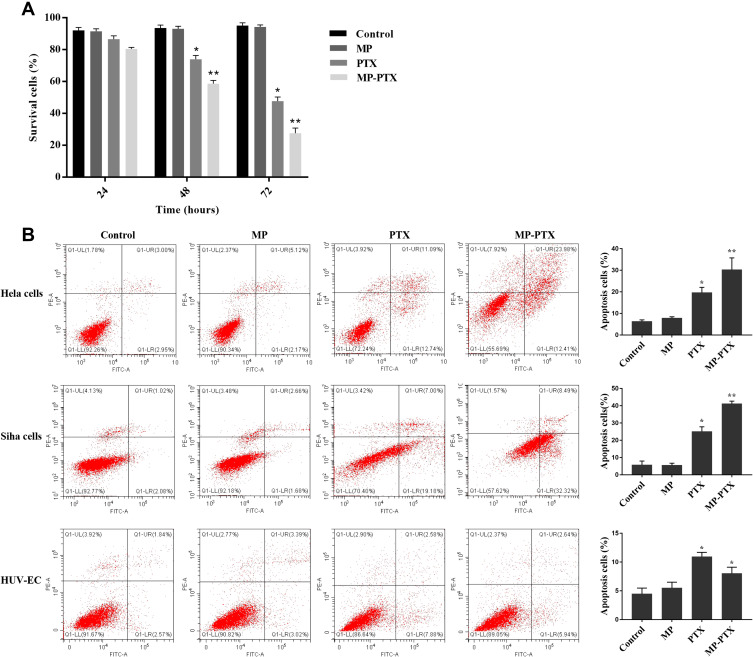
MP-PTX was generated from HeLa cells by ultraviolet radiation and subsequent centrifugation. The particle size, drug loading rate, and stability of MP-PTX were examined in vitro. Flow cytometry and the MTT assay were performed to test the inhibitory effect of MP-PTX using different cell lines. Immunodeficient mice bearing HeLa cervical carcinoma were treated with 0.9% normal saline, MP, paclitaxel (PTX) (2.5 mg/kg), or MP-PTX (PTX content identical to PTX group) every day for 6 consecutive days. Tumor volume and animal survival were observed. Micro F-FDG PET/CT was performed to monitor the therapeutic efficacy. The proliferation activity of cells and microvessel density in tumor tissues were determined by immunohistochemical staining using Ki-67 and CD31, respectively.
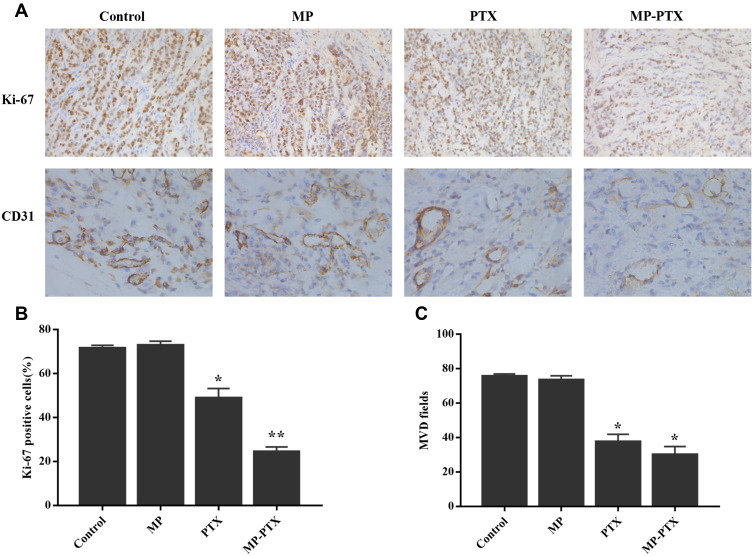
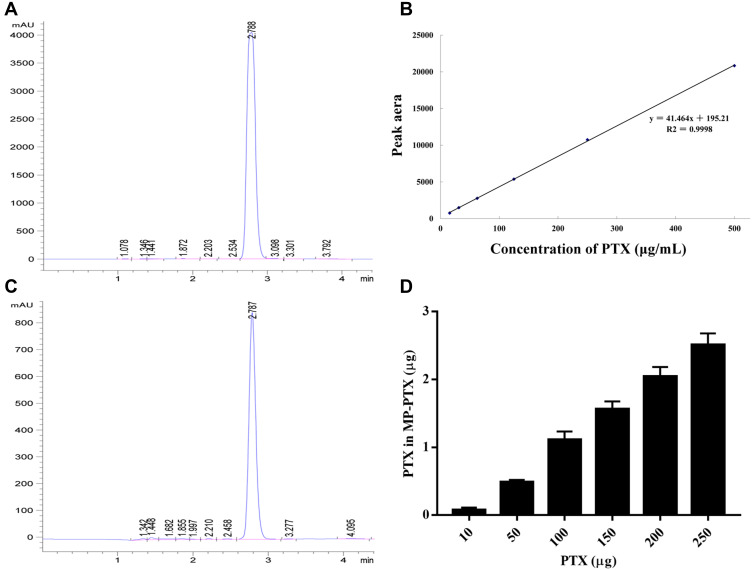
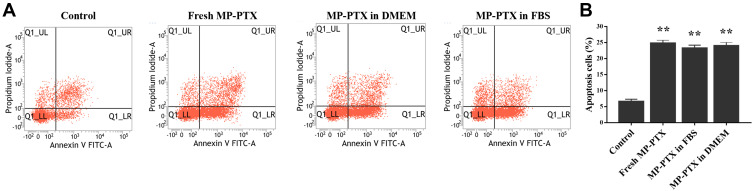
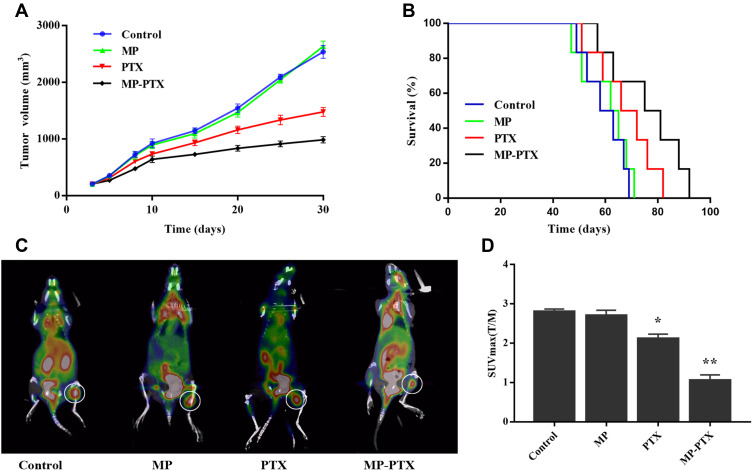
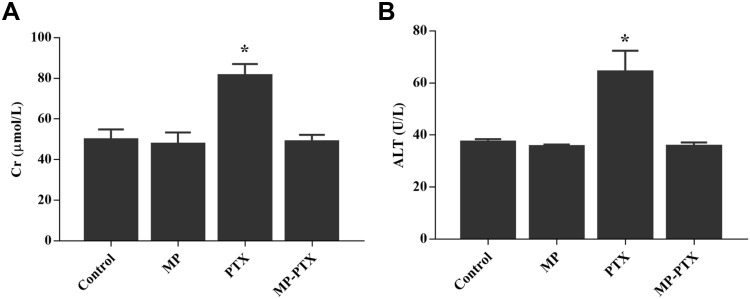
Dynamic laser scattering measurements showed that the particle size of MP-PTX was 285.58 ± 2.95 nm and the polydispersity index was 0.104 ± 0.106. And the particle size of MP-PTX was not change at 4°C for at least one week. More than 1% of PTX in the medium could be successfully encapsulated into HeLa cell-derived MP. When compared with PTX, MP-PTX treatment significantly increased apoptosis of tumor cells and reduced their proliferation. In addition, MP-PTX showed lower toxicity to normal human umbilical vein endothelial cells (HUVEC) than PTX. In vivo studies further demonstrated that MP-PTX treatment significantly inhibited the growth of cervical carcinoma, prolonged the survival of tumor-bearing mice, and reduced the toxicity of PTX. Immunohistochemical staining revealed that MP-PTX treatment led to decreased Ki-67 positive tumor cells and decreased microvessel density in tumor tissues.
Our results demonstrated that HeLa-derived MP-PTX significantly enhanced the anti-cancer effects of PTX with reduced toxicity, which may provide a novel strategy for the treatment of cervical carcinoma.
肿瘤细胞衍生的微粒(MP)可以作为靶向递药载体将抗肿瘤药物递送至肿瘤部位。本研究旨在从 HeLa 细胞中制备紫杉醇负载的微粒(MP-PTX),并研究其对人宫颈癌的治疗潜力。
采用紫外辐射和离心法从 HeLa 细胞中制备 MP-PTX。体外检测 MP-PTX 的粒径、载药量和稳定性。采用流式细胞术和 MTT 法检测不同细胞系中 MP-PTX 的抑制作用。免疫缺陷小鼠皮下接种 HeLa 宫颈癌细胞,每天给予 0.9%生理盐水、MP、紫杉醇(PTX)(2.5 mg/kg)或 MP-PTX(PTX 载药量与 PTX 组相同)连续 6 天。观察肿瘤体积和动物生存情况。采用微 F-FDG PET/CT 监测治疗效果。采用 Ki-67 和 CD31 免疫组化染色分别检测肿瘤组织中细胞的增殖活性和微血管密度。
动态激光散射测量结果显示,MP-PTX 的粒径为 285.58 ± 2.95nm,多分散指数为 0.104 ± 0.106。MP-PTX 在 4°C 下至少一周内粒径无明显变化。超过 1%的 PTX 可成功包封于 HeLa 细胞衍生的 MP 中。与 PTX 相比,MP-PTX 处理可显著增加肿瘤细胞的凋亡,降低其增殖。此外,MP-PTX 对人脐静脉内皮细胞(HUVEC)的毒性低于 PTX。体内研究进一步表明,MP-PTX 治疗可显著抑制宫颈癌的生长,延长荷瘤小鼠的生存时间,并降低 PTX 的毒性。免疫组化染色结果显示,MP-PTX 治疗可导致肿瘤组织中 Ki-67 阳性肿瘤细胞减少和微血管密度降低。
本研究结果表明,HeLa 细胞来源的 MP-PTX 可显著增强 PTX 的抗癌作用,同时降低其毒性,为宫颈癌的治疗提供了一种新策略。