Department of Hematology, the Third Xiangya Hospital, Central South University, Changsha, Hunan, P.R. China.
Department of Orthopaedics, Xiangya Hospital, Central South University, Changsha, Hunan, P.R. China.
Int J Med Sci. 2020 Jul 25;17(14):2063-2076. doi: 10.7150/ijms.48244. eCollection 2020.
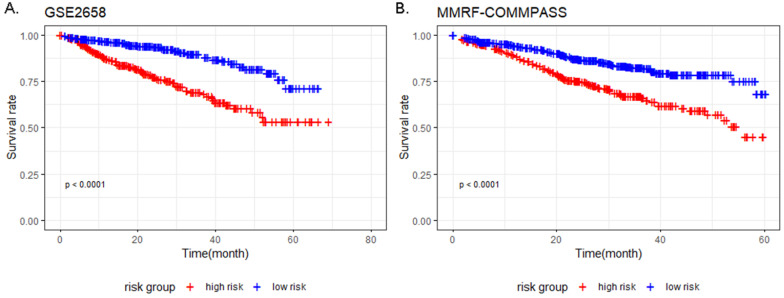
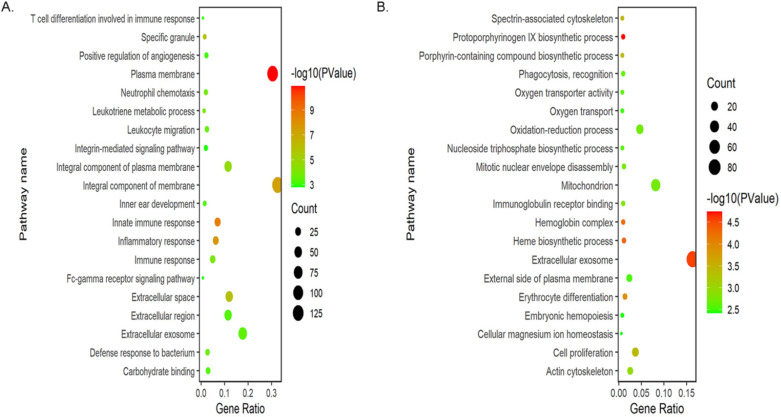
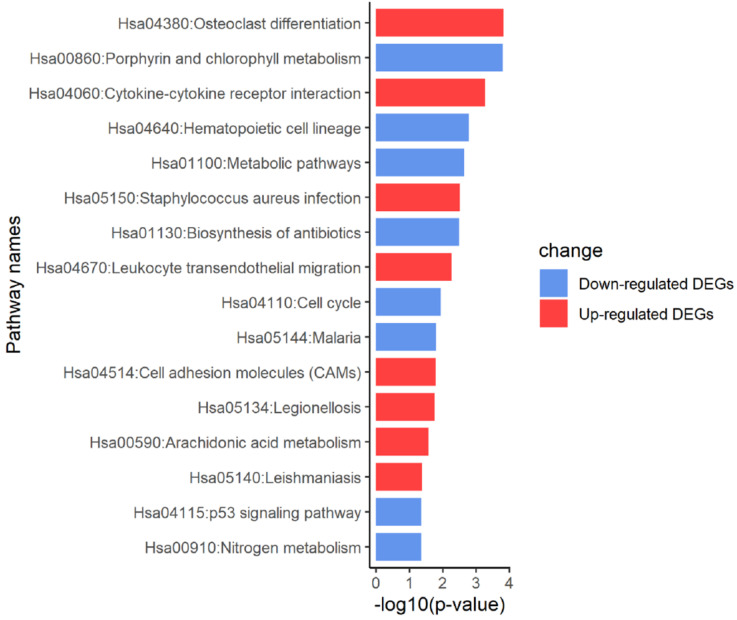
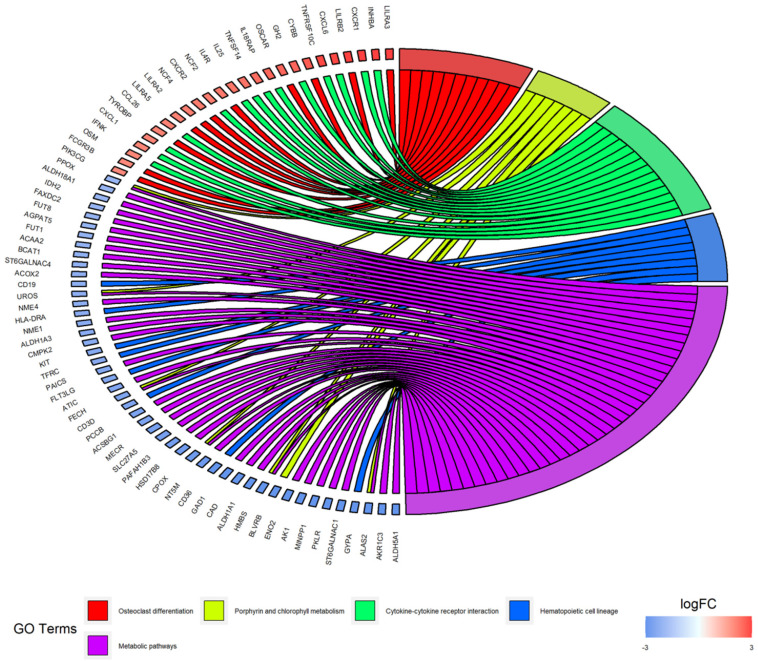
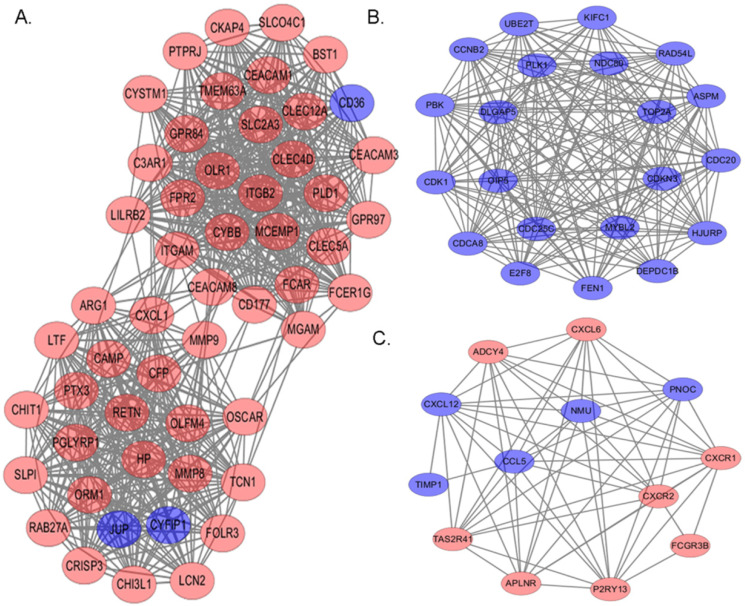
Multiple myeloma (MM) is the second most common hematological malignancy, which is still incurable and relapses inevitably, highlighting further understanding of the possible mechanisms. Side population (SP) cells are a group of enriched progenitor cells showing stem-like phenotypes with a distinct low-staining pattern with Hoechst 33342. Compared to main population (MP) cells, the underlying molecular characteristics of SP cells remain largely unclear. This bioinformatics analysis aimed to identify key genes and pathways in myeloma SP cells to provide novel biomarkers, predict MM prognosis and advance potential therapeutic targets. The gene expression profile GSE109651 was obtained from Gene Expression Omnibus database, and then differentially expressed genes (DEGs) with P-value <0.05 and |log2 fold-change (FC)| > 2 were selected by the comparison of myeloma light-chain (LC) restricted SP (LC/SP) cells and MP CD138 cells. Subsequently, gene ontology (GO) and Kyoto encyclopedia of genes and genomes (KEGG) pathway enrichment analysis, protein-protein interaction (PPI) network analysis were performed to identify the functional enrichment analysis of the DEGs and screen hub genes. Cox proportional hazards regression was used to select the potential prognostic DEGs in training dataset (GSE2658). The prognostic value of the potential prognostic genes was evaluated by Kaplan-Meier curve and validated in another external dataset (MMRF-CoMMpass cohort from TCGA). Altogether, 403 up-regulated and 393 down-regulated DEGs were identified. GO analysis showed that the up-regulated DEGs were significantly enriched in innate immune response, inflammatory response, plasma membrane and integral component of membrane, while the down-regulated DEGs were mainly involved in protoporphyrinogen IX and heme biosynthetic process, hemoglobin complex and erythrocyte differentiation. KEGG pathway analysis suggested that the DEGs were significantly enriched in osteoclast differentiation, porphyrin and chlorophyll metabolism and cytokine-cytokine receptor interaction. The top 10 hub genes, identified by the plug-in cytoHubba of the Cytoscape software using maximal clique centrality (MCC) algorithm, were ITGAM, MMP9, ITGB2, FPR2, C3AR1, CXCL1, CYBB, LILRB2, HP and FCER1G. Modules and corresponding GO enrichment analysis indicated that myeloma LC/SP cells were significantly associated with immune system, immune response and cell cycle. The predictive value of the prognostic model including TFF3, EPDR1, MACROD1, ARHGEF12, AMMECR1, NFATC2, HES6, PLEK2 and SNCA was identified, and validated in another external dataset (MMRF-CoMMpass cohort from TCGA). In conclusion, this study provides reliable molecular biomarkers for screening, prognosis, as well as novel therapeutic targets for myeloma LC/SP cells.
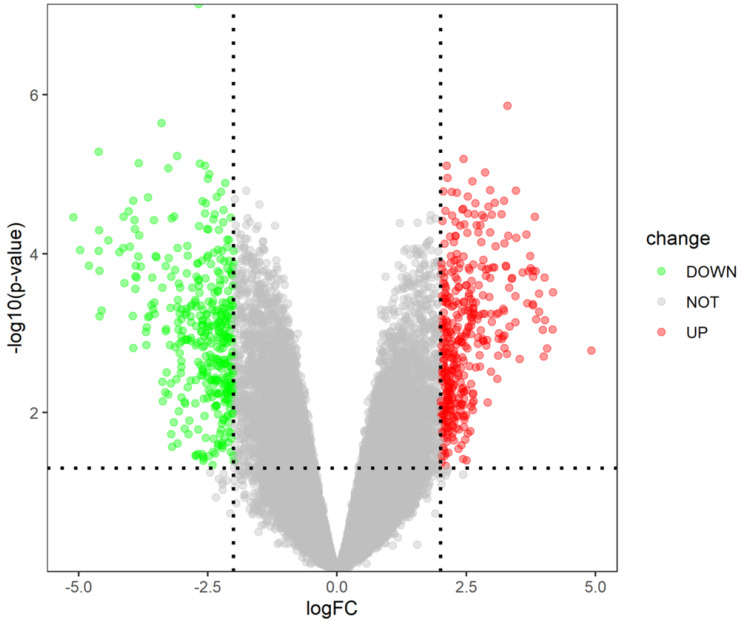
多发性骨髓瘤(MM)是第二大常见血液系统恶性肿瘤,目前仍无法治愈,且不可避免地会复发,这凸显了进一步了解可能的发病机制的必要性。侧群(SP)细胞是一组富含祖细胞的群体,具有明显的低染色模式,表现出干细胞样表型。与主群(MP)细胞相比,SP 细胞的潜在分子特征在很大程度上仍不清楚。本生物信息学分析旨在鉴定骨髓瘤 SP 细胞中的关键基因和通路,为提供新的生物标志物、预测 MM 预后和推进潜在的治疗靶点提供参考。从基因表达综合数据库中获取基因表达谱 GSE109651,通过骨髓瘤轻链(LC)限制的 SP(LC/SP)细胞与 MP CD138 细胞比较,选择 P 值<0.05 和 |log2 倍变化(FC)|>2 的差异表达基因(DEGs)。随后,进行基因本体(GO)和京都基因与基因组百科全书(KEGG)通路富集分析、蛋白质-蛋白质相互作用(PPI)网络分析,以鉴定 DEGs 的功能富集分析,并筛选枢纽基因。在训练数据集(GSE2658)中,使用 Cox 比例风险回归选择潜在的预后 DEGs。通过 Kaplan-Meier 曲线评估潜在预后基因的预后价值,并在另一个外部数据集(TCGA 中的 MMRF-CoMMpass 队列)中进行验证。结果显示,共鉴定出 403 个上调和 393 个下调的 DEGs。GO 分析表明,上调的 DEGs 显著富集于天然免疫反应、炎症反应、质膜和膜整体成分,而下调的 DEGs 主要参与原卟啉原 IX 和血红素生物合成过程、血红蛋白复合物和红细胞分化。KEGG 通路分析表明,DEGs 显著富集于破骨细胞分化、卟啉和叶绿素代谢以及细胞因子-细胞因子受体相互作用。使用 Cytoscape 软件中的插件 cytoHubba 基于最大团块中心度(MCC)算法鉴定出的前 10 个枢纽基因包括 ITGAM、MMP9、ITGB2、FPR2、C3AR1、CXCL1、CYBB、LILRB2、HP 和 FCER1G。模块和相应的 GO 富集分析表明,骨髓瘤 LC/SP 细胞与免疫系统、免疫反应和细胞周期显著相关。包括 TFF3、EPDR1、MACROD1、ARHGEF12、AMMECR1、NFATC2、HES6、PLEK2 和 SNCA 的预后模型的预测价值已在另一个外部数据集(TCGA 中的 MMRF-CoMMpass 队列)中得到验证。综上所述,本研究为骨髓瘤 LC/SP 细胞的筛选、预后提供了可靠的分子生物标志物,并为其提供了新的治疗靶点。