Brand Johannes, Piccirelli Marco, Hepp-Reymond Marie-Claude, Eng Kynan, Michels Lars
Institute of Neuroinformatics, University of Zurich and ETH Zurich, Zurich, Switzerland.
Neuroscience Center Zurich, Zurich, Switzerland.
Front Hum Neurosci. 2020 Aug 14;14:309. doi: 10.3389/fnhum.2020.00309. eCollection 2020.
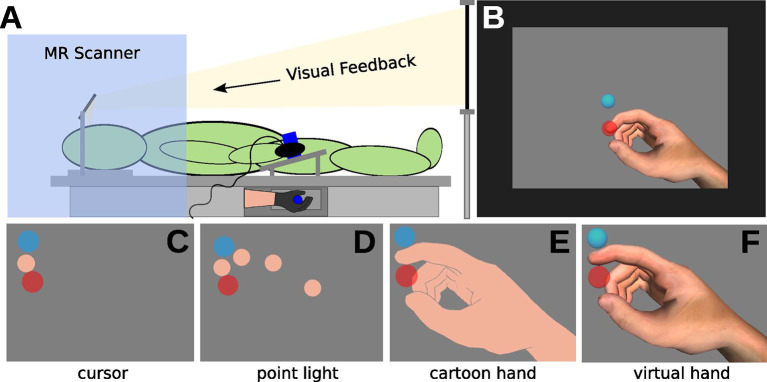
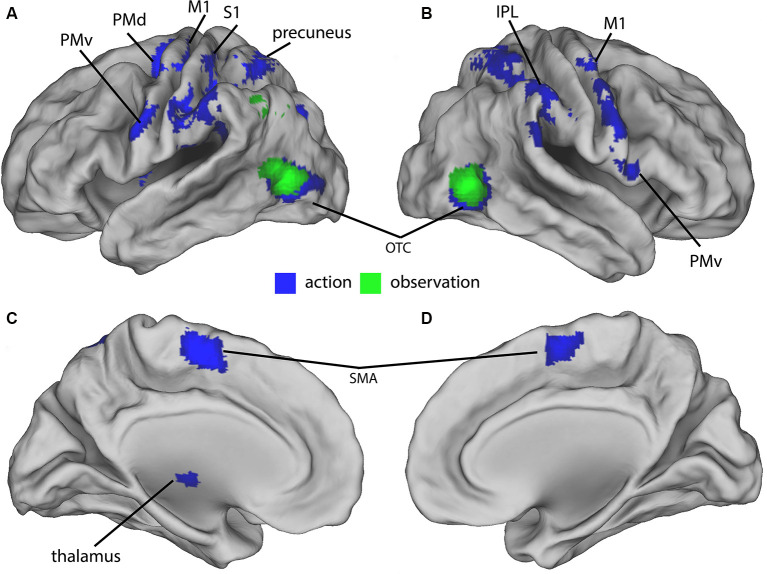
Computer interaction visually guided hand movements often employs either abstract cursor-based feedback or virtual hand (VH) representations of varying degrees of realism. The effect of changing this visual feedback in virtual reality settings is currently unknown. In this study, 19 healthy right-handed adults performed index finger movements ("action") and observed movements ("observation") with four different types of visual feedback: a simple circular cursor (CU), a point light (PL) pattern indicating finger joint positions, a shadow cartoon hand (SH) and a realistic VH. Finger movements were recorded using a data glove, and eye-tracking was recorded optically. We measured brain activity using functional magnetic resonance imaging (fMRI). Both action and observation conditions showed stronger fMRI signal responses in the occipitotemporal cortex compared to baseline. The action conditions additionally elicited elevated bilateral activations in motor, somatosensory, parietal, and cerebellar regions. For both conditions, feedback of a hand with a moving finger (SH, VH) led to higher activations than CU or PL feedback, specifically in early visual regions and the occipitotemporal cortex. Our results show the stronger recruitment of a network of cortical regions during visually guided finger movements with human hand feedback when compared to a visually incomplete hand and abstract feedback. This information could have implications for the design of visually guided tasks involving human body parts in both research and application or training-related paradigms.
计算机交互中视觉引导的手部动作通常采用基于抽象光标的反馈或不同程度逼真度的虚拟手(VH)表示。目前尚不清楚在虚拟现实环境中改变这种视觉反馈的效果。在本研究中,19名健康的右利手成年人用四种不同类型的视觉反馈进行食指动作(“动作”)和观察动作(“观察”):一个简单的圆形光标(CU)、一个指示手指关节位置的点光(PL)图案、一个阴影卡通手(SH)和一个逼真的VH。使用数据手套记录手指动作,并通过光学方式记录眼动。我们使用功能磁共振成像(fMRI)测量大脑活动。与基线相比,动作和观察条件在枕颞叶皮层均显示出更强的fMRI信号反应。动作条件还在运动、体感、顶叶和小脑区域引起双侧激活增加。对于这两种条件,带有移动手指的手的反馈(SH、VH)比CU或PL反馈导致更高的激活,特别是在早期视觉区域和枕颞叶皮层。我们的结果表明,与视觉上不完整的手和抽象反馈相比,在视觉引导的手指动作过程中,当有人类手部反馈时,皮层区域网络的募集更强。这些信息可能对涉及人体部位的视觉引导任务在研究、应用或训练相关范式中的设计有影响。