Bishop R Clayton, Boretto Matteo, Rutkowski Melanie R, Vankelecom Hugo, Derré Isabelle
Department of Microbiology, Immunology, and Cancer Biology, University of Virginia, Charlottesville, VA, United States.
Unit of Stem Cell Research, Cluster of Stem Cell and Developmental Biology, Department of Development and Regenerations, University of Leuven, Leuven, Belgium.
Front Cell Infect Microbiol. 2020 Aug 14;10:416. doi: 10.3389/fcimb.2020.00416. eCollection 2020.
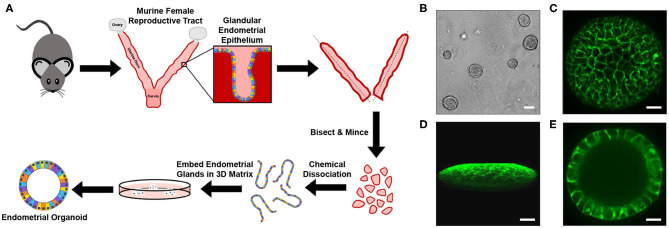
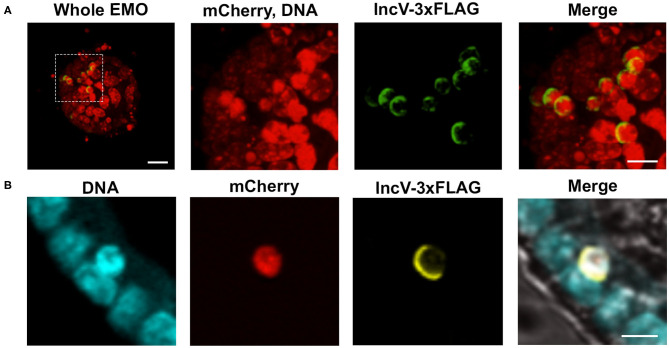
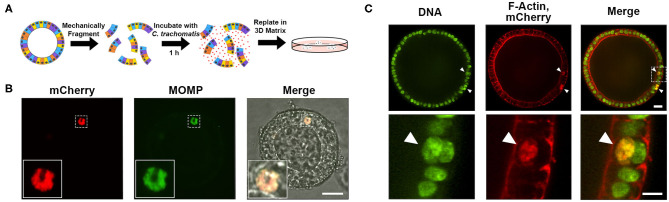
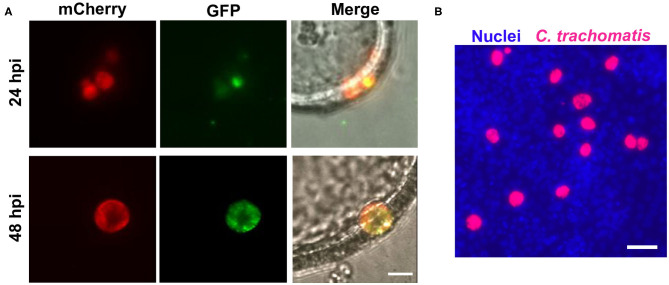
The obligate intracellular bacterium is the leading cause of bacterial sexually transmitted infections. Once internalized in host cells, undergoes a biphasic developmental cycle within a membrane-bound compartment, known as the inclusion. Successful establishment of the intracellular niche relies on bacterial Type III effector proteins, such as Inc proteins. and systems have contributed to elucidating the intracellular lifestyle of , but additional models combining the archetypal environment of infection with the advantages of systems are needed. Organoids are three-dimensional structures that recapitulate the microanatomy of an organ's epithelial layer, bridging the gap between and systems. Organoids are emerging as relevant model systems to study interactions between bacterial pathogens and their hosts. Here, we took advantage of recently developed murine endometrial organoids (EMOs) and present a -murine EMO infection model system. Confocal microscopy of EMOs infected with fluorescent protein-expressing bacteria revealed that inclusions are formed within the cytosol of epithelial cells. Moreover, infection with a strain that allows for the tracking of RB to EB transition indicated that the bacteria undergo a full developmental cycle, which was confirmed by harvesting infectious bacteria from infected EMOs. Finally, the inducible gene expression and cellular localization of a Inc protein within infected EMOs further demonstrated that this model is compatible with the study of Type III secreted effectors. Altogether, we describe a novel and relevant system for the study of -host interactions.
专性胞内细菌是细菌性性传播感染的主要病因。一旦被内化到宿主细胞中,它会在一个被称为包涵体的膜结合区室内经历双相发育周期。细胞内生态位的成功建立依赖于细菌III型效应蛋白,如Inc蛋白。[具体细菌名称1]和[具体细菌名称2]系统有助于阐明[具体细菌名称1]的细胞内生存方式,但需要将典型感染环境与[具体细菌名称2]系统的优势相结合的其他模型。类器官是三维结构,可概括器官上皮层的微观解剖结构,弥合[具体细菌名称1]和[具体细菌名称2]系统之间的差距。类器官正成为研究细菌病原体与其宿主之间相互作用的相关模型系统。在这里,我们利用最近开发的小鼠子宫内膜类器官(EMO),并展示了一种[具体细菌名称1]-小鼠EMO感染模型系统。对感染表达荧光蛋白细菌的EMO进行共聚焦显微镜检查发现,在上皮细胞的细胞质中形成了包涵体。此外,用一种允许追踪RB向EB转变的[具体细菌名称1]菌株进行感染表明,细菌经历了完整的发育周期,这通过从感染的EMO中收获感染性细菌得到了证实。最后,感染的EMO中[具体细菌名称1] Inc蛋白的可诱导基因表达和细胞定位进一步证明该模型与III型分泌效应器的研究兼容。总之,我们描述了一种用于研究[具体细菌名称1]-宿主相互作用的新型相关系统。