National Institute for Occupational Safety and Health, Centers for Disease Control and Prevention, Washington, District of Columbia, USA.
National Institute for Occupational Safety and Health, Centers for Disease Control and Prevention, Cincinnati, Ohio, USA.
Am J Ind Med. 2020 Dec;63(12):1065-1084. doi: 10.1002/ajim.23183. Epub 2020 Sep 14.
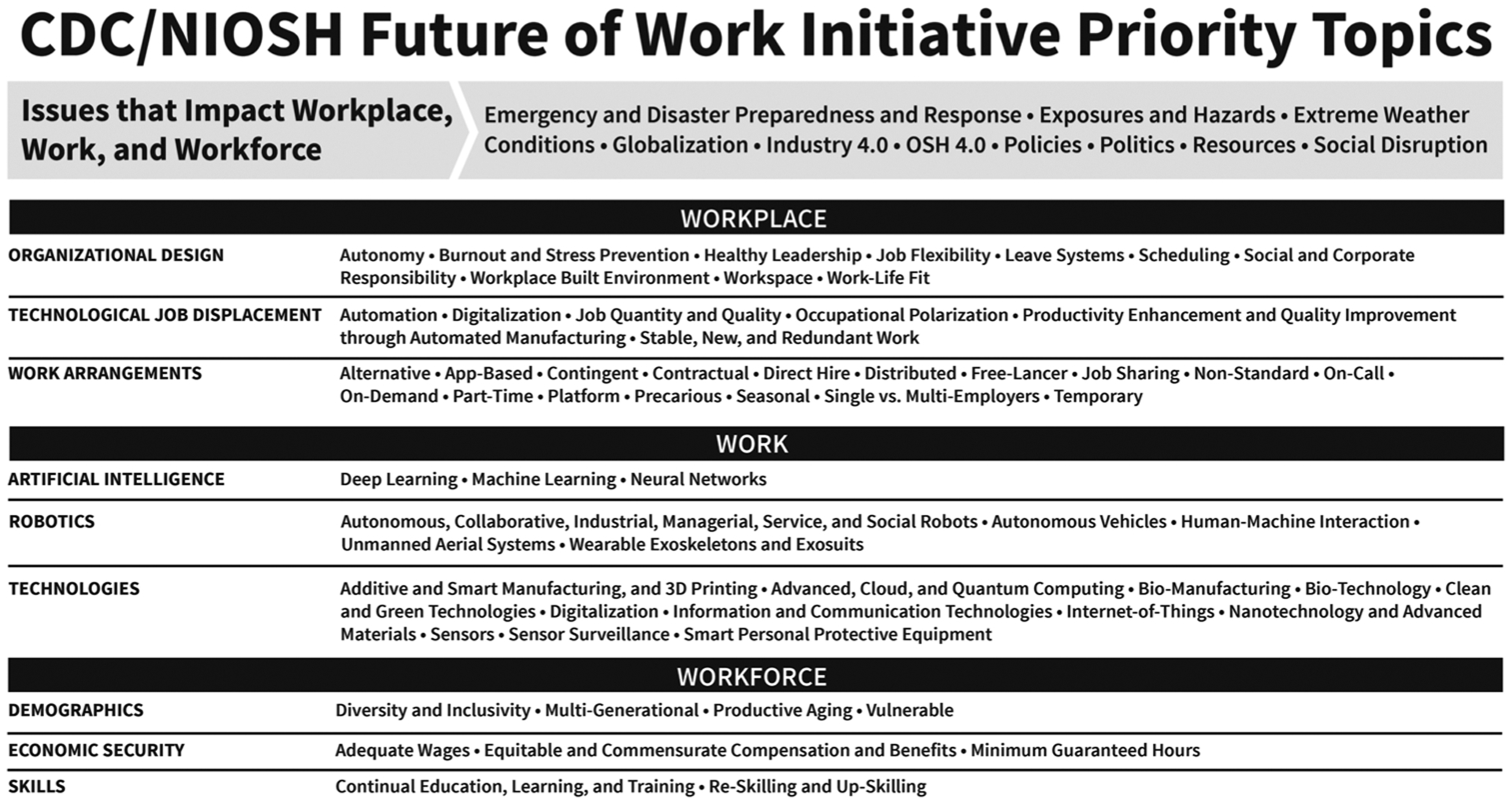
The future of work embodies changes to the workplace, work, and workforce, which require additional occupational safety and health (OSH) stakeholder attention. Examples include workplace developments in organizational design, technological job displacement, and work arrangements; work advances in artificial intelligence, robotics, and technologies; and workforce changes in demographics, economic security, and skills. This paper presents the Centers for Disease Control and Prevention, National Institute for Occupational Safety and Health's Future of Work Initiative; suggests an integrated approach to address worker safety, health, and well-being; introduces priority topics and subtopics that confer a framework for upcoming future of work research directions and resultant practical applications; and discusses preliminary next steps. All future of work issues impact one another. Future of work transformations are contingent upon each of the standalone factors discussed in this paper and their combined effects. Occupational safety and health stakeholders are becoming more aware of the significance and necessity of these factors for the workplace, work, and workforce to flourish, merely survive, or disappear altogether as the future evolves. The future of work offers numerous opportunities, while also presenting critical but not clearly understood difficulties, exposures, and hazards. It is the responsibility of OSH researchers and other partners to understand the implications of future of work scenarios to translate effective interventions into practice for employers safeguarding the safety, health, and well-being of their workers.
工作的未来体现了工作场所、工作和劳动力的变化,这需要职业安全与健康(OSH)利益相关者给予更多关注。例如,组织设计、技术工作替代和工作安排方面的工作场所发展;人工智能、机器人技术和技术方面的工作进展;以及人口统计学、经济安全和技能方面的劳动力变化。本文介绍了疾病控制与预防中心、国家职业安全与健康研究所的未来工作倡议;建议采取综合方法解决工人的安全、健康和福祉问题;介绍了优先主题和子主题,为即将到来的未来工作研究方向和由此产生的实际应用提供了框架;并讨论了初步的下一步措施。所有未来的工作问题都会相互影响。未来的工作转型取决于本文讨论的每一个独立因素及其综合影响。职业安全与健康利益相关者越来越意识到这些因素对工作场所、工作和劳动力的重要性和必要性,因为未来的发展会使它们繁荣、仅仅生存或完全消失。未来的工作带来了许多机会,同时也带来了尚未被清楚理解的困难、风险和危害。了解未来工作场景的影响是 OSH 研究人员和其他合作伙伴的责任,以便将有效的干预措施转化为雇主保障工人安全、健康和福祉的实践。