Department of Public Health, Section of Occupational Medicine, University of Naples Federico II, Via S. Pansini 5, 80131, Naples, Italy.
Department of Clinical Sciences and Community Health, University of Milan, Via San Barnaba 8, 20122, Milan, Italy.
BMC Public Health. 2024 Jul 30;24(1):2037. doi: 10.1186/s12889-024-19500-y.
The National Institute for Occupational Safety and Health (NIOSH), in 2011, developed the "Total Worker Health®" (TWH) as a holistic approach to protect and promote the workers' safety, health, and well-being. After over ten years from the TWH development, the aim of the present systematic review is to provide a comprehensive overview of the worldwide TWH initiatives.
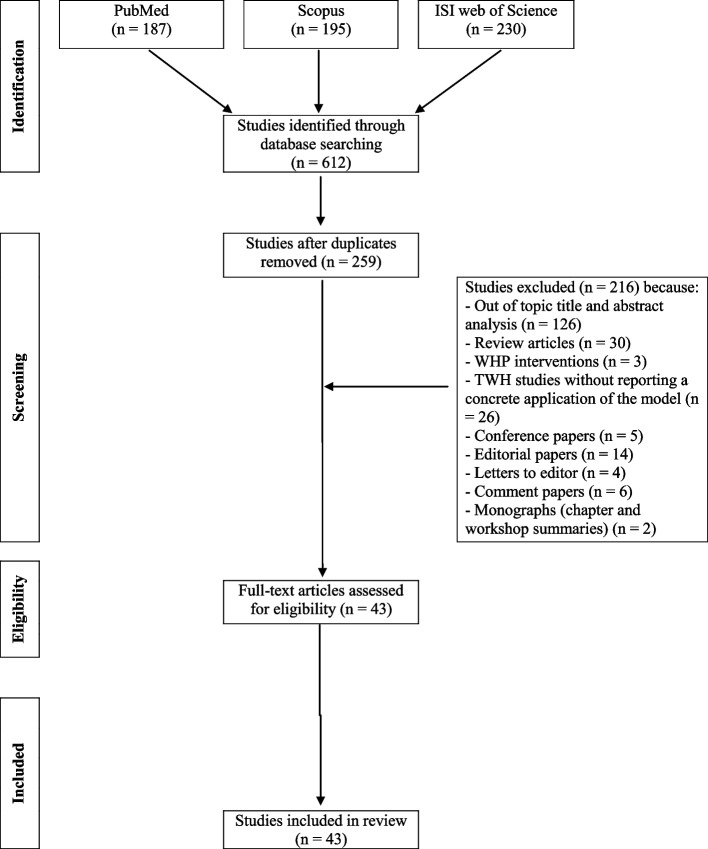
PubMed, Scopus and ISI Web of Science were searched for TWH studies published up to the 31 of July 2023, and 43 investigations could be included. The review was registered on the International prospective register of systematic reviews PROSPERO with the reference number CRD42023416972.
Issues that emerged as relevant for the TWH operationalization were the awareness about the TWH approach and fundamentals, the leadership commitment, and a participatory engagement of the workforce: these aspects all contributed to acceptable and effective setting oriented TWH plans, specifically tailored on the peculiarities of the workplace, including small enterprises and multiemployer worksites. Evaluation and continual improvement were reported as fundamental for the successful implementation of TWH initiatives. Limited resources for safety and health initiatives, in terms of time, people, and funds, together with difficulties in the identification of safety and health priorities and a poor participatory culture were recognized as obstacles to the TWH application. Training resulted the core component of the TWH leadership and workforce preparedness, with beneficial results in terms of safety culture and adoption of preventive measures.
Although interesting aspects emerged from our review, future longitudinal investigations should confirm the effectiveness, easy integration, and long-term sustainability of TWH models in different workplaces, in order to effectively support safe and health-enhancing works able to improve innovation and productivity.
美国国家职业安全与健康研究所(NIOSH)于 2011 年提出了“总体工人健康(TWH)”这一整体方法,以保护和促进工人的安全、健康和福祉。自 TWH 提出以来已超过十年,本系统评价的目的是全面概述全球范围内的 TWH 计划。
在 2023 年 7 月 31 日之前,我们在 PubMed、Scopus 和 ISI Web of Science 上搜索了有关 TWH 研究的文章,并纳入了 43 项研究。本综述已在国际前瞻性系统评价注册处 PROSPERO 上注册,注册号为 CRD42023416972。
对于 TWH 的实施,出现的相关问题是对 TWH 方法和原则的认识、领导力承诺以及员工的参与:这些方面都有助于制定可接受和有效的面向 TWH 计划,特别是针对工作场所的特点,包括小型企业和多雇主工作场所。评估和持续改进被报告为成功实施 TWH 计划的基础。安全和健康计划的资源有限,包括时间、人员和资金,以及在确定安全和健康重点方面的困难和参与文化较差,这些都被认为是 TWH 应用的障碍。培训是 TWH 领导力和员工准备的核心组成部分,在安全文化和预防措施的采用方面取得了有益的结果。
尽管我们的综述中出现了一些有趣的方面,但未来的纵向研究应该证实 TWH 模型在不同工作场所的有效性、易于整合和长期可持续性,以有效地支持安全和健康的工作,提高创新和生产力。