Institute of Healthy Ageing and Department of Genetics, Evolution and Environment, University College London, Darwin Building, Gower Street, London, WC1E 6BT, UK.
Max Planck Institute for Biology of Ageing, Joseph-Stelzmann-Strasse 9b, 50931, Cologne, Germany.
BMC Biol. 2020 Sep 14;18(1):124. doi: 10.1186/s12915-020-00854-9.
The increasing age of global populations highlights the urgent need to understand the biological underpinnings of ageing. To this end, inhibition of the insulin/insulin-like signalling (IIS) pathway can extend healthy lifespan in diverse animal species, but with trade-offs including delayed development. It is possible that distinct cell types underlie effects on development and ageing; cell-type-specific strategies could therefore potentially avoid negative trade-offs when targeting diseases of ageing, including prevalent neurodegenerative diseases. The highly conserved diversity of neuronal and non-neuronal (glial) cell types in the Drosophila nervous system makes it an attractive system to address this possibility. We have thus investigated whether IIS in distinct glial cell populations differentially modulates development and lifespan in Drosophila.
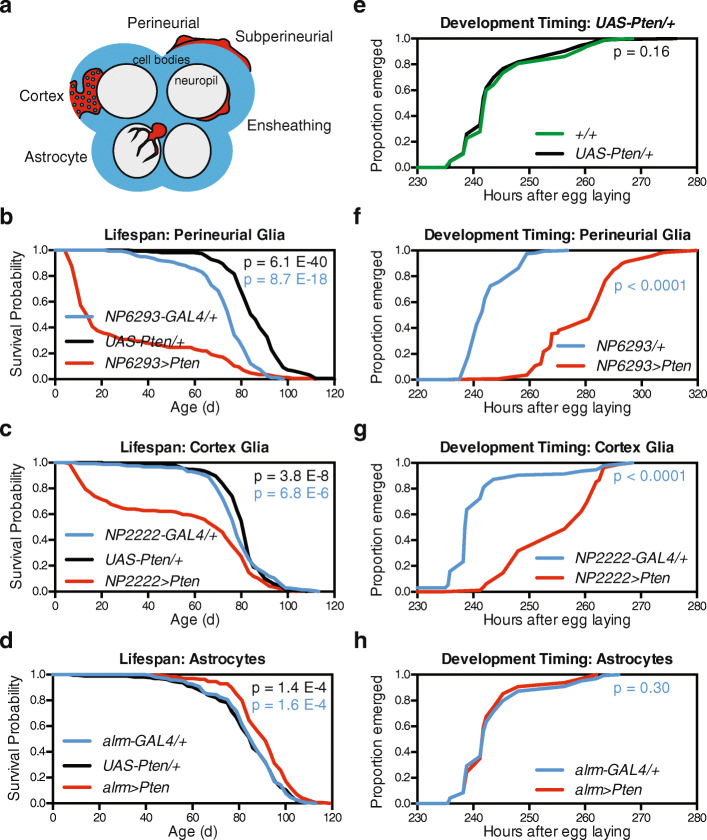
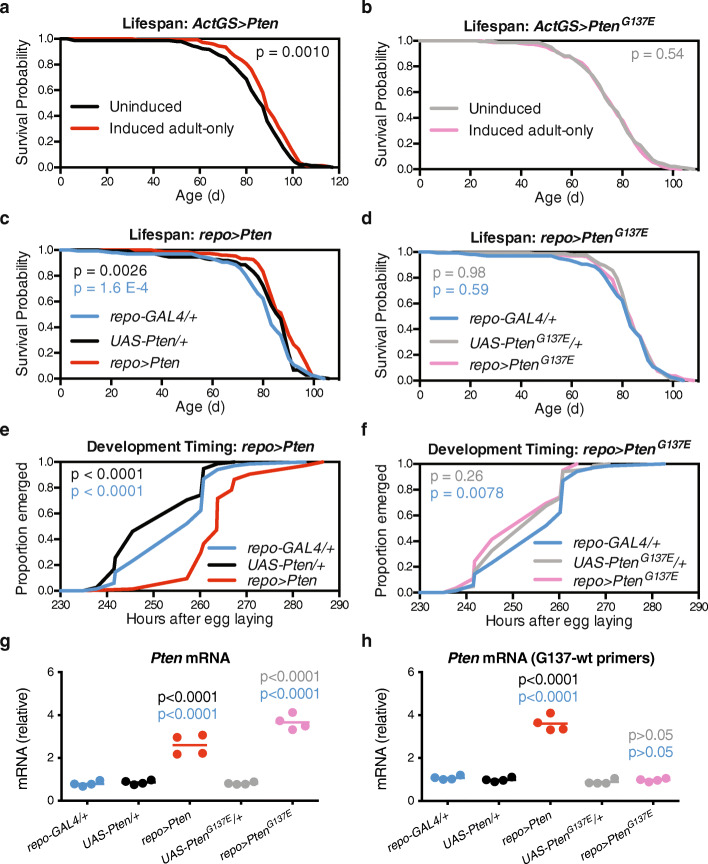
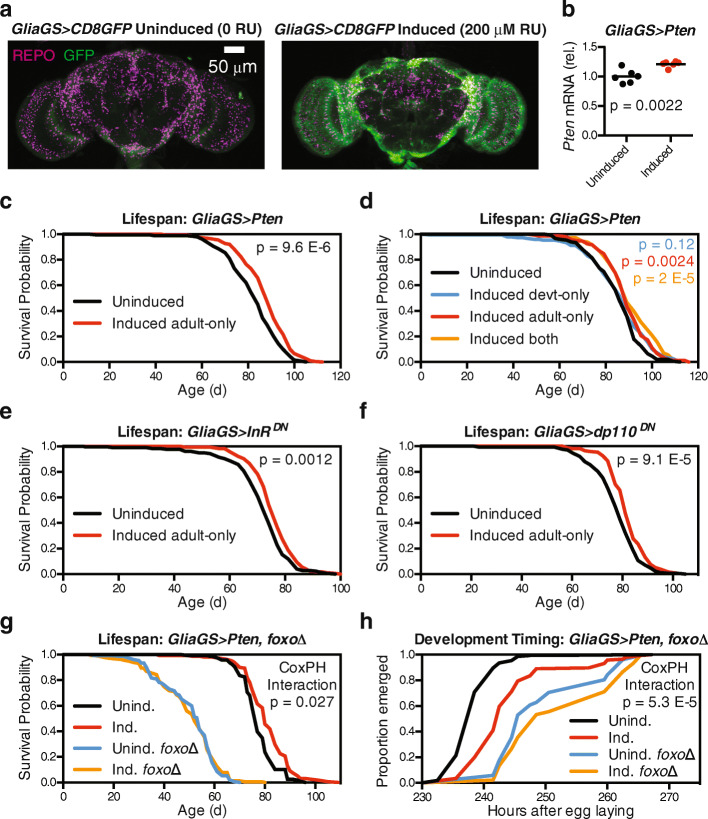
We report here that glia-specific IIS inhibition, using several genetic means, delays development while extending healthy lifespan. The effects on lifespan can be recapitulated by adult-onset IIS inhibition, whereas developmental IIS inhibition is dispensable for modulation of lifespan. Notably, the effects we observe on both lifespan and development act through the PI3K branch of the IIS pathway and are dependent on the transcription factor FOXO. Finally, IIS inhibition in several glial subtypes can delay development without extending lifespan, whereas the same manipulations in astrocyte-like glia alone are sufficient to extend lifespan without altering developmental timing.
These findings reveal a role for distinct glial subpopulations in the organism-wide modulation of development and lifespan, with IIS in astrocyte-like glia contributing to lifespan modulation but not to developmental timing. Our results enable a more complete picture of the cell-type-specific effects of the IIS network, a pathway whose evolutionary conservation in humans make it tractable for therapeutic interventions. Our findings therefore underscore the necessity for cell-type-specific strategies to optimise interventions for the diseases of ageing.
全球人口老龄化加剧,突显了深入了解衰老生物学基础的紧迫性。为此,抑制胰岛素/胰岛素样信号通路(IIS)可以延长多种动物物种的健康寿命,但存在发育迟缓等权衡。不同的细胞类型可能是影响发育和衰老的基础;因此,针对衰老相关疾病(包括普遍存在的神经退行性疾病)时,靶向特定细胞类型的策略可能会避免负面的权衡。果蝇神经系统中神经元和非神经元(神经胶质)细胞类型的高度保守多样性使其成为解决这一可能性的理想系统。因此,我们研究了 IIS 在不同胶质细胞群体中是否会对果蝇的发育和寿命产生不同的影响。
我们在此报告,使用几种遗传方法特异性抑制胶质细胞中的 IIS 会延迟发育,同时延长健康寿命。成年后 IIS 抑制可以重现对寿命的影响,而发育过程中的 IIS 抑制对于调节寿命则是可有可无的。值得注意的是,我们观察到的对寿命和发育的影响都通过 IIS 途径的 PI3K 分支起作用,并且依赖于转录因子 FOXO。最后,几种胶质细胞亚型中的 IIS 抑制可以延迟发育而不延长寿命,而仅在星形胶质细胞样胶质细胞中进行相同操作就足以延长寿命而不改变发育时间。
这些发现揭示了不同胶质亚群在调节发育和寿命方面的整体作用,星形胶质细胞样胶质细胞中的 IIS 有助于调节寿命,但不影响发育时间。我们的研究结果为 IIS 网络的细胞类型特异性作用提供了更全面的认识,该通路在人类中的进化保守性使其成为治疗干预的可行靶点。因此,我们的研究结果强调了针对衰老相关疾病进行细胞类型特异性干预的必要性。